DETERMINISTIC AND RANDOM PROCESSES IN EVOLUTION
NOTE: EQUATIONS
Evolutionary genetics is necessarily full of equations
But you are here to learn major concepts not details of specific equations
Keep in mind what Einstein said: “Never memorize what you can look up in a
book”
So, try to understand the major concepts, and do not waste time memorizing
details of complex equations
SELECTION = A ‘DETERMINISTIC’ PROCESS
Process of selection is predictable:
- dynamical equations predict allele frequency change (under various
assumptions)
- dynamics largely determined by the genotype-phenotype relationship
Consider a single locus with 2 alleles, A1 and A2, with frequencies p and q
Model selection favouring a dominant allele (where s is the selection coefficient)
If some fitness is assigned to phenotypes, s measures the strength of selection,
and rate of evolution.
A2 is recessive and deleterious, A1 is dominant. This relationship between
genotype and phenotype affects change in allele frequencies.
Equation = rate of change in allele frequencies
GENOTYPE-PHENOTYPE RELATIONSHIP:
1) FREQUENCY INDEPENDENT SELECTION
– fitness of a genotype does not depend on allele frequencies, so fitness is a
property of a genotype
Change in allele frequencies through time is a function of genotype-phenotype
relationship
Rate of evolution = mean fitness of 3 genotypes / mean fitness
, pq[ p( w11 w12 ) q( w12 w22 )]
p
w
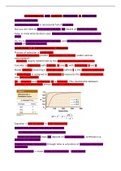
3 different genotype-phenotype
relationships with the same
predicted outcome – all predict
that allele will go to fixation.
BUT genotype-phenotype
relationship, for the same strength
of selection, changes the rate at
which processes happen
If a favoured allele is recessive
(yellow), it takes a long time to go
up in frequency. Once it does, it
goes to fixation rapidly. This is
because when it is rare, it is in
heterozygotes, so has no fitness
effects (essentially neutral). Once
homozygotes emerge, fitness
advantage is large.
If a favoured allele is dominant
(red), it is immediately favoured when it appears and is pulled into the
population, so evolves quickly. But once close to fixation, the rate of evolution of
the allele slows down – all the A2 alleles are in heterozygotes (don’t get rid of the
alternative deleterious allele very efficiently).
So genotype-phenotype relationship influences the rate of evolution to fixation if
an allele is favoured
But in this case, selection always proceeds ‘smoothly’ to eventually fix the
favoured allele. Evidence that this is a deterministic process.
But selection does not necessarily lead to fixation of an allele:
- Evolution can lead to a polymorphic equilibrium – both variants are maintained
in the population
- Average fitness of the two alleles must be equal at the equilibrium – if one
allele has a higher fitness, its frequency
will go up. w w
- Trivial equilibria – one of the alleles is notpˆ 12 22
present
2 w12 w11 w22
Equation: Equilibrium frequency =
depends on relative fitness of 3
genotypes.
For equilibrium, average
fitnesses must be equal and
change in allele frequencies is
zero.
NOTE: EQUATIONS
Evolutionary genetics is necessarily full of equations
But you are here to learn major concepts not details of specific equations
Keep in mind what Einstein said: “Never memorize what you can look up in a
book”
So, try to understand the major concepts, and do not waste time memorizing
details of complex equations
SELECTION = A ‘DETERMINISTIC’ PROCESS
Process of selection is predictable:
- dynamical equations predict allele frequency change (under various
assumptions)
- dynamics largely determined by the genotype-phenotype relationship
Consider a single locus with 2 alleles, A1 and A2, with frequencies p and q
Model selection favouring a dominant allele (where s is the selection coefficient)
If some fitness is assigned to phenotypes, s measures the strength of selection,
and rate of evolution.
A2 is recessive and deleterious, A1 is dominant. This relationship between
genotype and phenotype affects change in allele frequencies.
Equation = rate of change in allele frequencies
GENOTYPE-PHENOTYPE RELATIONSHIP:
1) FREQUENCY INDEPENDENT SELECTION
– fitness of a genotype does not depend on allele frequencies, so fitness is a
property of a genotype
Change in allele frequencies through time is a function of genotype-phenotype
relationship
Rate of evolution = mean fitness of 3 genotypes / mean fitness
, pq[ p( w11 w12 ) q( w12 w22 )]
p
w
3 different genotype-phenotype
relationships with the same
predicted outcome – all predict
that allele will go to fixation.
BUT genotype-phenotype
relationship, for the same strength
of selection, changes the rate at
which processes happen
If a favoured allele is recessive
(yellow), it takes a long time to go
up in frequency. Once it does, it
goes to fixation rapidly. This is
because when it is rare, it is in
heterozygotes, so has no fitness
effects (essentially neutral). Once
homozygotes emerge, fitness
advantage is large.
If a favoured allele is dominant
(red), it is immediately favoured when it appears and is pulled into the
population, so evolves quickly. But once close to fixation, the rate of evolution of
the allele slows down – all the A2 alleles are in heterozygotes (don’t get rid of the
alternative deleterious allele very efficiently).
So genotype-phenotype relationship influences the rate of evolution to fixation if
an allele is favoured
But in this case, selection always proceeds ‘smoothly’ to eventually fix the
favoured allele. Evidence that this is a deterministic process.
But selection does not necessarily lead to fixation of an allele:
- Evolution can lead to a polymorphic equilibrium – both variants are maintained
in the population
- Average fitness of the two alleles must be equal at the equilibrium – if one
allele has a higher fitness, its frequency
will go up. w w
- Trivial equilibria – one of the alleles is notpˆ 12 22
present
2 w12 w11 w22
Equation: Equilibrium frequency =
depends on relative fitness of 3
genotypes.
For equilibrium, average
fitnesses must be equal and
change in allele frequencies is
zero.