Lecture 6: MEASURING AND UNDERSTANDING HERITABILITY – an intro
to quantitative genetics:
There is a lot of rubbish spoken about “Nature” (i.e. genes) and “nurture” (i.e.
environment) as the causes of why we are as we are. Many accuse those who
emphasise the genetic component as being “genetic determinists”. This is
often a silly accusation for a number of reasons. When we talk about
evolution, most notably, we are interested in whether and how fast some
traits can evolve. Because we are interested in their evolution (rather their
developmental plasticity) we need to know whether the trait is heritable or
not and if it is, to what extent (weakly heritable traits will show a slow
response to selection). It does not mean that we must assume that the
presence of a given allele dictates that we shall be a particular way, merely
that on the average people possessing certain alleles or allele combinations
tend to be one way or the other. It does not mean that we cannot change the
situation e.g. it does not mean that merely because genes affect our weight
that eating more will not make us fat.
Heritability:
Another common source of confusion is what a lack of heritability means.
Does it mean that genes are not involved in the development of a trait? It
does not. Heritability instead is about explaining the causes of the
differences between individuals. Take a simple case. We know that in
the current population smoking (an environmental factor) and certain
polymorphic alleles both play a role determining who is more likely to have
lung cancer. But what if we were all genetically uniform? What if, for some
reason we looked at a population that was fixed for these susceptibility
alleles? Then who did and who did not have lung cancer would be entirely
due to who did and who did not smoke. The susceptibility genes are working
just as they did in the polymorphic population and equally involved in the
pathogenesis. But the variation between people (who has or has not got lung
cancer) is environmental.
The inverse can also apply. If everyone smoked the variation would be
entirely genetic. In neither case is the mechanism of the disease any
different. The action of genes and environment is involved in both cases. We
seek only to explain the causes of the differences.
So heritability is the proportion of total phenotypic variation of a
continuous trait which is due to genetic variation (the broad sense
heritability) i.e..
VP= VG +VE , (variance in phenotype = variance in genetics + variation in
environment)
And H2= VG/VP (H2 is called broad sense heritability – if 1, all variation is
due to genetic differences. If 0, variation is purely due to environment)
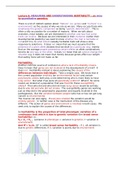
, Variance = SD2 ( SD being one purple bar)
Important consequence:
An absence of heritability (Vp = 0) doesn’t mean genes are not involved in the
development of a given trait. It just means that genetic variation doesn’t
explain the phenotypic variance. Further, if there is no variation in a trait, then
heritability has no meaning.
But we are more interested in the response to selection:
To understand this we need to break the genetic variance down a bit more. VG
actually has several different components (VA, VP & VI). The response to
selection is determined largely by only one of these, so called additive genetic
variation, VA. More accurately we should write that:
VP= VA +VD+ VI+ VE
Where is VD the variance in dominance deviations and VI is the
epistatic or interaction variation which results from interactions between
alleles at different loci. Not very relevant when talking about response to
selection.
We also then talk about narrow sense heritability, h2, which is relevant to
selection: the proportion of total phenotypic variation (VP) that is due to
additive genetic variation (VA) (variance due to additive effect that genes
have on phenotype)
As h2 increases from 0 to 1, a population’s response to selection is
greater.
h2= VA/VP
The latter is what animal and plant breeders need to know, because it
determines responses to selection.
Even this formulation is not quite complete. There is a possible interaction
term between any of the genetic components and the environment. For
example some strains of maize will do well on good soils but badly on bad
soils, but other strains do the opposite. However, if instead all strains
responded equally to increased nutrients then there wouldn’t be a gene by
environment interaction. So
VP= VG +VE +VGE
METHODS TO ESTIMATE HERITABILITY
There are various approaches to measuring heritability, all with their strengths
and weaknesses. For the most part gene by environment interactions get
subsumed in the environment component of the estimates. All of the methods
to quantitative genetics:
There is a lot of rubbish spoken about “Nature” (i.e. genes) and “nurture” (i.e.
environment) as the causes of why we are as we are. Many accuse those who
emphasise the genetic component as being “genetic determinists”. This is
often a silly accusation for a number of reasons. When we talk about
evolution, most notably, we are interested in whether and how fast some
traits can evolve. Because we are interested in their evolution (rather their
developmental plasticity) we need to know whether the trait is heritable or
not and if it is, to what extent (weakly heritable traits will show a slow
response to selection). It does not mean that we must assume that the
presence of a given allele dictates that we shall be a particular way, merely
that on the average people possessing certain alleles or allele combinations
tend to be one way or the other. It does not mean that we cannot change the
situation e.g. it does not mean that merely because genes affect our weight
that eating more will not make us fat.
Heritability:
Another common source of confusion is what a lack of heritability means.
Does it mean that genes are not involved in the development of a trait? It
does not. Heritability instead is about explaining the causes of the
differences between individuals. Take a simple case. We know that in
the current population smoking (an environmental factor) and certain
polymorphic alleles both play a role determining who is more likely to have
lung cancer. But what if we were all genetically uniform? What if, for some
reason we looked at a population that was fixed for these susceptibility
alleles? Then who did and who did not have lung cancer would be entirely
due to who did and who did not smoke. The susceptibility genes are working
just as they did in the polymorphic population and equally involved in the
pathogenesis. But the variation between people (who has or has not got lung
cancer) is environmental.
The inverse can also apply. If everyone smoked the variation would be
entirely genetic. In neither case is the mechanism of the disease any
different. The action of genes and environment is involved in both cases. We
seek only to explain the causes of the differences.
So heritability is the proportion of total phenotypic variation of a
continuous trait which is due to genetic variation (the broad sense
heritability) i.e..
VP= VG +VE , (variance in phenotype = variance in genetics + variation in
environment)
And H2= VG/VP (H2 is called broad sense heritability – if 1, all variation is
due to genetic differences. If 0, variation is purely due to environment)
, Variance = SD2 ( SD being one purple bar)
Important consequence:
An absence of heritability (Vp = 0) doesn’t mean genes are not involved in the
development of a given trait. It just means that genetic variation doesn’t
explain the phenotypic variance. Further, if there is no variation in a trait, then
heritability has no meaning.
But we are more interested in the response to selection:
To understand this we need to break the genetic variance down a bit more. VG
actually has several different components (VA, VP & VI). The response to
selection is determined largely by only one of these, so called additive genetic
variation, VA. More accurately we should write that:
VP= VA +VD+ VI+ VE
Where is VD the variance in dominance deviations and VI is the
epistatic or interaction variation which results from interactions between
alleles at different loci. Not very relevant when talking about response to
selection.
We also then talk about narrow sense heritability, h2, which is relevant to
selection: the proportion of total phenotypic variation (VP) that is due to
additive genetic variation (VA) (variance due to additive effect that genes
have on phenotype)
As h2 increases from 0 to 1, a population’s response to selection is
greater.
h2= VA/VP
The latter is what animal and plant breeders need to know, because it
determines responses to selection.
Even this formulation is not quite complete. There is a possible interaction
term between any of the genetic components and the environment. For
example some strains of maize will do well on good soils but badly on bad
soils, but other strains do the opposite. However, if instead all strains
responded equally to increased nutrients then there wouldn’t be a gene by
environment interaction. So
VP= VG +VE +VGE
METHODS TO ESTIMATE HERITABILITY
There are various approaches to measuring heritability, all with their strengths
and weaknesses. For the most part gene by environment interactions get
subsumed in the environment component of the estimates. All of the methods