NON-RANDOM MATING AND INBREEDING…
THE HARDY-WEINBERG MODEL
AND RANDOM MATING
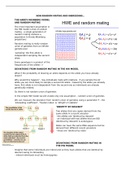
The most important assumption in
the HW model is that of random
mating - a single generation of
random mating restores a
population to Hardy-Weinberg
proportions
Random mating is really random
union of gametes from an infinite
gamete pool
‘sampling’ the first allele is
independent sampling the second
allele
Every genotype is a product of the
frequencies of the alleles ->
DEVIATIONS FROM RANDOM MATING IN THE HW MODEL
What if the probability of drawing an allele depends on the allele you have already
drawn?
Why would this happen? – Say individuals mate with relatives. If you sample the A2
allele you are more likely to sample a second A2 allele – biased by the allele you already
have, first allele is not independent from the second one as individuals are already
genetically related.
So there is not random union of gametes
In the simple HW model we will violate only one assumption – random union of gametes
We can measure the deviation from random union of gametes using a parameter F – the
‘inbreeding coefficient’, ‘fixation index’ or ‘Wright’s F-statistic’
‘IDENTITY BY DESCENT’
Two alleles that are copies derived from the
same allele in a recent ancestor
- the alleles are ‘identical by descent’
- an individual with two alleles that are IBD
(identical by descent) is autozygous
Allele can have the same DNA sequence but be
derived from different recent ancestors
- these are ‘identical by state’
DEVIATIONS FROM RANDOM MATING IN
THE HW MODEL
Imagine that some individuals are inbred and so they have alleles that are identical by
descent owing to inbreeding
- inbred individuals must be homozygotes
, - The proportion of individuals in the inbred group is F
(proportion of the homozygotes which have alleles that
are IBD)
- The proportion that do not have alleles that are
identical by descent is, therefore, 1 – F
Inbreeding is redistributing variation
out of heterozygotes and into
homozygotes – doesn’t change
allele frequencies.
If individuals actively avoided
mating with relatives (inbreeding
avoidance), there would be less
homozygosity than expected,
negative value of F and increased
heterozygosity
WHAT DOES F REPRESENT?
F is the proportional reduction in heterozygosity (compared to that expected in a random
mating population)
F is also equivalent to the correlation between ( H Exp H Obs )
the alleles in uniting gametes F
ALLELE AND GENOTYPE FREQUENCIES H Exp
In a large population where all individuals mate, inbreeding has no effect on allele
frequencies
- changes the combinations of alleles in genotypes
Inbreeding as a system of mating affects all loci in
the genome in the same way – there should be a
reduction in heterozygotes at all loci in the genome
if inbreeding is occurring.
<- selfing drives heterozygosity down to zero
INBREEDING DEPRESSION
Results when inbreeding (loss of heterozygosity)
produces a mean reduction in fitness
Must be caused by increase in homozygosity
THE HARDY-WEINBERG MODEL
AND RANDOM MATING
The most important assumption in
the HW model is that of random
mating - a single generation of
random mating restores a
population to Hardy-Weinberg
proportions
Random mating is really random
union of gametes from an infinite
gamete pool
‘sampling’ the first allele is
independent sampling the second
allele
Every genotype is a product of the
frequencies of the alleles ->
DEVIATIONS FROM RANDOM MATING IN THE HW MODEL
What if the probability of drawing an allele depends on the allele you have already
drawn?
Why would this happen? – Say individuals mate with relatives. If you sample the A2
allele you are more likely to sample a second A2 allele – biased by the allele you already
have, first allele is not independent from the second one as individuals are already
genetically related.
So there is not random union of gametes
In the simple HW model we will violate only one assumption – random union of gametes
We can measure the deviation from random union of gametes using a parameter F – the
‘inbreeding coefficient’, ‘fixation index’ or ‘Wright’s F-statistic’
‘IDENTITY BY DESCENT’
Two alleles that are copies derived from the
same allele in a recent ancestor
- the alleles are ‘identical by descent’
- an individual with two alleles that are IBD
(identical by descent) is autozygous
Allele can have the same DNA sequence but be
derived from different recent ancestors
- these are ‘identical by state’
DEVIATIONS FROM RANDOM MATING IN
THE HW MODEL
Imagine that some individuals are inbred and so they have alleles that are identical by
descent owing to inbreeding
- inbred individuals must be homozygotes
, - The proportion of individuals in the inbred group is F
(proportion of the homozygotes which have alleles that
are IBD)
- The proportion that do not have alleles that are
identical by descent is, therefore, 1 – F
Inbreeding is redistributing variation
out of heterozygotes and into
homozygotes – doesn’t change
allele frequencies.
If individuals actively avoided
mating with relatives (inbreeding
avoidance), there would be less
homozygosity than expected,
negative value of F and increased
heterozygosity
WHAT DOES F REPRESENT?
F is the proportional reduction in heterozygosity (compared to that expected in a random
mating population)
F is also equivalent to the correlation between ( H Exp H Obs )
the alleles in uniting gametes F
ALLELE AND GENOTYPE FREQUENCIES H Exp
In a large population where all individuals mate, inbreeding has no effect on allele
frequencies
- changes the combinations of alleles in genotypes
Inbreeding as a system of mating affects all loci in
the genome in the same way – there should be a
reduction in heterozygotes at all loci in the genome
if inbreeding is occurring.
<- selfing drives heterozygosity down to zero
INBREEDING DEPRESSION
Results when inbreeding (loss of heterozygosity)
produces a mean reduction in fitness
Must be caused by increase in homozygosity