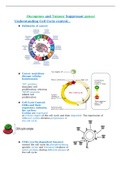
Oncogenes and Tumour Suppressor genes!
Understanding Cell Cycle control…
Hallmarks of cancer:
Cancer mutations
disrupt cellular
homeostasis:
‘GO’ proteins
stimulate cell
proliferation, whereas
‘STOP’ proteins
inhibit cell
proliferation
Cell Cycle Control:
CDKs and their
regulatory subunits,
the cyclins:
Cyclins are expressed
at certain stages of the cell cycle and then degraded. The expression of
different cyclins dictates progression of
the cell cycle.
CDKs (cyclin-dependent kinases)
control the cell cycle by phosphorylating
specific serine and threonine residues of
select proteins during different phases of
the cell cycle.
,
E.g. Nuclear lamins:
After DNA replication, dissolution
of nuclear membrane allows
chromosome separation. Lamin is a
structural protein that gives shape
to the nucleus – it must be removed
by being phosphorylated and
broken down by CDK.
Tumour suppressor genes: loss of function mutations
Code for proteins that inhibit /
regulate cell cycle – put a
brake on cell proliferation.
Inactivation of the tumour
suppressor gene leads to a
change in structure of the
suppressor protein, by adding
side chains (e.g.
hyperphosphorylation) – this
leads to an inactive protein
complex that cannot inhibit
the cell cycle.
Any mutations that result in
functional inactivation of these
proteins are termed as loss-of-
function mutations because
they remove the usual brakes on proliferative capacity.
Functional activity of TS proteins may be also affected by inhibitory /
competing oncoproteins or deregulation (phosphorylation status).
Oncogenes: gain of function mutations
Proto-oncogenes code for
proteins that regulate cell
cycle, so are necessary for
cellular function.
Mutated forms, called
oncogenes, cause stimulatory
proteins to be overactive, with
the result that cells
proliferate excessively.
This change allows the
protein to acquire a new role
in the cell, so is called a gain
of function mutation.
Disrupted oncogene could cause too much of the protein, a difference in protein
structure and function, or an altered fusion product.
Understanding Cell Cycle control…
Hallmarks of cancer:
Cancer mutations
disrupt cellular
homeostasis:
‘GO’ proteins
stimulate cell
proliferation, whereas
‘STOP’ proteins
inhibit cell
proliferation
Cell Cycle Control:
CDKs and their
regulatory subunits,
the cyclins:
Cyclins are expressed
at certain stages of the cell cycle and then degraded. The expression of
different cyclins dictates progression of
the cell cycle.
CDKs (cyclin-dependent kinases)
control the cell cycle by phosphorylating
specific serine and threonine residues of
select proteins during different phases of
the cell cycle.
,
E.g. Nuclear lamins:
After DNA replication, dissolution
of nuclear membrane allows
chromosome separation. Lamin is a
structural protein that gives shape
to the nucleus – it must be removed
by being phosphorylated and
broken down by CDK.
Tumour suppressor genes: loss of function mutations
Code for proteins that inhibit /
regulate cell cycle – put a
brake on cell proliferation.
Inactivation of the tumour
suppressor gene leads to a
change in structure of the
suppressor protein, by adding
side chains (e.g.
hyperphosphorylation) – this
leads to an inactive protein
complex that cannot inhibit
the cell cycle.
Any mutations that result in
functional inactivation of these
proteins are termed as loss-of-
function mutations because
they remove the usual brakes on proliferative capacity.
Functional activity of TS proteins may be also affected by inhibitory /
competing oncoproteins or deregulation (phosphorylation status).
Oncogenes: gain of function mutations
Proto-oncogenes code for
proteins that regulate cell
cycle, so are necessary for
cellular function.
Mutated forms, called
oncogenes, cause stimulatory
proteins to be overactive, with
the result that cells
proliferate excessively.
This change allows the
protein to acquire a new role
in the cell, so is called a gain
of function mutation.
Disrupted oncogene could cause too much of the protein, a difference in protein
structure and function, or an altered fusion product.