TUMOUR IMMUNOLOGY & OTHER HALLMARKS
Key Concepts in tumour immunology:
o The immune system – plays a dual role of tumour promoting as well as tumour destroying.
o Some inflammatory immune responses have anti-tumour effects (some immune system cells
are recruited to kill off tumour cells)
o Some tumour-associated responses enhance tumour progression (some immune system
cells are recruited to allow tumour cells to proliferate)
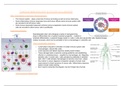
Haematopoiesis:
Haematopoietic stem cell undergoes a series of reprogramming
steps to differentiate into a myeloid/ lymphoid progenitor – myeloid or
lymphoid differentiation. Lymphoid lineage results in t cells, b cells and natural killer cells. Myeloid lineage
creates monocyte, which can be activated to form a macrophage or a dendritic cell.
The Lymphatic system:
o Lymph plays a big part in activation of certain immune system cells
(macrophages, natural killer cells).
o Local response and distant response (nearby lymph nodes).
o Tissue damage leads to bacteria crossing epidermis and establishing
infection in underlying tissue – engulfed by macrophages, etc. Migrating
dendritic cells. In lymph cells, t cells activated by antibodies in dendritic
cells. CD4 T cells activate macrophages to become more toxic. (video)
o Key marker in cancer diagnosis is biopsies/ samples of lymph node –
reservoir/pool to detect presence of cancer cells. Inflammatory response
leads to lymph nodes working.
o Don’t need to remember this diagram, but don’t forget role of lymph.
The Immune Response
, o The immune system targets ‘non-self’ molecules
o Antibodies will typically recognise intact proteins, whereas t cells will recognise fragments of proteins called peptides. Peptides are
expressed as antigens on the surface of the cell.
Overview of humoral & cellular immune systems
o T cells are either cytotoxic (CD8+) or helpers (CD4+) or Regulators (Tc; Th; Treg) . Unlike antibodies, which react to intact proteins only,
the CD8+ T cells react to peptide antigens expressed on the surface of a
cell. Peptide antigens are proteins that have been digested by the cell,
and presented as protein fragments—or peptides—displayed in the MHC.
The peptide and the MHC together attract T cells. CD8+ T cells are
specific for class I MHC molecules, while CD4+ T cells are specific for
class II MHC molecules.
o After attaching to the MHC-peptide complex expressed on a cell, the
CD8+ T cell destroys the cell by perforating its membrane with enzymes
or by triggering an apoptotic or self-destructive pathway. The CD8+ T cell
will then move to another cell expressing the same MHC-peptide
complex, and destroy it as well. In this manner cytotoxic T cells can kill
many invasive cells. Ideally, CD8+ T cells could engender a very specific
and robust response against tumor cells.
o One of the biggest breakthroughs in tumor immunotherapy in the past
several years has been our increased understanding of the role of helper
T cells. The helper T, or CD4+ T cell, is the major regulator of virtually all
immune system activities. These cells form a series of protein mediators
called lymphokines that act on other cells of the immune system and on bone marrow. Some of the most important lymphokines
secreted by the helper T cells include interleukin-2, interleukin-3, interleukin-4, interleukin-5, interleukin-6, granulocyte-monocyte colony
stimulating factor (GM-CSF), and interferon-gamma. Without these lymphokines, the remainder of the immune system does not function
as effectively as it would with the appropriate cytokine environment.
o Like the CD8+ T cells, CD4+ T cells also recognize MHC-peptide complexes in the context of class II MHC. CD4+T cells augment the
immune response by secreting cytokines that stimulate either a cytotoxic T cell response (Th1 helper T cells) or an antibody response
(Th2 helper T cells). These cytokines can initiate B-cells to produce antibodies, or enhance CD8+ T cell production. The function of the
CD4+ T cell depends upon the type of antigen it recognizes, and the type of immune response required.
Key Concepts in tumour immunology:
o The immune system – plays a dual role of tumour promoting as well as tumour destroying.
o Some inflammatory immune responses have anti-tumour effects (some immune system cells
are recruited to kill off tumour cells)
o Some tumour-associated responses enhance tumour progression (some immune system
cells are recruited to allow tumour cells to proliferate)
Haematopoiesis:
Haematopoietic stem cell undergoes a series of reprogramming
steps to differentiate into a myeloid/ lymphoid progenitor – myeloid or
lymphoid differentiation. Lymphoid lineage results in t cells, b cells and natural killer cells. Myeloid lineage
creates monocyte, which can be activated to form a macrophage or a dendritic cell.
The Lymphatic system:
o Lymph plays a big part in activation of certain immune system cells
(macrophages, natural killer cells).
o Local response and distant response (nearby lymph nodes).
o Tissue damage leads to bacteria crossing epidermis and establishing
infection in underlying tissue – engulfed by macrophages, etc. Migrating
dendritic cells. In lymph cells, t cells activated by antibodies in dendritic
cells. CD4 T cells activate macrophages to become more toxic. (video)
o Key marker in cancer diagnosis is biopsies/ samples of lymph node –
reservoir/pool to detect presence of cancer cells. Inflammatory response
leads to lymph nodes working.
o Don’t need to remember this diagram, but don’t forget role of lymph.
The Immune Response
, o The immune system targets ‘non-self’ molecules
o Antibodies will typically recognise intact proteins, whereas t cells will recognise fragments of proteins called peptides. Peptides are
expressed as antigens on the surface of the cell.
Overview of humoral & cellular immune systems
o T cells are either cytotoxic (CD8+) or helpers (CD4+) or Regulators (Tc; Th; Treg) . Unlike antibodies, which react to intact proteins only,
the CD8+ T cells react to peptide antigens expressed on the surface of a
cell. Peptide antigens are proteins that have been digested by the cell,
and presented as protein fragments—or peptides—displayed in the MHC.
The peptide and the MHC together attract T cells. CD8+ T cells are
specific for class I MHC molecules, while CD4+ T cells are specific for
class II MHC molecules.
o After attaching to the MHC-peptide complex expressed on a cell, the
CD8+ T cell destroys the cell by perforating its membrane with enzymes
or by triggering an apoptotic or self-destructive pathway. The CD8+ T cell
will then move to another cell expressing the same MHC-peptide
complex, and destroy it as well. In this manner cytotoxic T cells can kill
many invasive cells. Ideally, CD8+ T cells could engender a very specific
and robust response against tumor cells.
o One of the biggest breakthroughs in tumor immunotherapy in the past
several years has been our increased understanding of the role of helper
T cells. The helper T, or CD4+ T cell, is the major regulator of virtually all
immune system activities. These cells form a series of protein mediators
called lymphokines that act on other cells of the immune system and on bone marrow. Some of the most important lymphokines
secreted by the helper T cells include interleukin-2, interleukin-3, interleukin-4, interleukin-5, interleukin-6, granulocyte-monocyte colony
stimulating factor (GM-CSF), and interferon-gamma. Without these lymphokines, the remainder of the immune system does not function
as effectively as it would with the appropriate cytokine environment.
o Like the CD8+ T cells, CD4+ T cells also recognize MHC-peptide complexes in the context of class II MHC. CD4+T cells augment the
immune response by secreting cytokines that stimulate either a cytotoxic T cell response (Th1 helper T cells) or an antibody response
(Th2 helper T cells). These cytokines can initiate B-cells to produce antibodies, or enhance CD8+ T cell production. The function of the
CD4+ T cell depends upon the type of antigen it recognizes, and the type of immune response required.