…Sexual Selection…
Can produce bizarre adaptations: e.g. bright colour patterns in guppies, stalked-
eye flies (males have much longer eye stalks than females), plumage of birds of
paradise, corkscrew penis of argentine lake duck, penis-fencing in marine
flatworms, etc.
Why reproduce sexually?
2- fold cost of sex
Most (>90%) of organisms have 2 types of sex gametes, and 2 types of
phenotypes.
Male phenotype produces small mobile gametes (sperm)
Female phenotype produces large immobile gametes (ova)
These differences between gametes results in differences between sexes and
sex roles
E.g. coho salmon: males produces 100,000,000,000 sperm, whereas females
produce 3500 eggs. These eggs are usually larger and require greater
investment. Females are therefore the limiting sex, determining how sexual
selection occurs.
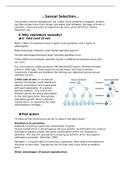
2-fold cost of sex: in an asexual
species, the female could double her
genetic contribution to the gene pool
with each generation. In a sexual
species however, only half of the
female’s genes are being transmitted
to the next generation. Also greater
population growth seen in asexual
reproduction, so should be the more
advantageous strategy…
Red queen
“It takes all the running you can do, to keep in the same place”
Resistance to parasites:
Depends on having a particular combination of genes
Sexual reproduction is advantageous because genetic recombination (to produce
the diploid zygote) creates new gene combinations which are resistant to
parasites. This aids the population in keeping up with the arms race against
pathogens/ parasites. (Hamilton 1980)
Parasites = consume parts of living prey organisms; often attach themselves to
the body of their host. Typically do not kill their host in the short or medium
term.
Other advantages of sexual reproduction:
, Sexual populations have more genetic variation, allowing the population to adapt
to environmental changes, etc.
Prevention of Müller's ratchet (accumulation of deleterious mutations in asexual
lineages) – in an asexual population, a deleterious mutation cannot be removed,
whereas in sexual populations this is possible via recombination.
Selection for advantageous mutations – not tied to deleterious (ruby in the
rubbish). Advantageous mutations can spread without carrying along linked
deleterious mutations (due to recombination), whereas in an asexual population
the two would remain linked.
Sexual conflict: male and female reproductive interests
differ
Sexual conflict = ‘a conflict between the evolutionary interests of individuals of
the two sexes’ – Parker 1979
This conflict is what leads to divergent phenotypic and behavioural traits.
Bateman’s Principle: Drosophila geneticist
Male reproductive success (RS) increases with the number of mates -> males are
interested in mating with as many females as possible, as this is the best
strategy.
Female RS does not increase with the number of mates -> females are
interested in mating with high quality males
These different strategies lead to a conflict of interest between sexes over
mating.
Note: Individual males and females may ‘win’ or ‘lose’ the conflict, but sexes
overall cannot, since the fitness of males and females are tied together (females
will have sons and males will have daughters, so this the conflict is genomic as
the genome must be in males and females)
Behavioural consequences of sexual conflict: Infanticide:-
Females’ interest: raise current offspring
Males’ interest: speed up female reproduction
Males ‘taking over’ females with dependent offspring will kill the young
(infanticide) e.g. lions, langurs, mice. Clearly not in the
female’s interests.
Evolutionary consequences of sexual
conflict: Sexual selection
Sexual selection = Behavioural conflict and differential use
of resources between individuals [of different sexes], drives
evolutionary divergence.
Theory of sex differences: difference in gamete size and
investment (females have higher investment into gametes
and offspring than males) determines females interest in
Can produce bizarre adaptations: e.g. bright colour patterns in guppies, stalked-
eye flies (males have much longer eye stalks than females), plumage of birds of
paradise, corkscrew penis of argentine lake duck, penis-fencing in marine
flatworms, etc.
Why reproduce sexually?
2- fold cost of sex
Most (>90%) of organisms have 2 types of sex gametes, and 2 types of
phenotypes.
Male phenotype produces small mobile gametes (sperm)
Female phenotype produces large immobile gametes (ova)
These differences between gametes results in differences between sexes and
sex roles
E.g. coho salmon: males produces 100,000,000,000 sperm, whereas females
produce 3500 eggs. These eggs are usually larger and require greater
investment. Females are therefore the limiting sex, determining how sexual
selection occurs.
2-fold cost of sex: in an asexual
species, the female could double her
genetic contribution to the gene pool
with each generation. In a sexual
species however, only half of the
female’s genes are being transmitted
to the next generation. Also greater
population growth seen in asexual
reproduction, so should be the more
advantageous strategy…
Red queen
“It takes all the running you can do, to keep in the same place”
Resistance to parasites:
Depends on having a particular combination of genes
Sexual reproduction is advantageous because genetic recombination (to produce
the diploid zygote) creates new gene combinations which are resistant to
parasites. This aids the population in keeping up with the arms race against
pathogens/ parasites. (Hamilton 1980)
Parasites = consume parts of living prey organisms; often attach themselves to
the body of their host. Typically do not kill their host in the short or medium
term.
Other advantages of sexual reproduction:
, Sexual populations have more genetic variation, allowing the population to adapt
to environmental changes, etc.
Prevention of Müller's ratchet (accumulation of deleterious mutations in asexual
lineages) – in an asexual population, a deleterious mutation cannot be removed,
whereas in sexual populations this is possible via recombination.
Selection for advantageous mutations – not tied to deleterious (ruby in the
rubbish). Advantageous mutations can spread without carrying along linked
deleterious mutations (due to recombination), whereas in an asexual population
the two would remain linked.
Sexual conflict: male and female reproductive interests
differ
Sexual conflict = ‘a conflict between the evolutionary interests of individuals of
the two sexes’ – Parker 1979
This conflict is what leads to divergent phenotypic and behavioural traits.
Bateman’s Principle: Drosophila geneticist
Male reproductive success (RS) increases with the number of mates -> males are
interested in mating with as many females as possible, as this is the best
strategy.
Female RS does not increase with the number of mates -> females are
interested in mating with high quality males
These different strategies lead to a conflict of interest between sexes over
mating.
Note: Individual males and females may ‘win’ or ‘lose’ the conflict, but sexes
overall cannot, since the fitness of males and females are tied together (females
will have sons and males will have daughters, so this the conflict is genomic as
the genome must be in males and females)
Behavioural consequences of sexual conflict: Infanticide:-
Females’ interest: raise current offspring
Males’ interest: speed up female reproduction
Males ‘taking over’ females with dependent offspring will kill the young
(infanticide) e.g. lions, langurs, mice. Clearly not in the
female’s interests.
Evolutionary consequences of sexual
conflict: Sexual selection
Sexual selection = Behavioural conflict and differential use
of resources between individuals [of different sexes], drives
evolutionary divergence.
Theory of sex differences: difference in gamete size and
investment (females have higher investment into gametes
and offspring than males) determines females interest in