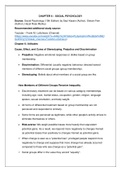
CHAPTER 6 – SOCIAL PSYCHOLOGY
Source: Social Psychology (10th Edition) by Saul Kassin (Author), Steven Fein
(Author), Hazel Rose Markus
Recommended additional study source:
Youtube – Frank M. LoSchiavo (Channel)
(https://www.youtube.com/watch?v=4i46o7xLNiY&list=PLApmiahrmPkv36dvFkRkD
GcWD7gYjTttr&ab_channel=FrankM.LoSchiavo)
Chapter 6: Attitudes
Cause, Effect, and Cures of Stereotyping, Prejudice and Discrimination
• Prejudice: Negative emotional responses or dislike based on group
membership.
• Discrimination: Differential (usually negative) behaviour directed toward
members of different social groups (group membership).
• Stereotyping: Beliefs about what members of a social group are like.
How Members of Different Groups Perceive Inequality
• Discriminatory treatment can be based on various category memberships,
including age, race, marital status, occupation, gender, religion, language
spoken, sexual orientation, and body weight.
• All forms of differential treatment based on group membership are not
perceived and responded to similarly.
• Some forms are perceived as legitimate, while other people's activity strives to
eliminate themselves or others.
• Risk-averse: We weigh possible losses more heavily than equivalent
potential gains. As a result, we respond more negatively to changes framed
as potential losses than positively to changes framed as potential gains.
✓ When change is seen as a "potential loss", privileged people respond more
negatively to change and suppose that more change has already occurred
compared to those who see change as a "potential gain".
✓ Social groups differ in the value they accord "equality".
, ▪ When equality is framed as a loss for whites, they perceive that more
progress has already occurred, and they are less supportive of
affirmative action.
▪ The perceived threat to the dominant groups' economic well-being
lowers support for affirmative action in white South Africans and for
immigration among Europeans.
The Nature and Origins of Stereotyping
• Stereotypes: Beliefs about social groups regarding the traits or
characteristics they are believed to share. Stereotypes are cognitive
frameworks that influence the processing of social information.
Stereotyping: Beliefs About Social Groups
• Gender stereotypes: Stereotypes concerning the traits of females and males
that distinguish the two genders from each other.
SEE TABLE 1: Common Traits Stereotypically Associated with Women and
Men
Stereotypes and the "glass cliff":
• Glass ceiling: Barriers based on an attitudinal or organisational bias that
prevent qualified females from advancing to top-level- positions.
- "Think manager –think male" bias exists and helps to explain how the glass
ceiling is maintained.
✓ "Typical manager" overlaps with the "typical man" and shares fewer
attributes with the "typical woman", which is perceived as "lack of fit".
✓ When women violate stereotypic expectancies (nurturing and warmth),
they are likely to face hostility and rejection.
Gender stereotypes and the "glass cliff":
- Women receive leadership positions (break the glass ceiling) when things are
going downhill.
• Glass cliff effect: Choosing women for leadership positions that are risky,
precarious, or when the outcome is more likely to fail.
Source: Social Psychology (10th Edition) by Saul Kassin (Author), Steven Fein
(Author), Hazel Rose Markus
Recommended additional study source:
Youtube – Frank M. LoSchiavo (Channel)
(https://www.youtube.com/watch?v=4i46o7xLNiY&list=PLApmiahrmPkv36dvFkRkD
GcWD7gYjTttr&ab_channel=FrankM.LoSchiavo)
Chapter 6: Attitudes
Cause, Effect, and Cures of Stereotyping, Prejudice and Discrimination
• Prejudice: Negative emotional responses or dislike based on group
membership.
• Discrimination: Differential (usually negative) behaviour directed toward
members of different social groups (group membership).
• Stereotyping: Beliefs about what members of a social group are like.
How Members of Different Groups Perceive Inequality
• Discriminatory treatment can be based on various category memberships,
including age, race, marital status, occupation, gender, religion, language
spoken, sexual orientation, and body weight.
• All forms of differential treatment based on group membership are not
perceived and responded to similarly.
• Some forms are perceived as legitimate, while other people's activity strives to
eliminate themselves or others.
• Risk-averse: We weigh possible losses more heavily than equivalent
potential gains. As a result, we respond more negatively to changes framed
as potential losses than positively to changes framed as potential gains.
✓ When change is seen as a "potential loss", privileged people respond more
negatively to change and suppose that more change has already occurred
compared to those who see change as a "potential gain".
✓ Social groups differ in the value they accord "equality".
, ▪ When equality is framed as a loss for whites, they perceive that more
progress has already occurred, and they are less supportive of
affirmative action.
▪ The perceived threat to the dominant groups' economic well-being
lowers support for affirmative action in white South Africans and for
immigration among Europeans.
The Nature and Origins of Stereotyping
• Stereotypes: Beliefs about social groups regarding the traits or
characteristics they are believed to share. Stereotypes are cognitive
frameworks that influence the processing of social information.
Stereotyping: Beliefs About Social Groups
• Gender stereotypes: Stereotypes concerning the traits of females and males
that distinguish the two genders from each other.
SEE TABLE 1: Common Traits Stereotypically Associated with Women and
Men
Stereotypes and the "glass cliff":
• Glass ceiling: Barriers based on an attitudinal or organisational bias that
prevent qualified females from advancing to top-level- positions.
- "Think manager –think male" bias exists and helps to explain how the glass
ceiling is maintained.
✓ "Typical manager" overlaps with the "typical man" and shares fewer
attributes with the "typical woman", which is perceived as "lack of fit".
✓ When women violate stereotypic expectancies (nurturing and warmth),
they are likely to face hostility and rejection.
Gender stereotypes and the "glass cliff":
- Women receive leadership positions (break the glass ceiling) when things are
going downhill.
• Glass cliff effect: Choosing women for leadership positions that are risky,
precarious, or when the outcome is more likely to fail.