L11 – Properties of Enzymes and Enzyme Kinetics
Review basics of enzymology: concept of catalysis, substrate specificity, effects of pH
and temperature on the rate of an enzyme catalysed reaction
Slide 5 – Definition/properties
• Enzymes are biological catalysts which speed up the rate of a reaction without altering
the final equilibrium between reactants and products
• Few enzymes are not proteins (eg. ribosomes)
• Extremely efficient
- Eg. The enzyme catalase catalyses the breakdown of its substrate hydrogen peroxide
to water at a rate 10^14 times faster than uncatalysed reaction at 30 degrees Celsius
Slide 6 – Effect of enzyme on activation energy of a reaction
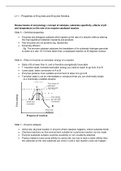
• State of B is lower than A, and is therefore energetically favourable
• T: transition state, transition/activation energy you need to reach to go from A to B
• Lower peak, faster conversion of A to B
• Enzymes produce more suitable environment to allow A to go to B
• Transition state is not an intermediate or compound that you can chemically isolate
- Is a chemically unstable situation
Slide 7 – Enzyme catalysis
• Active site: physical location in enzyme where catalysis happens, where substrate binds
• Chemical reactions so that environment suitable for a particular reaction can be made
• Enzyme-substrate complex could be covalently or non covalently attached
• Product needs to have some affinity for active site, but has to have a lower affinity than
the substrate so the new substrate can come in and a new reaction cycle can happen
, • As reaction progresses, more product being formed, always some competition between
products in forming the enzyme-product complex
Slide 8 – Substrate specificity
• Enzymes usually catalyse only one type of reaction and will act on only a few related
molecules (‘group specificity’)
• A few enzymes are so specific they will only act on one substrate
• If a natural compound can exist in two stereoisomer forms, the enzyme concerned with
its metabolism in the cell will usually act only on one isomer
• Specificity is determined by presence of a groove or cleft of defined shape (active site)
into which only the substrate of correct shape and charge can fit
Slide 9-10 – Consequences of enzyme specificity
• Group of enzymes present together in one compartment of a cell
- Eg. Cytoplasm of muscle cells can create a complex and coordinated metabolic
pathway in which the initial substrate D-glucose is converted through a sequence of
specific enzyme catalysed reaction to product lactic acid
`
- B then acts as a substrate to the second reaction to make C
• Specificity of enzymes has led to a systematic classification scheme by IUB commission
on enzymes
• Enzymes divided into 6 main classes according to type of reaction they catalyse
- Class 1, oxidoreductases, contains enzymes catalase and alcohol dehydrogenase
- Six classes further divided into subgroups according to substrates or source
• Each enzyme identified by its own individual 4 digit number
- Eg. Catalase is E.C. 1.11.1.6
Slide 11-17 – Classification of enzymes
Review basics of enzymology: concept of catalysis, substrate specificity, effects of pH
and temperature on the rate of an enzyme catalysed reaction
Slide 5 – Definition/properties
• Enzymes are biological catalysts which speed up the rate of a reaction without altering
the final equilibrium between reactants and products
• Few enzymes are not proteins (eg. ribosomes)
• Extremely efficient
- Eg. The enzyme catalase catalyses the breakdown of its substrate hydrogen peroxide
to water at a rate 10^14 times faster than uncatalysed reaction at 30 degrees Celsius
Slide 6 – Effect of enzyme on activation energy of a reaction
• State of B is lower than A, and is therefore energetically favourable
• T: transition state, transition/activation energy you need to reach to go from A to B
• Lower peak, faster conversion of A to B
• Enzymes produce more suitable environment to allow A to go to B
• Transition state is not an intermediate or compound that you can chemically isolate
- Is a chemically unstable situation
Slide 7 – Enzyme catalysis
• Active site: physical location in enzyme where catalysis happens, where substrate binds
• Chemical reactions so that environment suitable for a particular reaction can be made
• Enzyme-substrate complex could be covalently or non covalently attached
• Product needs to have some affinity for active site, but has to have a lower affinity than
the substrate so the new substrate can come in and a new reaction cycle can happen
, • As reaction progresses, more product being formed, always some competition between
products in forming the enzyme-product complex
Slide 8 – Substrate specificity
• Enzymes usually catalyse only one type of reaction and will act on only a few related
molecules (‘group specificity’)
• A few enzymes are so specific they will only act on one substrate
• If a natural compound can exist in two stereoisomer forms, the enzyme concerned with
its metabolism in the cell will usually act only on one isomer
• Specificity is determined by presence of a groove or cleft of defined shape (active site)
into which only the substrate of correct shape and charge can fit
Slide 9-10 – Consequences of enzyme specificity
• Group of enzymes present together in one compartment of a cell
- Eg. Cytoplasm of muscle cells can create a complex and coordinated metabolic
pathway in which the initial substrate D-glucose is converted through a sequence of
specific enzyme catalysed reaction to product lactic acid
`
- B then acts as a substrate to the second reaction to make C
• Specificity of enzymes has led to a systematic classification scheme by IUB commission
on enzymes
• Enzymes divided into 6 main classes according to type of reaction they catalyse
- Class 1, oxidoreductases, contains enzymes catalase and alcohol dehydrogenase
- Six classes further divided into subgroups according to substrates or source
• Each enzyme identified by its own individual 4 digit number
- Eg. Catalase is E.C. 1.11.1.6
Slide 11-17 – Classification of enzymes