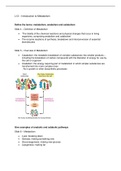
L13 – Introduction to Metabolism
Define the terms: metabolism, anabolism and catabolism
Slide 4 – Definition of Metabolism
• ‘The totality of the chemical reactions and physical changes that occur in living
organisms, comprising anabolism and catabolism’
• The enzyme reactions of synthesis, breakdown and interconversion of essential
biomolecules
Slide 5 – Overview of Metabolism
• Catabolism: the metabolic breakdown of complex substances into smaller products –
including the breakdown of carbon compounds with the liberation of energy for use by
the cell or organism
• Anabolism: the energy requiring part of metabolism in which simpler substances are
transformed into more complex ones
- As in growth or other biosynthetic processes
Give examples of anabolic and catabolic pathways
Slide 6 – Metabolism
• Lysis: breaking down
• Genesis: making something new
• Gluconeogenesis: making new glucose
• Lipogenesis: making fat
, • Happens in the cytosol
Explain the concept of controlled release of energy in enzyme catalysed metabolic
pathways
Slide 7 – Stepwise breakdown releases energy in useable small ‘packages’
• First: energetically favourable reaction, releasing a large amount of energy
• Second: Breaking down sugar by small steps
- Allow release of manageable packages of energy that can be stored in cells and
transfer and use somewhere else
- Each reaction or step has a smaller activation energy
- Enzymes help overcome activation energy and allow these reactions to occur at a
useful rate in the cells
Slide 8 – Pathways can be regulated by regulation of specific enzymes
• If you have an enzyme 2 (catalyses interconversion of B to C and C to B aka a reversible
reaction), the direction of the reaction will be driven by the relative concentrations of B
and C (Le Chatelier’s principle)
- Enzyme will catalyse the reaction going in both directions
• Irreversible reactions allows us to that level of control to be able to convert it from A to E
Define the terms: metabolism, anabolism and catabolism
Slide 4 – Definition of Metabolism
• ‘The totality of the chemical reactions and physical changes that occur in living
organisms, comprising anabolism and catabolism’
• The enzyme reactions of synthesis, breakdown and interconversion of essential
biomolecules
Slide 5 – Overview of Metabolism
• Catabolism: the metabolic breakdown of complex substances into smaller products –
including the breakdown of carbon compounds with the liberation of energy for use by
the cell or organism
• Anabolism: the energy requiring part of metabolism in which simpler substances are
transformed into more complex ones
- As in growth or other biosynthetic processes
Give examples of anabolic and catabolic pathways
Slide 6 – Metabolism
• Lysis: breaking down
• Genesis: making something new
• Gluconeogenesis: making new glucose
• Lipogenesis: making fat
, • Happens in the cytosol
Explain the concept of controlled release of energy in enzyme catalysed metabolic
pathways
Slide 7 – Stepwise breakdown releases energy in useable small ‘packages’
• First: energetically favourable reaction, releasing a large amount of energy
• Second: Breaking down sugar by small steps
- Allow release of manageable packages of energy that can be stored in cells and
transfer and use somewhere else
- Each reaction or step has a smaller activation energy
- Enzymes help overcome activation energy and allow these reactions to occur at a
useful rate in the cells
Slide 8 – Pathways can be regulated by regulation of specific enzymes
• If you have an enzyme 2 (catalyses interconversion of B to C and C to B aka a reversible
reaction), the direction of the reaction will be driven by the relative concentrations of B
and C (Le Chatelier’s principle)
- Enzyme will catalyse the reaction going in both directions
• Irreversible reactions allows us to that level of control to be able to convert it from A to E