L19 – Liver in Metabolism: Glucose Homeostasis
Slide 2
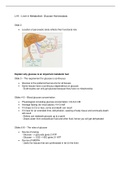
• Location of pancreatic islets reflects their functional role
Explain why glucose is an important metabolic fuel
Slide 3 – The requirement for glucose is continuous
• Glucose is the preferred fuel source for all tissues
• Some tissues have a continuous dependence on glucose
- Erythrocytes can only get glucose because they have no mitochondria
Slides 4-5 – Blood glucose concentration
• Physiological circulating glucose concentration: 3.9-6.2 mM
• Average fasting (for most adults): 4.4-5 mM
• If it drops to 2.5 or less, coma and death can result
• If it rises for an extended time, dehydration, wasting of body tissue and eventually death
will result
- Kidney can reabsorb glucose up to a point
- Draws water from extracellular fluid and other fluid, hence you will get dehydrated
Slides 6-8 – The roles of glucose
• Source of energy
- Glucose --> pyruvate gives 2 ATP
- Glucose --> CO2 + H2O gives 31 ATP
• Source of NADPH
- Useful for tissues that are synthesised in fat (in the liver)
, - Useful for integrity of the erythrocyte membrane which is subject to damage (has high
pentose phosphate pathway, produces NADPH)
- Needed for synthetic reactions (fatty acids, steroids) and drug metabolism
• Source of pentose sugars for synthetic reactions (nucleotides, DNA)
• Source of carbon for other sugars and glycoconjugates (mannose, galactose, glucuronic
acid)
• Erythrocytes reoxidise NAD by producing lactate as it cannot store it due to its lack of
mitochondria
Slide 7 – Advantages of glucose as a metabolic fuel
• Water soluble, does not require carrier in the circulation
• Can cross blood-brain barrier
• Can be oxidised anaerobically
Slide 8 – Disadvantages
• Relatively low yield of ATP per mole compared to fatty acids
• Osmotically active
• In high concentrations, can directly damage cells or lead to accumulation of toxic by-
products (fructose, sorbitol)
Slide 9 – Pathways involving glucose
• Predominant pathways involving glucose are different in different tissues
• On the whole, all tissues use glucose
• The liver can provide glucose for other tissues
Slide 10 – Role of glucose in skeletal muscle
• Glycogen used in the muscle is used in the muscle and not released anywhere
Slide 2
• Location of pancreatic islets reflects their functional role
Explain why glucose is an important metabolic fuel
Slide 3 – The requirement for glucose is continuous
• Glucose is the preferred fuel source for all tissues
• Some tissues have a continuous dependence on glucose
- Erythrocytes can only get glucose because they have no mitochondria
Slides 4-5 – Blood glucose concentration
• Physiological circulating glucose concentration: 3.9-6.2 mM
• Average fasting (for most adults): 4.4-5 mM
• If it drops to 2.5 or less, coma and death can result
• If it rises for an extended time, dehydration, wasting of body tissue and eventually death
will result
- Kidney can reabsorb glucose up to a point
- Draws water from extracellular fluid and other fluid, hence you will get dehydrated
Slides 6-8 – The roles of glucose
• Source of energy
- Glucose --> pyruvate gives 2 ATP
- Glucose --> CO2 + H2O gives 31 ATP
• Source of NADPH
- Useful for tissues that are synthesised in fat (in the liver)
, - Useful for integrity of the erythrocyte membrane which is subject to damage (has high
pentose phosphate pathway, produces NADPH)
- Needed for synthetic reactions (fatty acids, steroids) and drug metabolism
• Source of pentose sugars for synthetic reactions (nucleotides, DNA)
• Source of carbon for other sugars and glycoconjugates (mannose, galactose, glucuronic
acid)
• Erythrocytes reoxidise NAD by producing lactate as it cannot store it due to its lack of
mitochondria
Slide 7 – Advantages of glucose as a metabolic fuel
• Water soluble, does not require carrier in the circulation
• Can cross blood-brain barrier
• Can be oxidised anaerobically
Slide 8 – Disadvantages
• Relatively low yield of ATP per mole compared to fatty acids
• Osmotically active
• In high concentrations, can directly damage cells or lead to accumulation of toxic by-
products (fructose, sorbitol)
Slide 9 – Pathways involving glucose
• Predominant pathways involving glucose are different in different tissues
• On the whole, all tissues use glucose
• The liver can provide glucose for other tissues
Slide 10 – Role of glucose in skeletal muscle
• Glycogen used in the muscle is used in the muscle and not released anywhere