Taylor’s Notes Calculations
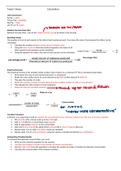
Unit Conversions
Kgg = x1000
Tonnesg = x1000000
Mgg = ÷1000
dm3 cm3 x1000
Relative Formula Mass (Mr)
Relative Formula Mass = sum of the relative atomic mass of all atoms in the formula
Reacting Masses
The number in front of each species is the ratio of each species present. If we know the mass of one species the others can be
calculated:
Calculate the number of moles of the species of known mass
Using the ratio of species from the chemical equation, the moles of all
other species in the equation can be calculated
Using the equation for moles, the mass of each species can be calculated
Percentage Yield
Empirical Formula
The empirical formula is the simplest whole number ratio of atoms in a compound This is calculated using moles.
Write down the mass of each element present in a compound
Divide the mass written down for each element by the RAM of that element RAM=Mr
This gives the number of moles
Divide the number of moles for each element by the smallest number of moles of any element
This will give the ratio of atoms in that compound
Make sure they are all whole numbers
Moles of a Gas
Concentration
Titration Procedure
A titration is an experiment used to calculate the concentration of an unknown solution from the conc of a known solution:
1. Fill a burette with a chosen acid up to the 0.00 mark
2. Add 25.0 of alkali to a conical flask using a pipette
3. Add an appropriate indicator to the conical flask
4. Add acid drop by drop to the alkali whilst swirling until a colour change is observed
5. Repeat steps 1) to 4) until concordant results are obtained
6. Repeat steps 1) to 4) without indicator using the volume recorded and perform a crystallisation
Interpreting Titration Results
To calculate the unknown concentration, you must:
Write out the chemical equation for the reaction
Calculate the number of moles of the solution of known concentration
Use the moles ratio from the equation to calculate the number of moles of solution of unknown concentration
Calculate the concentration of the unknown solution
Unit Conversions
Kgg = x1000
Tonnesg = x1000000
Mgg = ÷1000
dm3 cm3 x1000
Relative Formula Mass (Mr)
Relative Formula Mass = sum of the relative atomic mass of all atoms in the formula
Reacting Masses
The number in front of each species is the ratio of each species present. If we know the mass of one species the others can be
calculated:
Calculate the number of moles of the species of known mass
Using the ratio of species from the chemical equation, the moles of all
other species in the equation can be calculated
Using the equation for moles, the mass of each species can be calculated
Percentage Yield
Empirical Formula
The empirical formula is the simplest whole number ratio of atoms in a compound This is calculated using moles.
Write down the mass of each element present in a compound
Divide the mass written down for each element by the RAM of that element RAM=Mr
This gives the number of moles
Divide the number of moles for each element by the smallest number of moles of any element
This will give the ratio of atoms in that compound
Make sure they are all whole numbers
Moles of a Gas
Concentration
Titration Procedure
A titration is an experiment used to calculate the concentration of an unknown solution from the conc of a known solution:
1. Fill a burette with a chosen acid up to the 0.00 mark
2. Add 25.0 of alkali to a conical flask using a pipette
3. Add an appropriate indicator to the conical flask
4. Add acid drop by drop to the alkali whilst swirling until a colour change is observed
5. Repeat steps 1) to 4) until concordant results are obtained
6. Repeat steps 1) to 4) without indicator using the volume recorded and perform a crystallisation
Interpreting Titration Results
To calculate the unknown concentration, you must:
Write out the chemical equation for the reaction
Calculate the number of moles of the solution of known concentration
Use the moles ratio from the equation to calculate the number of moles of solution of unknown concentration
Calculate the concentration of the unknown solution