
Relations between branches 2: Executive and parliament
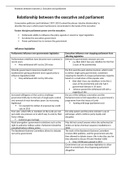
Relationship between the executive and parliament
Conservative politician Lord Hailsham (1907–2001) coined the phrase ‘elective dictatorship’ to
describe the way in which power had become concentrated in the hands of the executive.
Factors that give parliament power over the executive:
Parliaments ability to influence the policy agenda or amend or reject legislation
Scrutinise the executives government
Power parliament has to remove the government
Influence legislation
Parliaments influence over governments legislation Executives influence over stopping parliament from
affecting legislation
Parliamentary rebellions have become more common in Defeats for governments measure are rare
recent years e.g. Blair didn’t face any rebellion for the first
May withdrawal bill- lost by 230 votes 2 years of his premiership
Minority government means less loyalty from the first-past-the-post electoral system, which tends
backbenchers giving parliament more opportunity to to deliver single-party government, sometimes
influence legislation/rebel enjoying the benefit of a large parliamentary majority
May withdrawal bill- lost by 230 votes based on a small share of the popular vote
Blair didn’t face any rebellions in the first 2
years of his premiership and only had 3
government defeats in 10 years
Johnson passed the withdrawal bill with a
majority of 124
Increased willingness of the Lords to challenge the use of the Salisbury convention and the
government bills due to the lack of single-party control Parliament Acts to limit opposition to a government’s
and removal of most hereditary peers (so increasing programme from the House of Lords
legitimacy) hunting with dogs (parliament act)
for example the defeat of proposed tax credit
cuts in 2015
Free vote- which MPs or members of the Lords are not the whip system and the prime minister’s use of
put under any pressure as to which way to vote by their patronage, which reinforce party loyalty and
Party’s Whips. discipline
Cameron gay marriage
Royal prerogative- government restrictions such as the May did not consult anyone when she authorised air
right to authorise military action. Parliament should be strikes on Syrian chemical weapons installations in
consulted before military action 2018.
The Backbench Business Committee allows for debates The work of the Backbench Business Committee
not set by government receives little publicity, and the government sets the
time allowed to debate issues- this is also the case for
time allowed to discuss Private Member’s Bills
Only 3 PMB were passed in 2019
Government can use secondary legislation to allow
them to amend laws, thus bypassing parliament
altogether
Relationship between the executive and parliament
Conservative politician Lord Hailsham (1907–2001) coined the phrase ‘elective dictatorship’ to
describe the way in which power had become concentrated in the hands of the executive.
Factors that give parliament power over the executive:
Parliaments ability to influence the policy agenda or amend or reject legislation
Scrutinise the executives government
Power parliament has to remove the government
Influence legislation
Parliaments influence over governments legislation Executives influence over stopping parliament from
affecting legislation
Parliamentary rebellions have become more common in Defeats for governments measure are rare
recent years e.g. Blair didn’t face any rebellion for the first
May withdrawal bill- lost by 230 votes 2 years of his premiership
Minority government means less loyalty from the first-past-the-post electoral system, which tends
backbenchers giving parliament more opportunity to to deliver single-party government, sometimes
influence legislation/rebel enjoying the benefit of a large parliamentary majority
May withdrawal bill- lost by 230 votes based on a small share of the popular vote
Blair didn’t face any rebellions in the first 2
years of his premiership and only had 3
government defeats in 10 years
Johnson passed the withdrawal bill with a
majority of 124
Increased willingness of the Lords to challenge the use of the Salisbury convention and the
government bills due to the lack of single-party control Parliament Acts to limit opposition to a government’s
and removal of most hereditary peers (so increasing programme from the House of Lords
legitimacy) hunting with dogs (parliament act)
for example the defeat of proposed tax credit
cuts in 2015
Free vote- which MPs or members of the Lords are not the whip system and the prime minister’s use of
put under any pressure as to which way to vote by their patronage, which reinforce party loyalty and
Party’s Whips. discipline
Cameron gay marriage
Royal prerogative- government restrictions such as the May did not consult anyone when she authorised air
right to authorise military action. Parliament should be strikes on Syrian chemical weapons installations in
consulted before military action 2018.
The Backbench Business Committee allows for debates The work of the Backbench Business Committee
not set by government receives little publicity, and the government sets the
time allowed to debate issues- this is also the case for
time allowed to discuss Private Member’s Bills
Only 3 PMB were passed in 2019
Government can use secondary legislation to allow
them to amend laws, thus bypassing parliament
altogether


