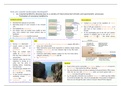
How are coastal landscapes developed?
2a. Coastal landforms develop due to a variety of interconnected climatic and geomorphic processes
- Formation of erosional landforms
Headlands and bays: Shore platforms:
Normally form adjacent to each other Created as a result of the repetition of marine
Alternating bands of more resistant & less resistant processes, collapsing & retreat
rock Base of cliff gets eroded by hydraulic action – as it
The headlands are promontory gets more & more eroded a wave cut notch is
The weaker rocks are eroded more rapidly to form formed
bays, more resistant rock remain between bays as As the overhanging part of the cliff can’t balance
headlands anymore it collapses due to the pull of gravity
Therefore, a discordant coastline is present causing mass movement – this whole process
E.g. Flamborough head (chalk), Filey bay (Kimmeridge repeats
Geos: Cliffs:
Narrow, steep sided inlets Horizontally bedded & landward dipping rock strata support cliffs with a
Usually consist of lines of steep, near vertical profile
weakness such as When destructive waves break repeatedly on relatively steeply sloping
joints/faults coastlines, undercutting can occur between high & low tide levels –
These are eroded more forming a wave cut notch
rapidly by hydraulic action Continued undercutting weakens support for the rock strata above –
than the more resistant rock collapses: producing steep profile and cliff
around them E.g. Flamborough
Hydraulic action may be very
important in forcing air &
water into the joints & Blowhole:
bedding planes, weakening
the rock strata If part of the roof of a tunnel-like cave collapses along a master joint it may form
Sometimes geos initially form a vertical shaft that reaches the cliff top = blowhole
as tunnel-like caves running Sea caves along the shore can have an opening in the ground above. When waves
at 90° to cliff line enter the sea cave with sufficient force, water can travel upward with great
As they become enlarged by pressure & escape through the opening
continuing erosion – roof E.g. Pre-glacially a blowhole was created at Selwick’s bay which was then infilled
collapse = geo & covered by Boulder Clay, only to be post-glacially re-excavated & enlarged so
Huntsman’s Leap in that now even though the water rushes in it doesn’t blow (PTO for diagram)
Pembrokeshire (35m deep) ->
2a. Coastal landforms develop due to a variety of interconnected climatic and geomorphic processes
- Formation of erosional landforms
Headlands and bays: Shore platforms:
Normally form adjacent to each other Created as a result of the repetition of marine
Alternating bands of more resistant & less resistant processes, collapsing & retreat
rock Base of cliff gets eroded by hydraulic action – as it
The headlands are promontory gets more & more eroded a wave cut notch is
The weaker rocks are eroded more rapidly to form formed
bays, more resistant rock remain between bays as As the overhanging part of the cliff can’t balance
headlands anymore it collapses due to the pull of gravity
Therefore, a discordant coastline is present causing mass movement – this whole process
E.g. Flamborough head (chalk), Filey bay (Kimmeridge repeats
Geos: Cliffs:
Narrow, steep sided inlets Horizontally bedded & landward dipping rock strata support cliffs with a
Usually consist of lines of steep, near vertical profile
weakness such as When destructive waves break repeatedly on relatively steeply sloping
joints/faults coastlines, undercutting can occur between high & low tide levels –
These are eroded more forming a wave cut notch
rapidly by hydraulic action Continued undercutting weakens support for the rock strata above –
than the more resistant rock collapses: producing steep profile and cliff
around them E.g. Flamborough
Hydraulic action may be very
important in forcing air &
water into the joints & Blowhole:
bedding planes, weakening
the rock strata If part of the roof of a tunnel-like cave collapses along a master joint it may form
Sometimes geos initially form a vertical shaft that reaches the cliff top = blowhole
as tunnel-like caves running Sea caves along the shore can have an opening in the ground above. When waves
at 90° to cliff line enter the sea cave with sufficient force, water can travel upward with great
As they become enlarged by pressure & escape through the opening
continuing erosion – roof E.g. Pre-glacially a blowhole was created at Selwick’s bay which was then infilled
collapse = geo & covered by Boulder Clay, only to be post-glacially re-excavated & enlarged so
Huntsman’s Leap in that now even though the water rushes in it doesn’t blow (PTO for diagram)
Pembrokeshire (35m deep) ->