A: Research methods and researching social inequalities
15 November 2020 13:58
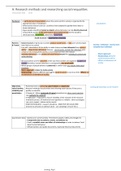
Positivism - A particular set of assumptions about the social world or society is organised & the
appropriate ways of studying it. assumptions
- Influenced by natural sciences - positivists have adapted & applied these ideas to
human behaviour
- Argue people should be treated as objects whose behaviour can be directly observed,
measured & counted in the same way as natural phenomena like the weather,
chemicals birds, Durkeheim called these 'social facts'
Social structure = organisation of society
Patterns - Social structure of particular societies produce social forces or laws over which people
& Trends have little or no control Society > individual - society more
- Free will, individualism & the ability to make choices are less influential than society's valuable than individual
ability to shape human behaviour because - society exists outside the individuals who
comprise it & consequently society is more important than the induvial
- Individual behaviour is the product of social forces beyond the individual's control and - Macro approach
understanding - Relationships between
social structure and its
- All social actions are the outcomes of the way that societies are organised 'puppets of effects on behaviours of
society' therefore, human behaviour is consequently very predictable society
- Whole groups of people behave in patterned or similar ways as a result of the social
structure.
- Marco approach is taken to study society
- Relationships between different parts of the social structure to work out their 'effects' on
the behaviour of members of society.
Objectivity, - Positivists keen on achieving value freedom or objectivity Leaving personal bias out of research
value freedom, - Research methods should exhibit the following ideal features if they are to
reliability and qualify as scientific:
quantitative - 1 Research - follow systematic & logical procedures so other social scientists
can replicate the research
- 2 Replication - important to ensure reliability of the research of the research
method & process. {if method to test hypothesis is reliable - other sociologists
can use to repeat + obtain similar results
- POSITIVISTS BELIEVE - research should be - OBJECTIVE OR VALUE-FREE
(neutral no personal or political values - use sampling to ensure this..)
Quantitative Data - Statistical or numerical data. Presented in graphs, tables percentages etc
- Comparative due to patterns, trends, correlations etc
- Used to establish cause and effect of relationships in order to deduce 'facts'
about human behaviour.
- Official statistics and public documents, especially historical documents
sociology Page 1
,Positivism
22 January 2021 11:33
Sociologist uses similar methods to natural sciences, for example an analysis of quantitative
data.
-
Positivism - A particular set of assumptions about the social world or society is organised & the
appropriate ways of studying it.
- Influenced by natural sciences - positivists have adapted & applied these ideas to
human behaviour
- Argue people should be treated as objects whose behaviour can be directly observed,
measured & counted in the same way as natural phenomena like the weather,
chemicals birds, Durkeheim called these 'social facts'
Patterns - Social structure of particular societies produce social forces or laws over which people
& Trends have little or no control
- Free will, individualism & the ability to make choices are less influential than society's
ability to shape human behaviour because - society exists outside the individuals who
comprise it & consequently society is more important than the induvial
- Individual behaviour is the product of social forces beyond the individual's control and
understanding
- All social actions are the outcomes of the way that societies are organised 'puppets of
society' therefore, human behaviour is consequently very predictable
- Whole groups of people behave in patterned or similar ways as a result of the social
structure.
- Marco approach is taken to study society
- Relationships between different parts of the social structure to work out their 'effects' on
the behaviour of members of society.
Objectivit - Keen on achieving value freedom/ or objectivity Value freedom =
y or value - Carry out research with open mind sociologist - objective
freedom - Subjectivity undermines reliability of research methods & results in findings that lack when carry out research -
validity. not bias
- Objectivity = central aspect of reliability
- Other sociologists should be able to replicate research device & obtain similar results in
order to verify the evidence gathered.
- Keen that - research demonstrate representativeness. - those take part = be typical of the
social group, so - researchers can generalise from their findings.
- Aim to make generalisations - aim too say what is true of group
Quantitat Statistics that can be converted into tubular or graphical information
ive data - Comparative value
- Observe patterns, trends, correlations
- Establish cause & effect relationships in order to deduce 'facts' about human
behaviour
- Official statistics & public documents, especially historical documents.
sociology Page 2
, Key Research Concepts
22 January 2021 11:26
Key Research Concepts
Validity
- True picture
- Difficult to achieve - people may not be entirely truthful in what they tell a
researcher
- Some ppl unconsciously change their behaviour when they know they're
being observed
Reliability
- Method - come up with very similar results
-
Representativeness
- Selecting smaller number (a sample) - representative of wider population
- Need to ask about the representativeness of sample
- larger sample = more representative it is likely to be
- Questionnaire more representative than observation - time consuming
however, - given to smaller groups.
- Extremely difficult
- Quantitative data - focus on representativeness & reliability
- Qualitative data aim for validity
Generalisability
- Sample must be a typical cross-section
- Behaviour/attitudes found in sample must be typical of wider population
sociology Page 3
15 November 2020 13:58
Positivism - A particular set of assumptions about the social world or society is organised & the
appropriate ways of studying it. assumptions
- Influenced by natural sciences - positivists have adapted & applied these ideas to
human behaviour
- Argue people should be treated as objects whose behaviour can be directly observed,
measured & counted in the same way as natural phenomena like the weather,
chemicals birds, Durkeheim called these 'social facts'
Social structure = organisation of society
Patterns - Social structure of particular societies produce social forces or laws over which people
& Trends have little or no control Society > individual - society more
- Free will, individualism & the ability to make choices are less influential than society's valuable than individual
ability to shape human behaviour because - society exists outside the individuals who
comprise it & consequently society is more important than the induvial
- Individual behaviour is the product of social forces beyond the individual's control and - Macro approach
understanding - Relationships between
social structure and its
- All social actions are the outcomes of the way that societies are organised 'puppets of effects on behaviours of
society' therefore, human behaviour is consequently very predictable society
- Whole groups of people behave in patterned or similar ways as a result of the social
structure.
- Marco approach is taken to study society
- Relationships between different parts of the social structure to work out their 'effects' on
the behaviour of members of society.
Objectivity, - Positivists keen on achieving value freedom or objectivity Leaving personal bias out of research
value freedom, - Research methods should exhibit the following ideal features if they are to
reliability and qualify as scientific:
quantitative - 1 Research - follow systematic & logical procedures so other social scientists
can replicate the research
- 2 Replication - important to ensure reliability of the research of the research
method & process. {if method to test hypothesis is reliable - other sociologists
can use to repeat + obtain similar results
- POSITIVISTS BELIEVE - research should be - OBJECTIVE OR VALUE-FREE
(neutral no personal or political values - use sampling to ensure this..)
Quantitative Data - Statistical or numerical data. Presented in graphs, tables percentages etc
- Comparative due to patterns, trends, correlations etc
- Used to establish cause and effect of relationships in order to deduce 'facts'
about human behaviour.
- Official statistics and public documents, especially historical documents
sociology Page 1
,Positivism
22 January 2021 11:33
Sociologist uses similar methods to natural sciences, for example an analysis of quantitative
data.
-
Positivism - A particular set of assumptions about the social world or society is organised & the
appropriate ways of studying it.
- Influenced by natural sciences - positivists have adapted & applied these ideas to
human behaviour
- Argue people should be treated as objects whose behaviour can be directly observed,
measured & counted in the same way as natural phenomena like the weather,
chemicals birds, Durkeheim called these 'social facts'
Patterns - Social structure of particular societies produce social forces or laws over which people
& Trends have little or no control
- Free will, individualism & the ability to make choices are less influential than society's
ability to shape human behaviour because - society exists outside the individuals who
comprise it & consequently society is more important than the induvial
- Individual behaviour is the product of social forces beyond the individual's control and
understanding
- All social actions are the outcomes of the way that societies are organised 'puppets of
society' therefore, human behaviour is consequently very predictable
- Whole groups of people behave in patterned or similar ways as a result of the social
structure.
- Marco approach is taken to study society
- Relationships between different parts of the social structure to work out their 'effects' on
the behaviour of members of society.
Objectivit - Keen on achieving value freedom/ or objectivity Value freedom =
y or value - Carry out research with open mind sociologist - objective
freedom - Subjectivity undermines reliability of research methods & results in findings that lack when carry out research -
validity. not bias
- Objectivity = central aspect of reliability
- Other sociologists should be able to replicate research device & obtain similar results in
order to verify the evidence gathered.
- Keen that - research demonstrate representativeness. - those take part = be typical of the
social group, so - researchers can generalise from their findings.
- Aim to make generalisations - aim too say what is true of group
Quantitat Statistics that can be converted into tubular or graphical information
ive data - Comparative value
- Observe patterns, trends, correlations
- Establish cause & effect relationships in order to deduce 'facts' about human
behaviour
- Official statistics & public documents, especially historical documents.
sociology Page 2
, Key Research Concepts
22 January 2021 11:26
Key Research Concepts
Validity
- True picture
- Difficult to achieve - people may not be entirely truthful in what they tell a
researcher
- Some ppl unconsciously change their behaviour when they know they're
being observed
Reliability
- Method - come up with very similar results
-
Representativeness
- Selecting smaller number (a sample) - representative of wider population
- Need to ask about the representativeness of sample
- larger sample = more representative it is likely to be
- Questionnaire more representative than observation - time consuming
however, - given to smaller groups.
- Extremely difficult
- Quantitative data - focus on representativeness & reliability
- Qualitative data aim for validity
Generalisability
- Sample must be a typical cross-section
- Behaviour/attitudes found in sample must be typical of wider population
sociology Page 3