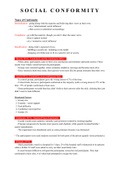
SOCIAL CONFORMITY
Types of Conformity
Internalisation - going along with the majority and believing their views as their own.
- a.k.a ‘informational social influence’
- often occurs in unfamiliar surroundings.
Compliance - go with the majority, though you don’t share the same views.
- done to appear normal
- a.k.a ‘normative social influence’
Identification - doing what’s expected of you.
- fulfilling a social role / imitating a role model.
- changing own behaviour to fit in a specific role in society.
Sherif (1935) - Conformity and the Autokinetic Effect ..
- When alone, participants came to their own conclusions and estimates (personal norms). These
results were widely varied between the participants.
- Groups were retested together, where estimates tended to converge and become more alive.
- Once retested a third time alone, their guesses were more like the group estimates than their own.
Asch (1951) - Conformity on an Ambiguous Task ..
- In control groups, participants gave the wrong answer 0.7% of the time.
- Critical trials, however, participants conformed to the majority (with a wrong answer) 37% of the
time. 75% of people conformed at least once.
- Some participants revealed that they didn’t believe their answers after the trial, claiming they just
didn’t want to look different.
Situational Factors
1. Group size
2. Unamity / social support
3. Task difficulty
4. Confidence and expertise
5. Gender (?)
Zimbardo (1973) - Stanford Prison Experiment ..
- Guards would assert authority (initially) and prisoners resisted by sticking together.
- Prisoners progressively became more passive and obedient, while guards invented harsher /
nastier punishments.
- The experiment was abandoned early as some prisoners became very distressed.
* The participants were male students recruited for both parts of the prison (guards versus prisoners).
Orlando (1973) .
- Mock psychiatric ward in a hospital for 3 days, 29 of the hospital staff volunteered to be patients
while a further 22 staff were asked to carry out their usual daily roles.
- It soon became difficult to tell apart the participants versus the real participants. They had
conformed to their roles, 6 of which had attempted to escape the ward.
Types of Conformity
Internalisation - going along with the majority and believing their views as their own.
- a.k.a ‘informational social influence’
- often occurs in unfamiliar surroundings.
Compliance - go with the majority, though you don’t share the same views.
- done to appear normal
- a.k.a ‘normative social influence’
Identification - doing what’s expected of you.
- fulfilling a social role / imitating a role model.
- changing own behaviour to fit in a specific role in society.
Sherif (1935) - Conformity and the Autokinetic Effect ..
- When alone, participants came to their own conclusions and estimates (personal norms). These
results were widely varied between the participants.
- Groups were retested together, where estimates tended to converge and become more alive.
- Once retested a third time alone, their guesses were more like the group estimates than their own.
Asch (1951) - Conformity on an Ambiguous Task ..
- In control groups, participants gave the wrong answer 0.7% of the time.
- Critical trials, however, participants conformed to the majority (with a wrong answer) 37% of the
time. 75% of people conformed at least once.
- Some participants revealed that they didn’t believe their answers after the trial, claiming they just
didn’t want to look different.
Situational Factors
1. Group size
2. Unamity / social support
3. Task difficulty
4. Confidence and expertise
5. Gender (?)
Zimbardo (1973) - Stanford Prison Experiment ..
- Guards would assert authority (initially) and prisoners resisted by sticking together.
- Prisoners progressively became more passive and obedient, while guards invented harsher /
nastier punishments.
- The experiment was abandoned early as some prisoners became very distressed.
* The participants were male students recruited for both parts of the prison (guards versus prisoners).
Orlando (1973) .
- Mock psychiatric ward in a hospital for 3 days, 29 of the hospital staff volunteered to be patients
while a further 22 staff were asked to carry out their usual daily roles.
- It soon became difficult to tell apart the participants versus the real participants. They had
conformed to their roles, 6 of which had attempted to escape the ward.