
CHAPTER 7
Continuity
7.1 Define: f(x) is continuous at x - a.
f(a) is defined, exists, and
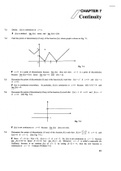
7.2 Find the points of discontinuity (if any) of the function f(x) whose graph is shown in Fig. 7-1.
Fig. 7-1
x = 0 is a point of discontinuity because lim f(x) does not exist, x = 1 is a point of discontinuity
because lim f ( x ) * f ( l ) [since lim/(jt) = 0 and /(I) = 2].
7.3 Determine the points of discontinuity (if any) of the function f(x) such that f(x) = x2 if x =£ 0 and f(x) - x
if x>0.
f(x) is continuous everywhere. In particular, f(x) is continuous at x = 0 because /(O) = (O)2 = 0 and
lim f(x) = 0.
*-»0
7.4 Determine the points of discontinuity (if any) of the function/(*) such that f(x) = 1 if x^O and /(jt)=-l
if x<0. (See Fig. 7-2.)
Fig. 7-2
/(*) is not continuous at x = 0 because lim f(x) does not exist.
7.5 Determine the points of discontinuity (if any) of the function f(x) such that f(x) = if and
fix) = 0 if x=-2. (See Fig. 7-3.)
Since x2 -4 = (x -2)(x + 2), f(x) = x-2 if x *-2. So, /(*) is not continuous at x=-2 because
lim_^f(x)*f(-2) [since /(-2) = 0 but jmi2/(A:) =-4]. [However, j: =-2 is called a removable dis-
continuity, because, if we redefine f(x) at x= -2 by setting /(-2) = -4, then the new function is
continuous at x = -2. Compare Problem 7.2.]
43
, 44 CHAPTER 7
Fig. 7-3
7.6 Find the points of discontinuity of the function
Since x2 — 1 = (x — l)(x + 1), f(x) = x + l wherever it is defined. However,/(or) is not defined when
x = \, since (x2 - l ) / ( x - 1) does not make sense when x = l. Therefore, f(x) is not continuous at
x=l.
7.7 Find the points of discontinuity (if any) of the function f(x) such that FOR AND
for x = 3.
Since x2 -9 = (x -3)(* + 3), /(*) = *+ 3 for x ^3. However, f(x) = x + 3 also when x = 3, since
/(3) = 6 = 3 + 3. Thus, f(x) = x + 3 for all x, and, therefore, f(x) is continuous everywhere.
7.8 Find the points of discontinuity (if any) of the function /(*) such that
(See Fig. 7-4.)
Fig. 7-4
f(x) is discontinuous at x = 1 because lim f(x) does not exist. f(x) is continuous at x = 2 because
/(2) = 2 + 1 = 3 and lim /(*) = 3. Obviously f(x) is continuous for all other x.
7.9 Find the points of discontinuity (if any) of , and write an equation for each vertical and
horizontal asymptote of the graph of /.
See Fig. 7-5. f(x) is discontinuous at x = 4 and x = -1 because it is
\ S\ f
not defined at those points. [However, x = —1 is a removable discontinuity, If we let the
new function is continuous at *=—!.] The only vertical asymptote is x = 4. Since
the jc-axis, y = 0, is a horizontal asymptote to the right and to the left.
Continuity
7.1 Define: f(x) is continuous at x - a.
f(a) is defined, exists, and
7.2 Find the points of discontinuity (if any) of the function f(x) whose graph is shown in Fig. 7-1.
Fig. 7-1
x = 0 is a point of discontinuity because lim f(x) does not exist, x = 1 is a point of discontinuity
because lim f ( x ) * f ( l ) [since lim/(jt) = 0 and /(I) = 2].
7.3 Determine the points of discontinuity (if any) of the function f(x) such that f(x) = x2 if x =£ 0 and f(x) - x
if x>0.
f(x) is continuous everywhere. In particular, f(x) is continuous at x = 0 because /(O) = (O)2 = 0 and
lim f(x) = 0.
*-»0
7.4 Determine the points of discontinuity (if any) of the function/(*) such that f(x) = 1 if x^O and /(jt)=-l
if x<0. (See Fig. 7-2.)
Fig. 7-2
/(*) is not continuous at x = 0 because lim f(x) does not exist.
7.5 Determine the points of discontinuity (if any) of the function f(x) such that f(x) = if and
fix) = 0 if x=-2. (See Fig. 7-3.)
Since x2 -4 = (x -2)(x + 2), f(x) = x-2 if x *-2. So, /(*) is not continuous at x=-2 because
lim_^f(x)*f(-2) [since /(-2) = 0 but jmi2/(A:) =-4]. [However, j: =-2 is called a removable dis-
continuity, because, if we redefine f(x) at x= -2 by setting /(-2) = -4, then the new function is
continuous at x = -2. Compare Problem 7.2.]
43
, 44 CHAPTER 7
Fig. 7-3
7.6 Find the points of discontinuity of the function
Since x2 — 1 = (x — l)(x + 1), f(x) = x + l wherever it is defined. However,/(or) is not defined when
x = \, since (x2 - l ) / ( x - 1) does not make sense when x = l. Therefore, f(x) is not continuous at
x=l.
7.7 Find the points of discontinuity (if any) of the function f(x) such that FOR AND
for x = 3.
Since x2 -9 = (x -3)(* + 3), /(*) = *+ 3 for x ^3. However, f(x) = x + 3 also when x = 3, since
/(3) = 6 = 3 + 3. Thus, f(x) = x + 3 for all x, and, therefore, f(x) is continuous everywhere.
7.8 Find the points of discontinuity (if any) of the function /(*) such that
(See Fig. 7-4.)
Fig. 7-4
f(x) is discontinuous at x = 1 because lim f(x) does not exist. f(x) is continuous at x = 2 because
/(2) = 2 + 1 = 3 and lim /(*) = 3. Obviously f(x) is continuous for all other x.
7.9 Find the points of discontinuity (if any) of , and write an equation for each vertical and
horizontal asymptote of the graph of /.
See Fig. 7-5. f(x) is discontinuous at x = 4 and x = -1 because it is
\ S\ f
not defined at those points. [However, x = —1 is a removable discontinuity, If we let the
new function is continuous at *=—!.] The only vertical asymptote is x = 4. Since
the jc-axis, y = 0, is a horizontal asymptote to the right and to the left.


