CHAPTER 10
Trigonometric Functions and
Their Derivatives
10.1 Define radian measure, that is, describe an angle of 1 radian.
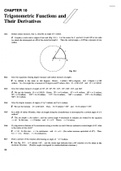
Consider a circle with a radius of one unit (Fig. 10-1). Let the center be C, and let CA and CB be two radii
for which the intercepted arc AB of the circle has length 1. Then the central angle /LACE has a measure of one
radian.
Fig. 10-1
10.2 Give the equations relating degree measure and radian measure of angles.
I 2-rr radians is the same as 360 degrees. Hence, 1 radian = 180/Tr degrees, and 1 degree = 77/180
radians. So, if an angle has a measure of D degrees and/? radians, then D = (180/7r).R and R = (77/180)D.
10.3 Give the radian measure of angles of 30°, 45°, 60°, 90°, 120°, 135°, 180°, 270°, and 360°.
I We use the formula R = (?r/180)D. Hence 30° = 77/6 radians, 45° = 77/4 radians, 60° = 77/3 radians,
90° = 77/2 radians, 120° = 27T/3 radians, 135° = 377/4 radians, 180° = 77 radians, 270° = 377/2 radians,
360° = 277 radians.
10.4 Give the degree measure of angles of 377/5 radians and 577/6 radians.
I We use the formula D = (180 ITT)R. Thus, 377/5 radians = 108° and 577/6 radians = 150°.
10.5 In a circle of radius 10 inches, what arc length along the circumference is intercepted by a central angle of 77/5
radians?
I The arc length s, the radius r, and the central angle 6 (measured in radians) are related by the equation
s = r6. In this case, r = 10 inches and 0 = 77/5. Hence, 5 = 277 inches.
10.6 If a bug moves a distance of 377 centimeters along a circular arc and if this arc subtends a central angle of 45°, what
is the radius of the circle?
I s = rO. In this case, s = 3ir centimeters and 0 = 77/4 (the radian measure equivalent of 45°). Thus,
377 = r • 77/4. Hence, r = 12 centimeters.
10.7 Draw a picture of the rotation determining an angle of -77/3 radians.
I See Fig. 10-2. 77/3 radians = 60°, and the minus sign indicates that a 60° rotation is to be taken in the
clockwise direction. (Positive angles correspond to counterclockwise rotations.)
62
, TRIGONOMETRIC FUNCTIONS AND THEIR DERIVATIVES 63
Fig. 10-2 Fig. 10-3
10.8 Give the definition of sin 0 and cos ft
Refer to Fig. 10-3. Place an arrow OA of unit length so that its initial point O is the origin of a coordinate
system and its endpoint A is (1,0). Rotate OA about the point O through an angle with radian measure 0. Let
OB be the final position of the arrow after the rotation. Then cos 6 is defined to be the ^-coordinate of B, and
sin 0 is defined to be the ^-coordinate of B.
10.9 State the values of cos 0 and sin 0 for 0 = 0, 77/6, ir/4, ir/3, ir!2, -IT, 3ir/2, 2ir, 9ir/4.
e sin 6 cos 0
0 0 1
7T-/6 1/2 V5/2
7T/4 V2/2 V2/2
IT/3 V3/2 1/2
it 12 1 0
IT 0 -1
37T/2 -1 0
2lT 0 1
Notice that 9ir/4 = 27r+ ir/4, and the sine and cosine functions have a period of 2ir, that is, sin(fl + 2ir) =
sin 6 and cos (6 1- 277-) = cos «. Hence, sin(97r/4) = sin(7r/4) = V2/2 and cos (97T/4) = cos (Tr/4) =
V2/2.
10.10 Evaluate: (a)cos(-ir/6) (b) sin (-7T/6) (c) cos(27r/3) (d) sin (2ir/3)
(a) In general, cos (-0) = cos ft Hence, cos (-ir/6) = cos (77/6) = V5/2. (*) In general,
sin(-0)= -sin ft Hence, sin(-ir/6) = -sin (ir/6) = -|. (c) 2ir/3 = ir/2 + ir/6. We use the identity
cos (0 + ir/2) = -sin ft Thus, cos(2ir/3)= -sin (-rr/6) = -\. (d) We use the identity sin (0 + ir/2) =
cos ft Thus, sin(27r/3) = cos(7r/6) = V3/2.
10.11 Sketch the graph of the cosine and sine functions.
We use the values calculated in Problem 10.9 to draw Fig. 10-4.
10.12 Sketch the graph of y = cos 3*.
Because cos 3(* + 2tr/3) = cos (3>x + 2ir) = cos 3x, the function is of period p = 2ir/3. Hence, the
length of each wave is 277/3. The number/of waves over an interval of length 2ir is 3. (In general, this number
/, called the frequency of the function, is given by the equation /= 2ir/p.) Thus, the graph is as indicated in
Fig. 10-5.
10.13 Sketch the graph of y = 1.5 sin 4*.
The period p = ir/2. (In general, p = 2ir/b, where b is the coefficient of x.) The coefficient 1.5 is the
amplitude, the greatest height above the x-axis reached by points of the graph. Thus, the graph looks like Fig.
10-6.
Trigonometric Functions and
Their Derivatives
10.1 Define radian measure, that is, describe an angle of 1 radian.
Consider a circle with a radius of one unit (Fig. 10-1). Let the center be C, and let CA and CB be two radii
for which the intercepted arc AB of the circle has length 1. Then the central angle /LACE has a measure of one
radian.
Fig. 10-1
10.2 Give the equations relating degree measure and radian measure of angles.
I 2-rr radians is the same as 360 degrees. Hence, 1 radian = 180/Tr degrees, and 1 degree = 77/180
radians. So, if an angle has a measure of D degrees and/? radians, then D = (180/7r).R and R = (77/180)D.
10.3 Give the radian measure of angles of 30°, 45°, 60°, 90°, 120°, 135°, 180°, 270°, and 360°.
I We use the formula R = (?r/180)D. Hence 30° = 77/6 radians, 45° = 77/4 radians, 60° = 77/3 radians,
90° = 77/2 radians, 120° = 27T/3 radians, 135° = 377/4 radians, 180° = 77 radians, 270° = 377/2 radians,
360° = 277 radians.
10.4 Give the degree measure of angles of 377/5 radians and 577/6 radians.
I We use the formula D = (180 ITT)R. Thus, 377/5 radians = 108° and 577/6 radians = 150°.
10.5 In a circle of radius 10 inches, what arc length along the circumference is intercepted by a central angle of 77/5
radians?
I The arc length s, the radius r, and the central angle 6 (measured in radians) are related by the equation
s = r6. In this case, r = 10 inches and 0 = 77/5. Hence, 5 = 277 inches.
10.6 If a bug moves a distance of 377 centimeters along a circular arc and if this arc subtends a central angle of 45°, what
is the radius of the circle?
I s = rO. In this case, s = 3ir centimeters and 0 = 77/4 (the radian measure equivalent of 45°). Thus,
377 = r • 77/4. Hence, r = 12 centimeters.
10.7 Draw a picture of the rotation determining an angle of -77/3 radians.
I See Fig. 10-2. 77/3 radians = 60°, and the minus sign indicates that a 60° rotation is to be taken in the
clockwise direction. (Positive angles correspond to counterclockwise rotations.)
62
, TRIGONOMETRIC FUNCTIONS AND THEIR DERIVATIVES 63
Fig. 10-2 Fig. 10-3
10.8 Give the definition of sin 0 and cos ft
Refer to Fig. 10-3. Place an arrow OA of unit length so that its initial point O is the origin of a coordinate
system and its endpoint A is (1,0). Rotate OA about the point O through an angle with radian measure 0. Let
OB be the final position of the arrow after the rotation. Then cos 6 is defined to be the ^-coordinate of B, and
sin 0 is defined to be the ^-coordinate of B.
10.9 State the values of cos 0 and sin 0 for 0 = 0, 77/6, ir/4, ir/3, ir!2, -IT, 3ir/2, 2ir, 9ir/4.
e sin 6 cos 0
0 0 1
7T-/6 1/2 V5/2
7T/4 V2/2 V2/2
IT/3 V3/2 1/2
it 12 1 0
IT 0 -1
37T/2 -1 0
2lT 0 1
Notice that 9ir/4 = 27r+ ir/4, and the sine and cosine functions have a period of 2ir, that is, sin(fl + 2ir) =
sin 6 and cos (6 1- 277-) = cos «. Hence, sin(97r/4) = sin(7r/4) = V2/2 and cos (97T/4) = cos (Tr/4) =
V2/2.
10.10 Evaluate: (a)cos(-ir/6) (b) sin (-7T/6) (c) cos(27r/3) (d) sin (2ir/3)
(a) In general, cos (-0) = cos ft Hence, cos (-ir/6) = cos (77/6) = V5/2. (*) In general,
sin(-0)= -sin ft Hence, sin(-ir/6) = -sin (ir/6) = -|. (c) 2ir/3 = ir/2 + ir/6. We use the identity
cos (0 + ir/2) = -sin ft Thus, cos(2ir/3)= -sin (-rr/6) = -\. (d) We use the identity sin (0 + ir/2) =
cos ft Thus, sin(27r/3) = cos(7r/6) = V3/2.
10.11 Sketch the graph of the cosine and sine functions.
We use the values calculated in Problem 10.9 to draw Fig. 10-4.
10.12 Sketch the graph of y = cos 3*.
Because cos 3(* + 2tr/3) = cos (3>x + 2ir) = cos 3x, the function is of period p = 2ir/3. Hence, the
length of each wave is 277/3. The number/of waves over an interval of length 2ir is 3. (In general, this number
/, called the frequency of the function, is given by the equation /= 2ir/p.) Thus, the graph is as indicated in
Fig. 10-5.
10.13 Sketch the graph of y = 1.5 sin 4*.
The period p = ir/2. (In general, p = 2ir/b, where b is the coefficient of x.) The coefficient 1.5 is the
amplitude, the greatest height above the x-axis reached by points of the graph. Thus, the graph looks like Fig.
10-6.