CHAPTER 22
Volume
22.1 Derive the formula V= jirr 3 for the volume of a sphere of radius r.
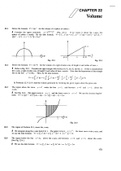
Consider the upper semicircle y = Vr2 - x2 (Fig. 22-1). If we rotate it about the x-axis, the
sphere of radius r results. By the disk formula, V= TT Jl y2 dx = TT |I (r2 - x2) dx = ir(r2x - j*3) lr_ =
TKr3-ir3)-(-rJ+ir3)]=^r3.
Fig. 22-1 Fig. 22-2
22.2 Derive the formula V= \irr-h for the volume of a right circular cone of height h and radius of base r.
Refer to Fig. 22-2. Consider the right triangle with vertices (0,0), (h, 0), and (h,r). If this is rotated about
the x-axis, a right circular cone of height h and radius of base r results. Note that the hypotenuse of the triangle
lies on the line y = (r/h)x. Then, by the disk formula,
In Problems 22.3-22.19, find the volume generated by revolving the given region about the given axis.
22.3 The region above the curve y = jc3, under the line y = \, and between * = 0 and * = !; about the
AC-axis.
See Fig. 22-3. The upper curve is y = 1, and the lower curve is y = x3. We use the circular ring for-
mula: V = w Jo' [I2 - (x3)2] dx = rr(x - fce7) ]10 = TT(! - }) = f TT.
Fig. 22-3
22.4 The region of Problem 22.3, about the y-axis.
We integrate along the y-axis from 0 to 1. The upper curve is x = y1'3, the lower curve is the y-axis, and
we use the disk formula:
22.5 The region below the line y-2x, above the x-axis, and between jr = 0 and x = I; about the jc-axis.
(See Fig. 22-4.)
We use the disk formula:
173
, 174 CHAPTER 22
Fig. 22-4
22.6 The region of Problem 22.5, about the y-axis.
We use the cylindrical shell formula:
22.7 The region of Problem 21.39, about the jc-axis.
The curves intersect at (0, 0) and (1,1). The upper curve is and the lower curve is
We use the circular ring formula:
22.8 The region inside the circle x2 + y2 = r2 with 0<x<a<r; about the .y-axis. (This gives the volume cut
from a sphere of radius r by a pipe of radius a whose axis is a diameter of the sphere.)
We shall consider only the region above the *-axis (Fig. 22-5), and then, by symmetry, double the result. We
use the cylindrical shell formula:
We multiply by 2 to obtain the
answer
Fig. 22-5 Fig. 22-6
22.9 The region below the quarter-circle x2 + y2 = r2 (x>0, y >0) and above the line y = a, where 0 < a < r ;
about the y-axis. (This gives the volume of a polar cap of a sphere.)
See Fig. 22-6. We use the disk formula along the y-axis:
22.10 The region bounded by y = 1 + x2 and y = 5; about the x-axis. (See Fig. 22-7.)
Fig. 22-7
Volume
22.1 Derive the formula V= jirr 3 for the volume of a sphere of radius r.
Consider the upper semicircle y = Vr2 - x2 (Fig. 22-1). If we rotate it about the x-axis, the
sphere of radius r results. By the disk formula, V= TT Jl y2 dx = TT |I (r2 - x2) dx = ir(r2x - j*3) lr_ =
TKr3-ir3)-(-rJ+ir3)]=^r3.
Fig. 22-1 Fig. 22-2
22.2 Derive the formula V= \irr-h for the volume of a right circular cone of height h and radius of base r.
Refer to Fig. 22-2. Consider the right triangle with vertices (0,0), (h, 0), and (h,r). If this is rotated about
the x-axis, a right circular cone of height h and radius of base r results. Note that the hypotenuse of the triangle
lies on the line y = (r/h)x. Then, by the disk formula,
In Problems 22.3-22.19, find the volume generated by revolving the given region about the given axis.
22.3 The region above the curve y = jc3, under the line y = \, and between * = 0 and * = !; about the
AC-axis.
See Fig. 22-3. The upper curve is y = 1, and the lower curve is y = x3. We use the circular ring for-
mula: V = w Jo' [I2 - (x3)2] dx = rr(x - fce7) ]10 = TT(! - }) = f TT.
Fig. 22-3
22.4 The region of Problem 22.3, about the y-axis.
We integrate along the y-axis from 0 to 1. The upper curve is x = y1'3, the lower curve is the y-axis, and
we use the disk formula:
22.5 The region below the line y-2x, above the x-axis, and between jr = 0 and x = I; about the jc-axis.
(See Fig. 22-4.)
We use the disk formula:
173
, 174 CHAPTER 22
Fig. 22-4
22.6 The region of Problem 22.5, about the y-axis.
We use the cylindrical shell formula:
22.7 The region of Problem 21.39, about the jc-axis.
The curves intersect at (0, 0) and (1,1). The upper curve is and the lower curve is
We use the circular ring formula:
22.8 The region inside the circle x2 + y2 = r2 with 0<x<a<r; about the .y-axis. (This gives the volume cut
from a sphere of radius r by a pipe of radius a whose axis is a diameter of the sphere.)
We shall consider only the region above the *-axis (Fig. 22-5), and then, by symmetry, double the result. We
use the cylindrical shell formula:
We multiply by 2 to obtain the
answer
Fig. 22-5 Fig. 22-6
22.9 The region below the quarter-circle x2 + y2 = r2 (x>0, y >0) and above the line y = a, where 0 < a < r ;
about the y-axis. (This gives the volume of a polar cap of a sphere.)
See Fig. 22-6. We use the disk formula along the y-axis:
22.10 The region bounded by y = 1 + x2 and y = 5; about the x-axis. (See Fig. 22-7.)
Fig. 22-7