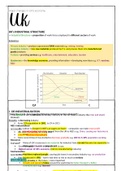
UK’s INDUSTRIAL STRUCTURE
-> Industrial Structure = proportion of work force employed in different sectors of work
Industries
Primary Industry = produce unprocessed RAW materials e.g. mining, farming
Secondary Industry = take raw materials produced by P.S. and process them into manufactured
goods/products
Tertiary = providing services e.g. healthcare, entertainment, education, tourism
Quaternary = the knowledge economy, providing information + developing new ideas e.g. ICT, vaccines,
R&D
CAUSES OF ECONOMIC CHANGE IN THE UK
1. DE-INDUSTRIALISATION
“Using the graph,
-> The decline howtraditional
of old, have the following
secondary industrial
industrysectors changed?”
in the UK (heavy industry like iron and steel)
PRIMARY
Reasons
A decreasing industry
From 22% population in 1851, to 2% in 2011
NEE’s industrialized
SECONDARY Labour is cheaper in NEE’s as wages are lower – companies can make more profit
Has been
Manufacturing
fluctuating industries moved from the UK to NEE’s e.g. China, causing our factories to
for a long time
close
1960’s – declined dramatically
More recent times it has started to decrease gradually e.g. 2011 is 5-10% population working
Resources
TERTIARY Many of UK’s resources (raw materials for industry) have run out/became too expensive to
Growingminerapidly
e.g. coal + iron =asmines
– wasn’t popularclosed
as it is now
Highest earner of UK’s economy (mirrors manufacturing industry)
Mechanisation
Machines replaced people, causing job losses in secondary industry e.g. car production
QUATERNARY
Only introduced in 1981 – hasn’t had time to rise as much as tertiary
GLOBALISATION
Will keep growing in the future = more important
Growth and spread of ideas around the world due to faster transport + better
communication e.g. internet
, 2. POST-INDUSTRIAL ECONOMY
-> The growth of tertiary + quaternary sectors of industry
Tertiary = finance
Quaternary = R&D (Research + Development), Consultancy (advice to businesses)
Why have these sectors grown in the UK?
The wealth of the UK population has grown = leading to an increased demand in services e.g.
financial investments
Growth of technology in the UK has led to Quaternary increasing
UK specializes in high value services e.g. finance
Also specializes in the very high Quaternary sector. It is a world leader in R&D e.g. vaccine
development + business consultancy
1.3 million work in the IT sector
Workers are better paid in the 2 sectors, so the UK earns more money – increasing its GNI faster
Service industries in the UK
Have grown rapidly since 1970s – RETAIL largest sector + finance
Finance example
The UK is the world’s leading financial centre (London) e.g. banking, insurance, fund management
etc.
Many companies e.g. HSBC have their local global HQ here
10% of UK’s GNI
R&D [Research + Development]
Adds over £3 billion to our economy
Research is done at universities using university graduates e.g. Cambridge by companies British
Antarctic Survey
ABCAM produces antibodies to treat diseases
Sector is growing
BUSINESS AND SCIENCE PARKS
-> Business parks = purpose-built area of offices + warehouses
Often at the edge of cities + close
ADVANTAGES to a main road (for access to materials/transport)
of Cambridge DISADVANTAGES of Cambridge
Good transport links including M11 City is overcrowded and congested =
SCIENCE PARKS motorway
= located near university sites
+ Stanstead Airport and high tech industries are established.
difficulty driving Science research
+ commercial development may be carried out in co-operation with the uni.
Quaternary industries are found in science/business parks. Often found:
Outskirts of cities near fast transport links e.g. motorways
-> Industrial Structure = proportion of work force employed in different sectors of work
Industries
Primary Industry = produce unprocessed RAW materials e.g. mining, farming
Secondary Industry = take raw materials produced by P.S. and process them into manufactured
goods/products
Tertiary = providing services e.g. healthcare, entertainment, education, tourism
Quaternary = the knowledge economy, providing information + developing new ideas e.g. ICT, vaccines,
R&D
CAUSES OF ECONOMIC CHANGE IN THE UK
1. DE-INDUSTRIALISATION
“Using the graph,
-> The decline howtraditional
of old, have the following
secondary industrial
industrysectors changed?”
in the UK (heavy industry like iron and steel)
PRIMARY
Reasons
A decreasing industry
From 22% population in 1851, to 2% in 2011
NEE’s industrialized
SECONDARY Labour is cheaper in NEE’s as wages are lower – companies can make more profit
Has been
Manufacturing
fluctuating industries moved from the UK to NEE’s e.g. China, causing our factories to
for a long time
close
1960’s – declined dramatically
More recent times it has started to decrease gradually e.g. 2011 is 5-10% population working
Resources
TERTIARY Many of UK’s resources (raw materials for industry) have run out/became too expensive to
Growingminerapidly
e.g. coal + iron =asmines
– wasn’t popularclosed
as it is now
Highest earner of UK’s economy (mirrors manufacturing industry)
Mechanisation
Machines replaced people, causing job losses in secondary industry e.g. car production
QUATERNARY
Only introduced in 1981 – hasn’t had time to rise as much as tertiary
GLOBALISATION
Will keep growing in the future = more important
Growth and spread of ideas around the world due to faster transport + better
communication e.g. internet
, 2. POST-INDUSTRIAL ECONOMY
-> The growth of tertiary + quaternary sectors of industry
Tertiary = finance
Quaternary = R&D (Research + Development), Consultancy (advice to businesses)
Why have these sectors grown in the UK?
The wealth of the UK population has grown = leading to an increased demand in services e.g.
financial investments
Growth of technology in the UK has led to Quaternary increasing
UK specializes in high value services e.g. finance
Also specializes in the very high Quaternary sector. It is a world leader in R&D e.g. vaccine
development + business consultancy
1.3 million work in the IT sector
Workers are better paid in the 2 sectors, so the UK earns more money – increasing its GNI faster
Service industries in the UK
Have grown rapidly since 1970s – RETAIL largest sector + finance
Finance example
The UK is the world’s leading financial centre (London) e.g. banking, insurance, fund management
etc.
Many companies e.g. HSBC have their local global HQ here
10% of UK’s GNI
R&D [Research + Development]
Adds over £3 billion to our economy
Research is done at universities using university graduates e.g. Cambridge by companies British
Antarctic Survey
ABCAM produces antibodies to treat diseases
Sector is growing
BUSINESS AND SCIENCE PARKS
-> Business parks = purpose-built area of offices + warehouses
Often at the edge of cities + close
ADVANTAGES to a main road (for access to materials/transport)
of Cambridge DISADVANTAGES of Cambridge
Good transport links including M11 City is overcrowded and congested =
SCIENCE PARKS motorway
= located near university sites
+ Stanstead Airport and high tech industries are established.
difficulty driving Science research
+ commercial development may be carried out in co-operation with the uni.
Quaternary industries are found in science/business parks. Often found:
Outskirts of cities near fast transport links e.g. motorways