

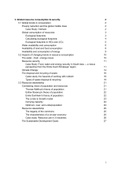
3. Global resource consumption & security 2
3.1 Global trends in consumption 2
Poverty reduction and the global middle class 2
Case Study: Vietnam 2
Global consumption of resources 3
Ecological footprints: 3
Calculating ecological footprints: 4
Ecological footprints in HICs and LICs: 5
Water availability and consumption 6
Availability of land and food consumption 8
Availability and consumption of energy 9
3.2 Impacts of changing trends in resource consumption 10
The water - food - energy nexus 10
Resource security 11
Case Study: Food, water and energy security in South Asia — a nexus
perspective from the Hindu Kush Himalayan region 11
Climate Change 14
The disposal and recycling of waste 16
Caste study: the hazards of working with rubbish 18
Types of waste disposal & recycling: 19
3.3 Resource stewardship 21
Contrasting views of population and resources 21
Thomas Malthus's theory of population: 21
Esther Boserup's theory of population: 22
Emile Durkheim's theory of population: 22
The Limits to Growth model 23
Carrying capacity: 24
Optimum, over- and underpopulation: 24
Resource stewardship 25
The tragedy of the commons: 25
The characteristics of a circular economy: 25
Case study: Resource use in 3 industries: 26
The Sustainable Development Goals 27
1
,3. Global resource consumption & security
3.1 Global trends in consumption
Poverty reduction and the global middle class
● global reduction in global extreme poverty, 2000 - 2015
○ 1990: 50% of ppl in LICs lived on less than $1.25/day → 2015: 14%
■ 1.9B → 836 M
○ number of people classified as middle class almost tripled: 18% → 50%
● increasing number of middle class:
○ result of increase in av. incomes & fall of people living in absolute poverty
○ important economic feature → helps increase sales of goods
■ e.g. sales of cars & motorbikes have increased by over 800% since
2009
○ However, continued growth isn't always guaranteed:
■ e.g. 1960s , Brazil & South Korea had similar incomes & economic
growth rates, by 1980s, Brazil's middle class accounted for less than
30% of pop while Korea's was over 50%
Not all middle class has economic security → many people on incomes over $4/day remain
vulnerable to unemployment and underemployment
○ for many working in informal activities, there is little to no economic or social
security
Also uneven progress in reducing poverty. → Some 800 million people still live in extreme
poverty & approx. half of all global workers work in unsafe conditions.
● People are disadvantaged on account of their gender, ethnicity, disability and
geographic location.
Latin America:
● women are more likely to live in
poverty than men: the
proportion of poor women to
poor men increased from 1997:
108 women to 100 men →
2012: 117 women to 100 men.
Globally, about 75% of men are part of
the global labour force, but only
around 50% of women are + women
earn, on av., 25% less than men.
Case Study: Vietnam
Since 1990, economic growth in
2
, Vietnam has averaged 6% per year. → has developed from one of the world’s poorest
countries into a MIC.
Reasons for its success:
● proximity to China :
○ gives it a competitive advantage. As wages in China have risen, firms have
relocated to low-cost Vietnam.
○ young population whereas China’s median age is 36, Vietnam’s is only 30.
● The Vietnamese govt has also used a series of 5 year plans to guide its
development:
○ It has invested in education, spending 6.3% of its GDP on education, around
2% more than most LICs and MICs.
○ Is a member of the Trans-Pacific Partnerships (TPP) , a 12-country trade bloc
that includes the USA and Japan.
○ Has a free trade agreement with Korea and is negotiating one with the EU.
Global consumption of resources
As the world’s population increases, and particularly as the number of wealthy people grows,
consumption of resources increases. Many of the world’s resources are in danger of being
used up.
Ecological footprints:
A country described as having an ecological footprint of 3.2 times its own geographical area
is consuming resources and assimilating its wastes on a scale that would require a land area
3.2 times larger than the actual size of the country.
● can act as a model for monitoring environmental impact
○ allow for direct comparisons between groups and individuals
○ can highlight unsustainable lifestyles → populations with a larger footprint
than their land area are living beyond sustainable limits.
● the originally estimated available capacity for the population of the Earth (for 6B) was
about 1.3 hectares of land per person
→ UN estimated by 2030 we will need the equivalent of two Earth's to supply the world's
population with all the resources that it wants
3
3.1 Global trends in consumption 2
Poverty reduction and the global middle class 2
Case Study: Vietnam 2
Global consumption of resources 3
Ecological footprints: 3
Calculating ecological footprints: 4
Ecological footprints in HICs and LICs: 5
Water availability and consumption 6
Availability of land and food consumption 8
Availability and consumption of energy 9
3.2 Impacts of changing trends in resource consumption 10
The water - food - energy nexus 10
Resource security 11
Case Study: Food, water and energy security in South Asia — a nexus
perspective from the Hindu Kush Himalayan region 11
Climate Change 14
The disposal and recycling of waste 16
Caste study: the hazards of working with rubbish 18
Types of waste disposal & recycling: 19
3.3 Resource stewardship 21
Contrasting views of population and resources 21
Thomas Malthus's theory of population: 21
Esther Boserup's theory of population: 22
Emile Durkheim's theory of population: 22
The Limits to Growth model 23
Carrying capacity: 24
Optimum, over- and underpopulation: 24
Resource stewardship 25
The tragedy of the commons: 25
The characteristics of a circular economy: 25
Case study: Resource use in 3 industries: 26
The Sustainable Development Goals 27
1
,3. Global resource consumption & security
3.1 Global trends in consumption
Poverty reduction and the global middle class
● global reduction in global extreme poverty, 2000 - 2015
○ 1990: 50% of ppl in LICs lived on less than $1.25/day → 2015: 14%
■ 1.9B → 836 M
○ number of people classified as middle class almost tripled: 18% → 50%
● increasing number of middle class:
○ result of increase in av. incomes & fall of people living in absolute poverty
○ important economic feature → helps increase sales of goods
■ e.g. sales of cars & motorbikes have increased by over 800% since
2009
○ However, continued growth isn't always guaranteed:
■ e.g. 1960s , Brazil & South Korea had similar incomes & economic
growth rates, by 1980s, Brazil's middle class accounted for less than
30% of pop while Korea's was over 50%
Not all middle class has economic security → many people on incomes over $4/day remain
vulnerable to unemployment and underemployment
○ for many working in informal activities, there is little to no economic or social
security
Also uneven progress in reducing poverty. → Some 800 million people still live in extreme
poverty & approx. half of all global workers work in unsafe conditions.
● People are disadvantaged on account of their gender, ethnicity, disability and
geographic location.
Latin America:
● women are more likely to live in
poverty than men: the
proportion of poor women to
poor men increased from 1997:
108 women to 100 men →
2012: 117 women to 100 men.
Globally, about 75% of men are part of
the global labour force, but only
around 50% of women are + women
earn, on av., 25% less than men.
Case Study: Vietnam
Since 1990, economic growth in
2
, Vietnam has averaged 6% per year. → has developed from one of the world’s poorest
countries into a MIC.
Reasons for its success:
● proximity to China :
○ gives it a competitive advantage. As wages in China have risen, firms have
relocated to low-cost Vietnam.
○ young population whereas China’s median age is 36, Vietnam’s is only 30.
● The Vietnamese govt has also used a series of 5 year plans to guide its
development:
○ It has invested in education, spending 6.3% of its GDP on education, around
2% more than most LICs and MICs.
○ Is a member of the Trans-Pacific Partnerships (TPP) , a 12-country trade bloc
that includes the USA and Japan.
○ Has a free trade agreement with Korea and is negotiating one with the EU.
Global consumption of resources
As the world’s population increases, and particularly as the number of wealthy people grows,
consumption of resources increases. Many of the world’s resources are in danger of being
used up.
Ecological footprints:
A country described as having an ecological footprint of 3.2 times its own geographical area
is consuming resources and assimilating its wastes on a scale that would require a land area
3.2 times larger than the actual size of the country.
● can act as a model for monitoring environmental impact
○ allow for direct comparisons between groups and individuals
○ can highlight unsustainable lifestyles → populations with a larger footprint
than their land area are living beyond sustainable limits.
● the originally estimated available capacity for the population of the Earth (for 6B) was
about 1.3 hectares of land per person
→ UN estimated by 2030 we will need the equivalent of two Earth's to supply the world's
population with all the resources that it wants
3


