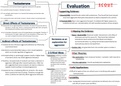
Testosterone SCOUT
• Testosterone is the hormone linked to aggression produced in the gonads. Evaluation
• In a male this means the testes, in females the ovaries
Supporting Evidence:
• It is an androgen which means it is a chemical that develops and maintains male
characteristics • Edwards(1968): Injected female rodent with testosterone. They found that those injected
• It is produced by males and females, however, females produce considerably lower were more aggressive when given testosterone as adults compared to the controls.
levels
• D’Andrade(1966): Boys= more aggressive than girls. Correlated with higher exposure to
Direct Effects of Testosterone testosterone both pre- and postnatally. Fits with anecdotal evidence of boys and girls
• Testosterone has an organising effect on the brain. This means it causes the brain to
develop in a certain way. There is a critical period shortly after birth. During this
time testosterone sensitizes certain neural circuits
• E.g. it stimulates cell growth in areas of the hypothalamus and amygdala. Therefore, if
Critiquing the Evidence:
testosterone is too high it might result in over-stimulation of these areas. This
• Mazur + Booth(1998): Reciprocal model= testosterone is the effect of
can result in atypical structures and functioning of these areas
dominance and not the cause of it. They found that individual
Hormones as an testosterone levels varied across the lifespan according to
Indirect effects of Testosterone explanation for environmental status. E.g. being married decreased testosterone
levels whereas divorce increased them
• Testosterone also influences aggressive behaviour by influencing aggression
neurotransmission • Positive critic: can generalise from rats as limbic system is similar in
• Serotonin (a neurotransmitter) plays a role in mood regulation humans an rats ad testosterone has similar functions
which can include regulation of aggression 2 Critical Ideas Other Theories:
• Increased activity in serotonergic synapses results in higher levels • Reductionism: explaining a complex
of serotonin which may inhibit aggressive behaviour phenomenon (i.e. behaviour) • Bio explanations= brain structure/ function + evolution– both may link to
by reducing it down to a testosterone
• Therefore, increased levels of serotonin can mean a reduction in simple causal explanation (e.g.
aggression (although other research eg Brunner, 1993, has biological processes) which • Non-bio explanation= Freud’s psychodynamic explanation
may ignore other controlling
also suggested that excess serotonin can lead to a failure to factors
regulate mood resulting in increased aggression) Useful Applications:
• Determinism: a point of view which
• Testosterone has a modulating effect on serotonin. This means suggests people have no free • Difficult to apply as there are ethical issues in interfering with people’s
that it controls the level of activity. Therefore, through this will or control over their
actions as they have been pre-
hormone levels
action, testosterone indirectly affects aggressive behaviour
determined by some factor
(e.g. their biological make-up) Testability:
which suggests they my not be
responsible for their • Can manipulate hormone levels in animals but not ethical to do so in humans
behaviour
and still can’t prove cause and effect
, Prefrontal Cortex
• located directly behind the forehead Evaluation SCOUT
• The prefrontal cortex is influential in governing social iteration and regulation of behaviour– it is Supporting Evidence:
linked to planning
• Raine et al (1997): conducted a PET scan study on 41 convicted murderers. Found lower activity in the prefrontal cortex and
• Damage To the prefrontal cortex= someone might focus only on the present meaning that they differences in the functioning of the limbic system in brain scans of murderers compared to control grp of non-murderers.
aren’t able to plan for the long term
Areas of lower activity involved in impulse control + learning from experience
• Therefore they seek immediate rewards
• Lonstein + Stern (1998): studied the role of the PAG. This links the amygdala + hypothalamus with the prefrontal cortex. Lesions to
• Prefrontal cortex isn't for aggression but this means that the prefrontal cortex is involved in the PAG in rats showed an increase in aggression when the rats were introduced to an unfamiliar male rat
regulating emotional responses
Critiquing the Evidence:
• Aggressive Damage= someone unable to control their aggressive reactions as they can’t see the
wider or long-term view Raine et al (1997):
• Scans are good scientific reliable evidence
The limbic system
• Still needs to be interpreted by a person which makes it a little bit less valid
Hippocampus: Lonstein + Stern:
Brain function
• Has an important role in memory and is theorised to take short-term memories and convert • Limbic system is similar in rats and humans
them to long-term
explanation of
• Human cortex is far more complex than rats so we can’t assume same behaviour
• If someone can’t build long-term memories then they are effectively trapped in the present
aggression
• Abnormalities= an individual failing to see the longer-term outcomes of behaviour and they Hypothalamus:
Other Theories:
focus on immediate gratification (act aggressively to obtain immediate rewards)
• This is linked to aggression as heightened • Reductionism: Alternative factors which may contribute to aggression are ignored e.g. there
Amygdala: levels of testosterone correlate to an are cultural variation in aggression which shouldn’t matter if brain function is sole
increase in aggressive behaviour cause
• Helps regulate autonomic (automatic) behavioural function. Centre for emotions, emotional
behaviour and motivation • Abnomality in this area = atypical hormone • Association + reinforcement may explain why a person continues with a behaviour after they have
production which might explain Useful Applications:
• It intergrates internal and external stimuli and each sensory modality has an input here. When aggressive behaviour
info from these sources are combined it creates an instinctive response.
Periaqueductal grey matter • Determinism: suggests people have no free will and are therefore not morally responsible for
their aggressive actions. Potential for people to challenge the idea of punishment for
• This might be a feeling or interaction with the envirnment , and responses might include (PAG): crime + may reduce motivation to charge
aggression. Thus an individual might act aggressively to aid survival.
• Role= coordinating and integrating • Determinism: Allows us to make more specific predictions about cause and effect which could
• Abnormalities in this area= inappropriate or over-activation of the amydala behavioural responses to perceived lead to useful applications e.g. early screening could be used to predict who may be
internal and external stressors such
Hypothalamus: more predisposed to aggression and interventions put in place
as pai and threat
• Role= to maintain homeostasis (process that maintains the stability of the human body in • Located in the midbrain area and is linked Testability:
responses to changes in external conditions) to the amygdala, hypothalamus and
the hippocampus
• Allows a more scientific approach by focusing in-depth on specific brain activity and makes it
easier to test
• Testosterone is the hormone linked to aggression produced in the gonads. Evaluation
• In a male this means the testes, in females the ovaries
Supporting Evidence:
• It is an androgen which means it is a chemical that develops and maintains male
characteristics • Edwards(1968): Injected female rodent with testosterone. They found that those injected
• It is produced by males and females, however, females produce considerably lower were more aggressive when given testosterone as adults compared to the controls.
levels
• D’Andrade(1966): Boys= more aggressive than girls. Correlated with higher exposure to
Direct Effects of Testosterone testosterone both pre- and postnatally. Fits with anecdotal evidence of boys and girls
• Testosterone has an organising effect on the brain. This means it causes the brain to
develop in a certain way. There is a critical period shortly after birth. During this
time testosterone sensitizes certain neural circuits
• E.g. it stimulates cell growth in areas of the hypothalamus and amygdala. Therefore, if
Critiquing the Evidence:
testosterone is too high it might result in over-stimulation of these areas. This
• Mazur + Booth(1998): Reciprocal model= testosterone is the effect of
can result in atypical structures and functioning of these areas
dominance and not the cause of it. They found that individual
Hormones as an testosterone levels varied across the lifespan according to
Indirect effects of Testosterone explanation for environmental status. E.g. being married decreased testosterone
levels whereas divorce increased them
• Testosterone also influences aggressive behaviour by influencing aggression
neurotransmission • Positive critic: can generalise from rats as limbic system is similar in
• Serotonin (a neurotransmitter) plays a role in mood regulation humans an rats ad testosterone has similar functions
which can include regulation of aggression 2 Critical Ideas Other Theories:
• Increased activity in serotonergic synapses results in higher levels • Reductionism: explaining a complex
of serotonin which may inhibit aggressive behaviour phenomenon (i.e. behaviour) • Bio explanations= brain structure/ function + evolution– both may link to
by reducing it down to a testosterone
• Therefore, increased levels of serotonin can mean a reduction in simple causal explanation (e.g.
aggression (although other research eg Brunner, 1993, has biological processes) which • Non-bio explanation= Freud’s psychodynamic explanation
may ignore other controlling
also suggested that excess serotonin can lead to a failure to factors
regulate mood resulting in increased aggression) Useful Applications:
• Determinism: a point of view which
• Testosterone has a modulating effect on serotonin. This means suggests people have no free • Difficult to apply as there are ethical issues in interfering with people’s
that it controls the level of activity. Therefore, through this will or control over their
actions as they have been pre-
hormone levels
action, testosterone indirectly affects aggressive behaviour
determined by some factor
(e.g. their biological make-up) Testability:
which suggests they my not be
responsible for their • Can manipulate hormone levels in animals but not ethical to do so in humans
behaviour
and still can’t prove cause and effect
, Prefrontal Cortex
• located directly behind the forehead Evaluation SCOUT
• The prefrontal cortex is influential in governing social iteration and regulation of behaviour– it is Supporting Evidence:
linked to planning
• Raine et al (1997): conducted a PET scan study on 41 convicted murderers. Found lower activity in the prefrontal cortex and
• Damage To the prefrontal cortex= someone might focus only on the present meaning that they differences in the functioning of the limbic system in brain scans of murderers compared to control grp of non-murderers.
aren’t able to plan for the long term
Areas of lower activity involved in impulse control + learning from experience
• Therefore they seek immediate rewards
• Lonstein + Stern (1998): studied the role of the PAG. This links the amygdala + hypothalamus with the prefrontal cortex. Lesions to
• Prefrontal cortex isn't for aggression but this means that the prefrontal cortex is involved in the PAG in rats showed an increase in aggression when the rats were introduced to an unfamiliar male rat
regulating emotional responses
Critiquing the Evidence:
• Aggressive Damage= someone unable to control their aggressive reactions as they can’t see the
wider or long-term view Raine et al (1997):
• Scans are good scientific reliable evidence
The limbic system
• Still needs to be interpreted by a person which makes it a little bit less valid
Hippocampus: Lonstein + Stern:
Brain function
• Has an important role in memory and is theorised to take short-term memories and convert • Limbic system is similar in rats and humans
them to long-term
explanation of
• Human cortex is far more complex than rats so we can’t assume same behaviour
• If someone can’t build long-term memories then they are effectively trapped in the present
aggression
• Abnormalities= an individual failing to see the longer-term outcomes of behaviour and they Hypothalamus:
Other Theories:
focus on immediate gratification (act aggressively to obtain immediate rewards)
• This is linked to aggression as heightened • Reductionism: Alternative factors which may contribute to aggression are ignored e.g. there
Amygdala: levels of testosterone correlate to an are cultural variation in aggression which shouldn’t matter if brain function is sole
increase in aggressive behaviour cause
• Helps regulate autonomic (automatic) behavioural function. Centre for emotions, emotional
behaviour and motivation • Abnomality in this area = atypical hormone • Association + reinforcement may explain why a person continues with a behaviour after they have
production which might explain Useful Applications:
• It intergrates internal and external stimuli and each sensory modality has an input here. When aggressive behaviour
info from these sources are combined it creates an instinctive response.
Periaqueductal grey matter • Determinism: suggests people have no free will and are therefore not morally responsible for
their aggressive actions. Potential for people to challenge the idea of punishment for
• This might be a feeling or interaction with the envirnment , and responses might include (PAG): crime + may reduce motivation to charge
aggression. Thus an individual might act aggressively to aid survival.
• Role= coordinating and integrating • Determinism: Allows us to make more specific predictions about cause and effect which could
• Abnormalities in this area= inappropriate or over-activation of the amydala behavioural responses to perceived lead to useful applications e.g. early screening could be used to predict who may be
internal and external stressors such
Hypothalamus: more predisposed to aggression and interventions put in place
as pai and threat
• Role= to maintain homeostasis (process that maintains the stability of the human body in • Located in the midbrain area and is linked Testability:
responses to changes in external conditions) to the amygdala, hypothalamus and
the hippocampus
• Allows a more scientific approach by focusing in-depth on specific brain activity and makes it
easier to test