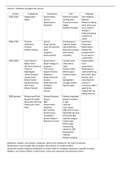
History – Medicine through time factors
Period Individuals Institutions S&T Attitudes
1250-1500 Hippocrates Government Relied on monks Very religious
Galen Church writing texts Miasma
Apothecaries Dissections were Medicine always
Hospitals illegal done same way
Herbal remedies so no need to
change it
Preferred being
cared for at
home
1500-1700 Thomas Church Printing press Humanism
Sydenham Royal Society Fugitive sheets Protestant
Vesalius Louis XIV typhoid Iatrochemistry Reformation
William Harvey fever New microscopes People still
Hospitals New herbal treated with 4
Guild systems remedies H’s as easy to
understand
1700-1900 Louis Pasteur Government Carbolic acid People didn't
Robert Koch Royal College of Chloroform trust
(Dr Henry Bastian) Surgoens Ether anaesthetics
Florence The Lancet Nitrous oxide Believed pain
Nightingale Queen Victoria Microscopes relief interfering
James Simpson Napoleon Industrial dyes with God’s plan
Joseph Lister Royal Jennerian etc. Doctors said
Robert Liston Society Bazalgette’s more likely to
Humphrey Davy Nobel prize for sewage system survive if
John Snow medicine Pavilion plan conscious, didn't
Edward Jenner Hospitals want to be
Church responsible for
killing patients
1900-present Watson and Crick Human Genome Kidney transplant
Rosalind Franklin Project Dialysis machine
Alexander Fleming NHS X-rays
Florey and Chain Government Electron
Hata Hospitals microscope
GP’s charter MRI and CT scans
British Heart Radiotherapy and
Foundation chemotherapy
British Medical Keyhole surgery
Research Council Endoscopes
Blood sugar
monitoring
Salvarson 606
Hypodermic
needles
Robotic surgery
Medieval: studied and treated symptoms rather than looking for the cause of disease
Renaissance: even though ideas changed, the practice of medicine didn’t
Industrial: doctors looked at symptoms to match them to a disease caused by a specific microbe
Modern: as a result of NHS, in short-term, access has improved, but provision hasn't
Period Individuals Institutions S&T Attitudes
1250-1500 Hippocrates Government Relied on monks Very religious
Galen Church writing texts Miasma
Apothecaries Dissections were Medicine always
Hospitals illegal done same way
Herbal remedies so no need to
change it
Preferred being
cared for at
home
1500-1700 Thomas Church Printing press Humanism
Sydenham Royal Society Fugitive sheets Protestant
Vesalius Louis XIV typhoid Iatrochemistry Reformation
William Harvey fever New microscopes People still
Hospitals New herbal treated with 4
Guild systems remedies H’s as easy to
understand
1700-1900 Louis Pasteur Government Carbolic acid People didn't
Robert Koch Royal College of Chloroform trust
(Dr Henry Bastian) Surgoens Ether anaesthetics
Florence The Lancet Nitrous oxide Believed pain
Nightingale Queen Victoria Microscopes relief interfering
James Simpson Napoleon Industrial dyes with God’s plan
Joseph Lister Royal Jennerian etc. Doctors said
Robert Liston Society Bazalgette’s more likely to
Humphrey Davy Nobel prize for sewage system survive if
John Snow medicine Pavilion plan conscious, didn't
Edward Jenner Hospitals want to be
Church responsible for
killing patients
1900-present Watson and Crick Human Genome Kidney transplant
Rosalind Franklin Project Dialysis machine
Alexander Fleming NHS X-rays
Florey and Chain Government Electron
Hata Hospitals microscope
GP’s charter MRI and CT scans
British Heart Radiotherapy and
Foundation chemotherapy
British Medical Keyhole surgery
Research Council Endoscopes
Blood sugar
monitoring
Salvarson 606
Hypodermic
needles
Robotic surgery
Medieval: studied and treated symptoms rather than looking for the cause of disease
Renaissance: even though ideas changed, the practice of medicine didn’t
Industrial: doctors looked at symptoms to match them to a disease caused by a specific microbe
Modern: as a result of NHS, in short-term, access has improved, but provision hasn't