

Chapter 28- organic synthesis
28.1 Carbon-carbon bond formation
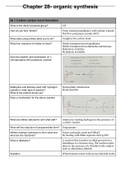
What is the nitrile functional group? CN
How do you form nitriles? From reacting haloalkanes with sodium cyanide,
NaCN or potassium cyanide, KCN.
What does using nitriles allow you to do? Lengthen the carbon chain
What four reactions of nitriles to know? Nitrile formation from haloalkanes
Nitrile formation from aldehydes and ketones
Reduction of nitriles
Hydrolysis of nitriles
Give the reaction and mechanism of 1-
chloropropane with potassium cyanide
Aldehydes and ketones react with hydrogen Nucleophilic substitution
cyanide in what type of reaction? Hydroxynitrile
What is the product known as?
Draw a mechanism for the above reaction
What are nitriles reduced to and what with? Amines by reacting hydrogen in the presence of
a nickel catalyst
What will the reduction of propanenitrile form? Propylamine
Nitriles undergo hydrolysis to form what and Forms carboxylic acids and NH4Cl
what are the reactants? By heating with dilute aqueous acid eg HCl
What is alkylation? A reaction that transfers an alkyl group from a
haloalkane to a benzene ring. The reaction takes
place in the presence of a Friedel-Crafts catalyst
such as aluminium chloride
Acylation When benzene reacts with an acyl chloride in the
, Chapter 28- organic synthesis
presence of an aluminium chloride catalyst,
forming a ketone.
28.2 Further practical techniques
What three techniques in this chapter? Filtration under reduced pressure
Recrystallisation
Melting point determination
Filtration under reduced pressure purpose For separating a solid product from a solvent or
liquid reaction mixture
What 5 things do you need for filtration under Buchner flask, buchner funnel, pressure tubing,
reduced pressure? filter paper, access to filter or vacuum pump
What does recrystallisation do? It removes impurities contained in the solid
product after filtration
How do you carry out recrystallisation?
What do you do if the solvent is flammable?
What do you add?
What do you do once dissolved?
What does recrystallisation depend on? The desired product and the impurities having
28.1 Carbon-carbon bond formation
What is the nitrile functional group? CN
How do you form nitriles? From reacting haloalkanes with sodium cyanide,
NaCN or potassium cyanide, KCN.
What does using nitriles allow you to do? Lengthen the carbon chain
What four reactions of nitriles to know? Nitrile formation from haloalkanes
Nitrile formation from aldehydes and ketones
Reduction of nitriles
Hydrolysis of nitriles
Give the reaction and mechanism of 1-
chloropropane with potassium cyanide
Aldehydes and ketones react with hydrogen Nucleophilic substitution
cyanide in what type of reaction? Hydroxynitrile
What is the product known as?
Draw a mechanism for the above reaction
What are nitriles reduced to and what with? Amines by reacting hydrogen in the presence of
a nickel catalyst
What will the reduction of propanenitrile form? Propylamine
Nitriles undergo hydrolysis to form what and Forms carboxylic acids and NH4Cl
what are the reactants? By heating with dilute aqueous acid eg HCl
What is alkylation? A reaction that transfers an alkyl group from a
haloalkane to a benzene ring. The reaction takes
place in the presence of a Friedel-Crafts catalyst
such as aluminium chloride
Acylation When benzene reacts with an acyl chloride in the
, Chapter 28- organic synthesis
presence of an aluminium chloride catalyst,
forming a ketone.
28.2 Further practical techniques
What three techniques in this chapter? Filtration under reduced pressure
Recrystallisation
Melting point determination
Filtration under reduced pressure purpose For separating a solid product from a solvent or
liquid reaction mixture
What 5 things do you need for filtration under Buchner flask, buchner funnel, pressure tubing,
reduced pressure? filter paper, access to filter or vacuum pump
What does recrystallisation do? It removes impurities contained in the solid
product after filtration
How do you carry out recrystallisation?
What do you do if the solvent is flammable?
What do you add?
What do you do once dissolved?
What does recrystallisation depend on? The desired product and the impurities having


