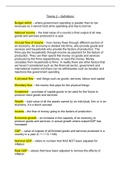
Theme 2 – Definitions:
Budget deficit – where government spending is greater than its tax
revenues so it cannot fund all its spending and has to borrow
National income – the total value of a country’s final output of all new
goods and services produced in a year
Circular flow of income – how money flows through different sectors of
an economy. An economy is divided into firms, who provide goods and
services and households who provide the factors of production. The
firms pay the households through income as payment for the factors of
production. They can then spend this money on goods and services
produced by the firms (expenditure), or save the money. Money
circulates from households to firms. In reality there are other factors that
we haven’t considered such as the financial sector, government and
international market and there can be withdrawals such as taxation and
injections like government spending
A physical flow – real things such as goods, services, labour and capital
Monetary flow – the money that pays for the physical things
Investment – purchase of capital goods to be used for the future to
produce more goods and services
Wealth – total value of all the assets owned by an individual, firm or in an
economy. It’s a stock concept
Income – the flow of money going to the factors of production
Economic growth – an increase in the capacity of an economy to
produce goods and services; in actual growth where output/GDP has
increased
GDP – value of outputs of all finished goods and services produced in a
country in a year (C + I + G + NX)
Nominal GDP – refers to number that HAS NOT been adjusted for
inflation
Real GDP – values that have been adjusted to remove the effects of
inflation
, GNI – the total primary income received by residents of a country
whether the source of value is created domestically or overseas
GNP – the total market value of all goods and services produced
domestically and abroad by residents of a country
PPP - takes into account the purchasing power of the economy and the
different costs of living between countries
Inflation – a sustained increase in general price level
Deflation – a fall in the general price level
Disinflation – a fall in the rate of inflation
CPI – Consumer price index, calculates inflation by multiplying the
percentage change in price for each item, in the “basket of goods” which
is a representative basket of goods and services used by average
households which is decided by a household expenditure survey, by its
weight based on proportion of spending on that good to give a price
index.
RPI – retail price index, is an index used to measure inflation that
includes housing costs such as mortgage interest payments
Price value = price x weight
Index for year X = (price value of year X / price value of base year) x 100
Demand pull inflation – inflation caused by an increased consumption,
investment, government spending or net exports (shift of the AD curve to
the right)
Cost push inflation – inflation caused by increased production costs
causing SRAS to shift to left
Unemployment – people who are willing and able to work but are not
currently employed
Frictional unemployment – when people move between jobs
Budget deficit – where government spending is greater than its tax
revenues so it cannot fund all its spending and has to borrow
National income – the total value of a country’s final output of all new
goods and services produced in a year
Circular flow of income – how money flows through different sectors of
an economy. An economy is divided into firms, who provide goods and
services and households who provide the factors of production. The
firms pay the households through income as payment for the factors of
production. They can then spend this money on goods and services
produced by the firms (expenditure), or save the money. Money
circulates from households to firms. In reality there are other factors that
we haven’t considered such as the financial sector, government and
international market and there can be withdrawals such as taxation and
injections like government spending
A physical flow – real things such as goods, services, labour and capital
Monetary flow – the money that pays for the physical things
Investment – purchase of capital goods to be used for the future to
produce more goods and services
Wealth – total value of all the assets owned by an individual, firm or in an
economy. It’s a stock concept
Income – the flow of money going to the factors of production
Economic growth – an increase in the capacity of an economy to
produce goods and services; in actual growth where output/GDP has
increased
GDP – value of outputs of all finished goods and services produced in a
country in a year (C + I + G + NX)
Nominal GDP – refers to number that HAS NOT been adjusted for
inflation
Real GDP – values that have been adjusted to remove the effects of
inflation
, GNI – the total primary income received by residents of a country
whether the source of value is created domestically or overseas
GNP – the total market value of all goods and services produced
domestically and abroad by residents of a country
PPP - takes into account the purchasing power of the economy and the
different costs of living between countries
Inflation – a sustained increase in general price level
Deflation – a fall in the general price level
Disinflation – a fall in the rate of inflation
CPI – Consumer price index, calculates inflation by multiplying the
percentage change in price for each item, in the “basket of goods” which
is a representative basket of goods and services used by average
households which is decided by a household expenditure survey, by its
weight based on proportion of spending on that good to give a price
index.
RPI – retail price index, is an index used to measure inflation that
includes housing costs such as mortgage interest payments
Price value = price x weight
Index for year X = (price value of year X / price value of base year) x 100
Demand pull inflation – inflation caused by an increased consumption,
investment, government spending or net exports (shift of the AD curve to
the right)
Cost push inflation – inflation caused by increased production costs
causing SRAS to shift to left
Unemployment – people who are willing and able to work but are not
currently employed
Frictional unemployment – when people move between jobs