

HAZARDOUS ENVIRONMENTS
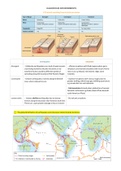
9.1 hazards resulting from tectonic processes
earthquakes volcanoes
divergent • Moderate earthquakes as a result of weak oceanic • effusive eruptions with fluid magma where gas is
crust being moved by volcanic intrusions, or by released. Lava fountain situations with no ash. Forms
transform faults caused by different speeds of new crust. e.g Hawaii, mid-atlantic ridge, some
spreading along the boundary (Mid-Atlantic Ridge) Icelandic.
convergent • Deeper earthquakes, inclined along the Benioff • explosive eruptions with viscous magma due to
zone, where slab pull occurs. greater melting, which traps gas, building up pressure.
e.g nevado del ruiz and indonesia.
• fold mountains formed when subduction of oceanic
beneath continental e.g Andes (Nazca Plate beneath
south American Plate).
conservative • Intense shallow earthquakes due to intense • No volcanic eruptions
friction along the boundary (San-Andreas fault line).
These can cause greater damage as focus is nearer.
The global distribution of earthquakes and volcanoes related to plate tectonics.
, earthquakes volcanoes tsunamis
• Clear linear chains along plate • Strong bands of linear volcanoes along • 90% occur in the Pacific Ocean
boundaries (Mid-Atlantic Ridge - boundaries because they are associated with
constructive) • ¾ Earth’s volcanoes lie around Pacific subduction zones which are mostly
• Broad chains along subduction zones Ring of Fire found in the pacific ocean.
(Nazca/South American plate) and • Clustered volcanoes over hotspots
collision boundaries e.g. Himalayas. (Hawaii)
Narrow belts along constructive and • Most intense along subduction zones as
conservative boundaries e.g. San Andreas they produce more viscous lava which
fault line erupt explosively and produce ash.
• isolated earthquakes not on boundaries, • at mid-ocean ridges or hotspots produce
due to human activities or hotspots relatively fluid basaltic lava e.g Hawaii.
(Hawaiian Hot Spot)
EARTHQUAKES
A series of seismic shock waves that originate from the focus – point where plates release their tension and energy. The epicentre
marks the point on Earth’s surface immediately above the focus.
Tectonic plates move around due to convectional currents in the mantle. Plates ‘lock up’ due to the intense friction and huge
amount of tension builds. Eventually tension is too great and plates slip, causing a rapid release of pressure.
1. body waves → transferred through Earth’s structure.
• P- waves → travel by compression and expansion, where propagation is parallel
to the direction of travel. Are able to pass through rocks, gases and liquids. Can
cause liquefaction.
• S- waves: transverse waves that travel with side to side motion and where
propagation is perpendicular to the direction of travel. Only travel through solids
due to elastic properties needed for a transverse wave.
2. surface waves → body waves arrive at surface, generating waves that
propagate parallel to surface.
• Raleigh waves: similar motion to water waves – the ground ‘rolls’ but particles
rotate away from the direction of travel.
• Love waves: propagate across Earth’s surface, particles move side to side,
perpendicular to the path of the wave’s energy.
Measuring earthquake strength
• Mercalli Scale – qualitative measurement of quake
damage an area faces. Can have low Richter mag, and high
Mercalli score, if there are poor constructions.
• Richter Scale – quantitative measurement of earthquake
amplitude, measured with a seismometer. 0-10 scale, with 1
dp. Mapped to a logarithmic scale, so 1 integer increase =
10x quake strength = 32x energy release
, Resultant hazards
primary hazards secondary hazards
• shaking • tsunamis
• surface faulting • debris flow and mudflow
• landslides (e.g avalanches) and rockfall
• soil liquefaction → decrease in cohesive strength of soil due
to increase between particles spaces = liquid.
impacts
• deaths, injury, panic, shock, night-time hypothermia
• loss of livelihood
• destruction of building structures → material on road networks blocks aid, food supplies and emergency (medical) access
• if mass falls into lake/reservoir, may displace water, or cause dam wall to fail = flooding
• interruption of water supplies
• breakage of sewage disposal systems (disease)
• loss of public utilities such as electricity and gas isolates people
• fires
• spread of chronic diseases
Factors affecting earthquake damage
• strength and depth of focus → the stronger the earthquake the more damage it can do. shallow-focus earthquakes tend to do
more damage as more energy of the latter is absorbed by underlying rocks.
• distance from epicentre → the closer from epicentre the greater damage.
• number of shocks → more aftershocks the greater damage done to weakened buildings/infrastructure.
• population density → more people, more deaths.
• time of day → earthquakes during busy time may cause more deaths than one at a quiet time (Sundays or at night) as industrial
and commercial areas have more people in them, less people at their homes.
• types of rock and sediment → loose materials may act as liquids when shaken (liquefaction). Solid rock is much safer and
buildings should be built on flat areas formed of solid rock.
• building quality → HICs have stronger buildings, insurance cover, more emergency services and funds to recover from disasters.
• economic development → affects level of preparedness and effectiveness of emergency response services, access to technology
and quality of health services.
• secondary hazards → an earthquake may cause mudslides, tsunamis, fires, disease, hunger, and hypothermia.
Anthropogenic causes of earthquakes:
• Disposal of liquid waste into bedrock → creates minor earthquakes as it reactivates a series of deep underground faults that
had been inactive.
• Underground nuclear testing → triggers earthquakes in numerous places and produces radioactive fallout.
• Fracking/mining/explosions/tunnelling → use of high-powered water to break up shale rocks is thought to trigger earthquakes.
• Increased crustal loading on previously stable surfaces → trigger earthquakes
HAITI 7.0 EARTHQUAKE – 2010
Hispaniola sits on the Gonave microplate between the North American and
Caribbean tectonic plates. There was slippage along a conservative plate
boundary that runs through Haiti at 16:53 local time. Two things magnified
its destructive power: its epicentre was just 25 kilometres south-west of
Port-au-Prince and its focus was only 13 kilometres below ground.
Aftershocks were as strong as 5.9, occurring 9 kilometres below surface.
Impacts on landscapes and people:
• killed over 300,000 people, injured another 300,000, and left about 1.3
million people displaced and homeless.
9.1 hazards resulting from tectonic processes
earthquakes volcanoes
divergent • Moderate earthquakes as a result of weak oceanic • effusive eruptions with fluid magma where gas is
crust being moved by volcanic intrusions, or by released. Lava fountain situations with no ash. Forms
transform faults caused by different speeds of new crust. e.g Hawaii, mid-atlantic ridge, some
spreading along the boundary (Mid-Atlantic Ridge) Icelandic.
convergent • Deeper earthquakes, inclined along the Benioff • explosive eruptions with viscous magma due to
zone, where slab pull occurs. greater melting, which traps gas, building up pressure.
e.g nevado del ruiz and indonesia.
• fold mountains formed when subduction of oceanic
beneath continental e.g Andes (Nazca Plate beneath
south American Plate).
conservative • Intense shallow earthquakes due to intense • No volcanic eruptions
friction along the boundary (San-Andreas fault line).
These can cause greater damage as focus is nearer.
The global distribution of earthquakes and volcanoes related to plate tectonics.
, earthquakes volcanoes tsunamis
• Clear linear chains along plate • Strong bands of linear volcanoes along • 90% occur in the Pacific Ocean
boundaries (Mid-Atlantic Ridge - boundaries because they are associated with
constructive) • ¾ Earth’s volcanoes lie around Pacific subduction zones which are mostly
• Broad chains along subduction zones Ring of Fire found in the pacific ocean.
(Nazca/South American plate) and • Clustered volcanoes over hotspots
collision boundaries e.g. Himalayas. (Hawaii)
Narrow belts along constructive and • Most intense along subduction zones as
conservative boundaries e.g. San Andreas they produce more viscous lava which
fault line erupt explosively and produce ash.
• isolated earthquakes not on boundaries, • at mid-ocean ridges or hotspots produce
due to human activities or hotspots relatively fluid basaltic lava e.g Hawaii.
(Hawaiian Hot Spot)
EARTHQUAKES
A series of seismic shock waves that originate from the focus – point where plates release their tension and energy. The epicentre
marks the point on Earth’s surface immediately above the focus.
Tectonic plates move around due to convectional currents in the mantle. Plates ‘lock up’ due to the intense friction and huge
amount of tension builds. Eventually tension is too great and plates slip, causing a rapid release of pressure.
1. body waves → transferred through Earth’s structure.
• P- waves → travel by compression and expansion, where propagation is parallel
to the direction of travel. Are able to pass through rocks, gases and liquids. Can
cause liquefaction.
• S- waves: transverse waves that travel with side to side motion and where
propagation is perpendicular to the direction of travel. Only travel through solids
due to elastic properties needed for a transverse wave.
2. surface waves → body waves arrive at surface, generating waves that
propagate parallel to surface.
• Raleigh waves: similar motion to water waves – the ground ‘rolls’ but particles
rotate away from the direction of travel.
• Love waves: propagate across Earth’s surface, particles move side to side,
perpendicular to the path of the wave’s energy.
Measuring earthquake strength
• Mercalli Scale – qualitative measurement of quake
damage an area faces. Can have low Richter mag, and high
Mercalli score, if there are poor constructions.
• Richter Scale – quantitative measurement of earthquake
amplitude, measured with a seismometer. 0-10 scale, with 1
dp. Mapped to a logarithmic scale, so 1 integer increase =
10x quake strength = 32x energy release
, Resultant hazards
primary hazards secondary hazards
• shaking • tsunamis
• surface faulting • debris flow and mudflow
• landslides (e.g avalanches) and rockfall
• soil liquefaction → decrease in cohesive strength of soil due
to increase between particles spaces = liquid.
impacts
• deaths, injury, panic, shock, night-time hypothermia
• loss of livelihood
• destruction of building structures → material on road networks blocks aid, food supplies and emergency (medical) access
• if mass falls into lake/reservoir, may displace water, or cause dam wall to fail = flooding
• interruption of water supplies
• breakage of sewage disposal systems (disease)
• loss of public utilities such as electricity and gas isolates people
• fires
• spread of chronic diseases
Factors affecting earthquake damage
• strength and depth of focus → the stronger the earthquake the more damage it can do. shallow-focus earthquakes tend to do
more damage as more energy of the latter is absorbed by underlying rocks.
• distance from epicentre → the closer from epicentre the greater damage.
• number of shocks → more aftershocks the greater damage done to weakened buildings/infrastructure.
• population density → more people, more deaths.
• time of day → earthquakes during busy time may cause more deaths than one at a quiet time (Sundays or at night) as industrial
and commercial areas have more people in them, less people at their homes.
• types of rock and sediment → loose materials may act as liquids when shaken (liquefaction). Solid rock is much safer and
buildings should be built on flat areas formed of solid rock.
• building quality → HICs have stronger buildings, insurance cover, more emergency services and funds to recover from disasters.
• economic development → affects level of preparedness and effectiveness of emergency response services, access to technology
and quality of health services.
• secondary hazards → an earthquake may cause mudslides, tsunamis, fires, disease, hunger, and hypothermia.
Anthropogenic causes of earthquakes:
• Disposal of liquid waste into bedrock → creates minor earthquakes as it reactivates a series of deep underground faults that
had been inactive.
• Underground nuclear testing → triggers earthquakes in numerous places and produces radioactive fallout.
• Fracking/mining/explosions/tunnelling → use of high-powered water to break up shale rocks is thought to trigger earthquakes.
• Increased crustal loading on previously stable surfaces → trigger earthquakes
HAITI 7.0 EARTHQUAKE – 2010
Hispaniola sits on the Gonave microplate between the North American and
Caribbean tectonic plates. There was slippage along a conservative plate
boundary that runs through Haiti at 16:53 local time. Two things magnified
its destructive power: its epicentre was just 25 kilometres south-west of
Port-au-Prince and its focus was only 13 kilometres below ground.
Aftershocks were as strong as 5.9, occurring 9 kilometres below surface.
Impacts on landscapes and people:
• killed over 300,000 people, injured another 300,000, and left about 1.3
million people displaced and homeless.





