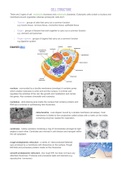
Cell Structure
There are 2 types of cell : eukaryotic (humans) and prokaryotic (bacteria). Eukaryotic cells contain a nucleus and
membrane-bound organelles whereas prokaryotic cells don’t.
1. Tissues - groups of cells that carry out a common function
e.g muscle tissue, nervous tissue, connective tissue, epithelial tissue
2. Organ - groups of tissues that work together to carry out a common function
e.g. stomach and pancreas
3. Organ system - groups of organs that carry out a common function
e.g digestive system
Eukaryotic cells
nucleus - surrounded by a double membrane (envelope) it contains pores
which enable molecules to enter and exit the nucleus. It controls and
regulates the activities of the cell, like growth and metabolism and carries
the genes. Also contains chromatin and nucleolus.
nucleolus - dark-staining area inside the nucleus that contains proteins and
RNA as is involved in synthesising new ribosomes.
mitochondria - oval shaped, bound by a double membrane (envelope). Inner
membrane is folded to form projections called cristae with a matrix on the inside,
containing enzymes needed for respiration.
centrioles - hollow cylinders containing a ring of microtubules arranged at right
angles to each other. Centrioles are involved in cell division and transport within
the cell cytoplasm.
rough endoplasmic reticulum - a series of interconnected flattened
sacs enclosed by a membrane with ribosomes on the surface. Rough
ER folds and processes proteins made on the ribosomes.
smooth endoplasmic reticulum - like rough ER, but does not have any
attached ribosomes. Produces and processes lipids and steroids (e.g.
reproductive hormones)
, lysosomes - spherical sacs containing digestive enzymes and bound by a single
membrane. Involved in the breakdown of unwanted structures within the cell.
golgi apparatus - a series of fluid filled,
flattened and curved sacs with vesicles
surrounding the edges. It processes and
packages proteins and lipids. Also produces
lysosomes.
ribosomes - composed of two subunits of RNA and protein and found in
the cytoplasm or attached to the endoplasmic reticulum. They are the site
of protein synthesis.
Prokaryotic cells
cell wall - rigid outer covering made of
peptidoglycan.
capsule - protective slimy layer which helps cells to
retain moisture and adhere to surfaces.
plasmid - circular piece of extra DNA
flagellum - hollow tail-like structure that rotates to
move the cell.
pili - thin, protein tubes that allow bacteria to
adhere to surfaces.
ribosomes - site of protein production
mesosome - infoldings of the inner membrane which contain enzymes required for respiration.
circular DNA - keeps molecules stable because the ends aren’t flailing.
microscopy
LIGHT MICROSCOPE - uses light to form an image, light has a longer wavelength than electrons, so lower resolution.
advantages disadvantages
- easy to use - lowest resolution
- slides are easy to prepare - lowest maximum magnification
- can view live specimens - only large organelles are visible
SCANNING ELECTRON MICROSCOPE - scans a beam of electrons across the sample which knocks off electrons which
then form an image.
advantages disadvantages
- higher resolution than optical - lower resolution than transmission electron
- higher magnification than optical microscope
There are 2 types of cell : eukaryotic (humans) and prokaryotic (bacteria). Eukaryotic cells contain a nucleus and
membrane-bound organelles whereas prokaryotic cells don’t.
1. Tissues - groups of cells that carry out a common function
e.g muscle tissue, nervous tissue, connective tissue, epithelial tissue
2. Organ - groups of tissues that work together to carry out a common function
e.g. stomach and pancreas
3. Organ system - groups of organs that carry out a common function
e.g digestive system
Eukaryotic cells
nucleus - surrounded by a double membrane (envelope) it contains pores
which enable molecules to enter and exit the nucleus. It controls and
regulates the activities of the cell, like growth and metabolism and carries
the genes. Also contains chromatin and nucleolus.
nucleolus - dark-staining area inside the nucleus that contains proteins and
RNA as is involved in synthesising new ribosomes.
mitochondria - oval shaped, bound by a double membrane (envelope). Inner
membrane is folded to form projections called cristae with a matrix on the inside,
containing enzymes needed for respiration.
centrioles - hollow cylinders containing a ring of microtubules arranged at right
angles to each other. Centrioles are involved in cell division and transport within
the cell cytoplasm.
rough endoplasmic reticulum - a series of interconnected flattened
sacs enclosed by a membrane with ribosomes on the surface. Rough
ER folds and processes proteins made on the ribosomes.
smooth endoplasmic reticulum - like rough ER, but does not have any
attached ribosomes. Produces and processes lipids and steroids (e.g.
reproductive hormones)
, lysosomes - spherical sacs containing digestive enzymes and bound by a single
membrane. Involved in the breakdown of unwanted structures within the cell.
golgi apparatus - a series of fluid filled,
flattened and curved sacs with vesicles
surrounding the edges. It processes and
packages proteins and lipids. Also produces
lysosomes.
ribosomes - composed of two subunits of RNA and protein and found in
the cytoplasm or attached to the endoplasmic reticulum. They are the site
of protein synthesis.
Prokaryotic cells
cell wall - rigid outer covering made of
peptidoglycan.
capsule - protective slimy layer which helps cells to
retain moisture and adhere to surfaces.
plasmid - circular piece of extra DNA
flagellum - hollow tail-like structure that rotates to
move the cell.
pili - thin, protein tubes that allow bacteria to
adhere to surfaces.
ribosomes - site of protein production
mesosome - infoldings of the inner membrane which contain enzymes required for respiration.
circular DNA - keeps molecules stable because the ends aren’t flailing.
microscopy
LIGHT MICROSCOPE - uses light to form an image, light has a longer wavelength than electrons, so lower resolution.
advantages disadvantages
- easy to use - lowest resolution
- slides are easy to prepare - lowest maximum magnification
- can view live specimens - only large organelles are visible
SCANNING ELECTRON MICROSCOPE - scans a beam of electrons across the sample which knocks off electrons which
then form an image.
advantages disadvantages
- higher resolution than optical - lower resolution than transmission electron
- higher magnification than optical microscope