Cel biologie COURSE 10BM
Lesson 1: GPCR + desensitisation (Chapter 15 Cell Signalling pages 813-820, 830-842, 848-
874)
Notes of the book…
Many bacteria and yeasts respond to chemical signals that are secreted by
their neighbors and accumulate at higher population density. This process,
called quorum sensing, allows bacteria to coordinate their behavior, including
their motility, antibiotic production, spore formation, and sexual conjugation.
Summary of page 814: cells receive signals signal molecule binds to
receptor proteins (usually at cell surface) activate one or more intracellular
signaling pathways/systems effector proteins
Different types of signaling: contact dependent (important during
development and immune responses, uses membrane bounded signal
molecule that binds from signaling cell to target cell), paracrine (signaling cells
secrete signal molecules, the local mediators, into extracellulair fluid), synaptic (nerve cells or
neurons which extend long branching axons to target cells far away, the activated neuron can send
an electric impulse, also called action potential, along its axon which reaches the synapse at the end
of the axon. Secretion of a neurotransmitter is triggered), endocrine (long
distance, uses hormones as signal molecules in bloodstreams)
Extracellular signal molecules bind to specific receptors. The target cell
responds by means of a receptor, which binds the signal molecule and
then initiates a sesponse in the target cell. A lot of the time a receptor is a
transmembrane protein, which can be activated by a ligand. After
activation, various intracellular signals that alter cell behavior. Each cell is
programmed to respond to specific combinations of extracellular signals
(see picture)
The three major classes of cell surface receptor proteins:
Ion-channel-coupled, g-protein-coupled, enzyme-coupled.
Cells can adjust their sensitivity to a signal. The target cells accomplish
this through a reversible process of adaptation, or desensitization. Receptor desensitization refers to
the decreased responsiveness that occurs with repeated or chronic exposure to agonist and is a
general feature of most signaling membrane receptors.
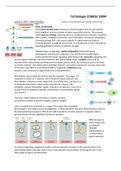
different ways in
which target cells
can become
adapted
(desensitized) to
an extracellular
signal molecule)
In chemical signaling, adaptation enables cells to respond to changes in the concentration of an
extracellular signal molecule (rather than to the absolute concentration of the signal) over a very
wide range of signal concentrations.
, Adaptation to a signal molecule can occur in various ways. It can result from inactivation of the
receptors themselves. The binding of signal molecules to cell-surface receptors, for example, may
induce the endocytosis and temporary sequestration of the receptors in endosomes.
Target cells use various mechanisms, including feedback loops, to adjust the ways in which they
respond to extracellular signals. Positive feedback loops can help cells to respond in an all-or-none
fashion to a gradually increasing concentration of an extracellular signal and to convert a short-
lasting signal into a long lasting, or even irreversible, response. Negative feedback allows cells to
adapt to a signal molecule, which enables them to respond to small changes in the concentration of
the signal molecule over a large concentration range.
As talked about before (in powerpoint
notes/summary course 5) Ca 2+ channels can be
active by IP3 because of the G-protein. The
opening of the Ca 2+ channel creates a positive
feedback, which means that it will open the gates
next to the first one. This is similar to action
potential. The wave produces a high Ca2+
concentration across the entire cell. Eventually,
the local Ca2+ concentration inactivates IP3
receptors and ryanodine receptors shutting down
the Ca2+ release. After the Ca2+ is in the cytosol,
the channels will close again (negative feedback).
Eventually, however, the negative feedback
wears off, allowing IP3 to trigger another Ca2+
wave.
Ca2+/Calmodulin-Dependent Protein Kinases
Mediate Many Responses to Ca2+ Signals.
Various Ca2+-binding proteins help to relay the
cytosolic Ca2+ signal. The most important is
calmodulin, which is found in all eukaryotic cells and can constitute as much as 1% of a cell's total
protein mass.
Lesson 2: pages 850-866
Lesson 1: GPCR + desensitisation (Chapter 15 Cell Signalling pages 813-820, 830-842, 848-
874)
Notes of the book…
Many bacteria and yeasts respond to chemical signals that are secreted by
their neighbors and accumulate at higher population density. This process,
called quorum sensing, allows bacteria to coordinate their behavior, including
their motility, antibiotic production, spore formation, and sexual conjugation.
Summary of page 814: cells receive signals signal molecule binds to
receptor proteins (usually at cell surface) activate one or more intracellular
signaling pathways/systems effector proteins
Different types of signaling: contact dependent (important during
development and immune responses, uses membrane bounded signal
molecule that binds from signaling cell to target cell), paracrine (signaling cells
secrete signal molecules, the local mediators, into extracellulair fluid), synaptic (nerve cells or
neurons which extend long branching axons to target cells far away, the activated neuron can send
an electric impulse, also called action potential, along its axon which reaches the synapse at the end
of the axon. Secretion of a neurotransmitter is triggered), endocrine (long
distance, uses hormones as signal molecules in bloodstreams)
Extracellular signal molecules bind to specific receptors. The target cell
responds by means of a receptor, which binds the signal molecule and
then initiates a sesponse in the target cell. A lot of the time a receptor is a
transmembrane protein, which can be activated by a ligand. After
activation, various intracellular signals that alter cell behavior. Each cell is
programmed to respond to specific combinations of extracellular signals
(see picture)
The three major classes of cell surface receptor proteins:
Ion-channel-coupled, g-protein-coupled, enzyme-coupled.
Cells can adjust their sensitivity to a signal. The target cells accomplish
this through a reversible process of adaptation, or desensitization. Receptor desensitization refers to
the decreased responsiveness that occurs with repeated or chronic exposure to agonist and is a
general feature of most signaling membrane receptors.
different ways in
which target cells
can become
adapted
(desensitized) to
an extracellular
signal molecule)
In chemical signaling, adaptation enables cells to respond to changes in the concentration of an
extracellular signal molecule (rather than to the absolute concentration of the signal) over a very
wide range of signal concentrations.
, Adaptation to a signal molecule can occur in various ways. It can result from inactivation of the
receptors themselves. The binding of signal molecules to cell-surface receptors, for example, may
induce the endocytosis and temporary sequestration of the receptors in endosomes.
Target cells use various mechanisms, including feedback loops, to adjust the ways in which they
respond to extracellular signals. Positive feedback loops can help cells to respond in an all-or-none
fashion to a gradually increasing concentration of an extracellular signal and to convert a short-
lasting signal into a long lasting, or even irreversible, response. Negative feedback allows cells to
adapt to a signal molecule, which enables them to respond to small changes in the concentration of
the signal molecule over a large concentration range.
As talked about before (in powerpoint
notes/summary course 5) Ca 2+ channels can be
active by IP3 because of the G-protein. The
opening of the Ca 2+ channel creates a positive
feedback, which means that it will open the gates
next to the first one. This is similar to action
potential. The wave produces a high Ca2+
concentration across the entire cell. Eventually,
the local Ca2+ concentration inactivates IP3
receptors and ryanodine receptors shutting down
the Ca2+ release. After the Ca2+ is in the cytosol,
the channels will close again (negative feedback).
Eventually, however, the negative feedback
wears off, allowing IP3 to trigger another Ca2+
wave.
Ca2+/Calmodulin-Dependent Protein Kinases
Mediate Many Responses to Ca2+ Signals.
Various Ca2+-binding proteins help to relay the
cytosolic Ca2+ signal. The most important is
calmodulin, which is found in all eukaryotic cells and can constitute as much as 1% of a cell's total
protein mass.
Lesson 2: pages 850-866