

LECTURE 1
• IMPORTANT CHAPTERS FROM THE BOOK: models of drug abuse and dependence, alcohol, opioids, cocaine and
amphetamines, nicotine and caffeine, marijuana, hallucinogens, and inhalants, GHB, steroids
• Learning objectives – how drugs affect behaviour via actions on the brain and the brain mechanisms underlying addiction
• Classical neurotransmitters involved in addiction – dopamine (addiction of amphetamine and cocaine); noradrenaline
(addiction of amphetamine and cocaine); serotonin 5-hydroxytryptamine (ecstasy or MDMA); acetylcholine (addiction of
nicotine)
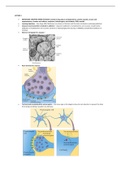
• Electron micrograph of a synapse –
• Axon terminal of a neuron –
• Terminal and somatodendritic autoreceptors – the minus sign on the diagram show the net reduction to prevent the brain
from doing something it wouldn’t do otherwise
, • Mechanisms by which drugs can alter synaptic transmission –
LECTURE 2
• Learning objectives – how drugs affect behaviour actions on the brain; the brain mechanisms underlying addiction
• Catecholamines are synthesized in a multi-step pathway – TH and AADC are found in all catecholaminergic neurons, DBH is
only found in noradrenergic cells
• Catecholamine depletion and behavioral depressant effects – rabbits injected with reserpine (depletes catecholamines)
showed behavioral sedation (A) which was reversed by treatment with DOPA (B)
• Structural features of catecholamines –
, • Drug action: key and lock – A is potential to bond at receptor site, B is full agonist, and C is antagonist (drug attaches but no
response is triggered)
• Typical dopaminergic neuron with terminal autoreceptors –
• Three ascending dopamine pathways –
NIGROSTRIATAL MESOLIMBIC MESOCORTICAL
Nigrostriatal pathway is implicated in Mesolimbic pathway is implicated in Mesocortical pathway is implicated in
Parkinson’s disease natural reward and drug abuse schizophrenia
• Damage to the nigrostriatal pathway – experimental toxin into nigrostriatal pathway on one side; causes degeneration of
dopaminergic fibers in striatum on same side; affected area looks relatively pale; even the non-damaged section shows the loss
of pigmented neurons in the substantia nigra
• IMPORTANT CHAPTERS FROM THE BOOK: models of drug abuse and dependence, alcohol, opioids, cocaine and
amphetamines, nicotine and caffeine, marijuana, hallucinogens, and inhalants, GHB, steroids
• Learning objectives – how drugs affect behaviour via actions on the brain and the brain mechanisms underlying addiction
• Classical neurotransmitters involved in addiction – dopamine (addiction of amphetamine and cocaine); noradrenaline
(addiction of amphetamine and cocaine); serotonin 5-hydroxytryptamine (ecstasy or MDMA); acetylcholine (addiction of
nicotine)
• Electron micrograph of a synapse –
• Axon terminal of a neuron –
• Terminal and somatodendritic autoreceptors – the minus sign on the diagram show the net reduction to prevent the brain
from doing something it wouldn’t do otherwise
, • Mechanisms by which drugs can alter synaptic transmission –
LECTURE 2
• Learning objectives – how drugs affect behaviour actions on the brain; the brain mechanisms underlying addiction
• Catecholamines are synthesized in a multi-step pathway – TH and AADC are found in all catecholaminergic neurons, DBH is
only found in noradrenergic cells
• Catecholamine depletion and behavioral depressant effects – rabbits injected with reserpine (depletes catecholamines)
showed behavioral sedation (A) which was reversed by treatment with DOPA (B)
• Structural features of catecholamines –
, • Drug action: key and lock – A is potential to bond at receptor site, B is full agonist, and C is antagonist (drug attaches but no
response is triggered)
• Typical dopaminergic neuron with terminal autoreceptors –
• Three ascending dopamine pathways –
NIGROSTRIATAL MESOLIMBIC MESOCORTICAL
Nigrostriatal pathway is implicated in Mesolimbic pathway is implicated in Mesocortical pathway is implicated in
Parkinson’s disease natural reward and drug abuse schizophrenia
• Damage to the nigrostriatal pathway – experimental toxin into nigrostriatal pathway on one side; causes degeneration of
dopaminergic fibers in striatum on same side; affected area looks relatively pale; even the non-damaged section shows the loss
of pigmented neurons in the substantia nigra


