Revision 27 de mayo de 2022
RESPIRATION
A-level Bio | Unit 5 | Notes
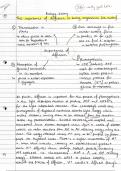
Cellular respiration
Aerobic respiration: Glycolysis
(cytoplasm), Link, Krebs (matrix)
and electron transport
chain(membrane). 36 ATP mol.
RQ=CO2 produced/O2 used.
Glycolysis
Sugar breakdown in the
cytoplasm.
• Glucose (6C) is
phosphorylated (ATP—>ADP)
and breaks down to 2x3C
sugars.
Link Reaction
Pyruvate crosses mitochondrial membrane into the matriz. It
• NAD is reduced to NADH+ is decarboxylated (-CO2) by decarboxylases to form a 2C
and ADP—>ATP
Acetyl, which joins with CoA. At the same time, pyruvate is
• Pyruvate is made dehydrogenated by dehydrogenases to NAD—>NADH+.
Fermentation* (if This forms Acetil-CoA (2C).
anaerobic) Krebs Cycle
IN PLANT CELLS: Acetyl CoA combines with 4C
Pyruvate is decarboxylated by compound to form a 6C.
losing a CO2 to ethanal
The 6C is decarboxylated and
NADH oxidises to NAD to form NAD—>NADH to form a 5C.
ethanol
The 5C is decarboxylated, ATP
IN ANIMAL CELLS:
formed, 2NAD—>2NADH and
NADH oxidised to NAD and FAD—->FADH to form the 4C
pyruvate transformed to lactate. again.
Lactate is toxic so it must be The NADH and FADH will be used in the electron transport
removed form the body, it chain as electron carriers.
causes the pH to drop.
NOTES 1
RESPIRATION
A-level Bio | Unit 5 | Notes
Cellular respiration
Aerobic respiration: Glycolysis
(cytoplasm), Link, Krebs (matrix)
and electron transport
chain(membrane). 36 ATP mol.
RQ=CO2 produced/O2 used.
Glycolysis
Sugar breakdown in the
cytoplasm.
• Glucose (6C) is
phosphorylated (ATP—>ADP)
and breaks down to 2x3C
sugars.
Link Reaction
Pyruvate crosses mitochondrial membrane into the matriz. It
• NAD is reduced to NADH+ is decarboxylated (-CO2) by decarboxylases to form a 2C
and ADP—>ATP
Acetyl, which joins with CoA. At the same time, pyruvate is
• Pyruvate is made dehydrogenated by dehydrogenases to NAD—>NADH+.
Fermentation* (if This forms Acetil-CoA (2C).
anaerobic) Krebs Cycle
IN PLANT CELLS: Acetyl CoA combines with 4C
Pyruvate is decarboxylated by compound to form a 6C.
losing a CO2 to ethanal
The 6C is decarboxylated and
NADH oxidises to NAD to form NAD—>NADH to form a 5C.
ethanol
The 5C is decarboxylated, ATP
IN ANIMAL CELLS:
formed, 2NAD—>2NADH and
NADH oxidised to NAD and FAD—->FADH to form the 4C
pyruvate transformed to lactate. again.
Lactate is toxic so it must be The NADH and FADH will be used in the electron transport
removed form the body, it chain as electron carriers.
causes the pH to drop.
NOTES 1