

Heart rate regulation
Why are we interested in modulating heart rate?
Clinical benefits
- It is a predictor of CVD mortality – how serious it can be
How is HR a predictor of CVD?
HR is a predictor of CVD mortality in acute and chronic disease
What HR is considered high risk?
Resting HR = > 70 beat/min considered high risk for CVD
Why is high HR considered high risk?
Increased HR linked to atherosclerosis/coronary artery plaque disruption
- A lot of plaque – more likely to disrupt that plaque if you have a higher heart rate
- This disruption can cause rupture, thrombus formation + occlusion of the coronary artery – MI
What else is HR a determinant of?
- Determinant of myocardial O2 consumption – higher HR can push myocardial O2 consumption to a higher level
that could cause increased severity
- Determinants of coronary circulation perfusion time – every time the heart beats (systolic contraction) we get
a reduction in coronary circulation perfusion – this increased HR = mechanical stressor = occludes the coronary
circulation= get less blood flow.
- High HR = more time spent in systole = less time relaxing in diastole = reduction in coronary perfusion – less
gaseous exchange= If you already have problems with coronary perfusion, a higher HR will make that worse.
What does decreased HR lead to?
Decreased HR leads to a decreased O2 demands of heart = increased Blood flow to heart
What is decreased heart rate a target for treating?
Decreased HR is a target for treating post-MI, angina, heart failure etc.
How is this treated?
Beta1 blockers
Ca2+ channel blockers
Where is HR initiated and regulated?
Sino- atrial node (SAN)
- Primary area generating pacemaker potentials in the heart
What does it provide?
- Provides the initial electrical stimulus for myogenic activity of the heart
What does this electrical activity produce?
- Pacemaker potentials
What is the pacemaker potential frequency related to?
Direct relationship between pacemaker frequency and heart
rate (HR)
e.g.
Pacemaker potential frequency = 60 action potentials per min
from SAN
Heart rate (HR) = 60bmp
Where is the SAN? TEXTBOOK ANSWER
A small nodule of specialised cells at the junction of the superior vena
cava (SVC) with the right atrium (RA).
, - This contains a few hundred specialised cells which generate electrical activity and pacemaker potentials.
The ‘real’ SAN – there is more detailed explanation of the SAN
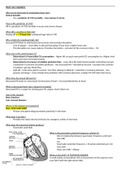
What type of view does the image show?
Dorsal view
- Red: SAN node
- Blue: peripheral SAN node
What is now known about the SAN?
It is a bigger + broader structure in the heart
Why do we think this is a larger structure / What is the area of the SAN
determined by?
Measuring electrical activity stimulate the vagus nerve and measure
electrical activity. Vagus nerve innervates the SAN, so cells that are stimulated
by vagal stimulation must be in the SAN.
- Can be used as a mapping tool
Staining
- Neurofilaments (found in SAN + atrial myocytes)
- Connexin43 (Cx43) (found in atrial myocytes)
- ANP (peptide released by atrial myocytes)
Then you look for the area where there is no Cx43/ANP but there is neurofilament staining = SAN
- This gives you a structure similar to the area depicted in vagal stimulation.
SAN properties
Describe SAN cells? – what do they and do they not generate
SAN cells electrical generating not contractile or conduction
- Generate electrical activity
- Do not generate contraction or conduction – they do not contract
What contracts?
Atrial myocytes
Ventricular myocytes
What do they express?
Express If channels = ion channels made up of HCN4 proteins
Expresses HCN4 proteins – molecular correlate of If channels (HCN4 proteins are not present in other areas of the heart)
What do If channels do?
If channels are ion channels are important in producing electrical activity in the heart
How can If channels be described?
If channels are hyperpolarisation-activated non-selective cation channels
What are central SAN areas surrounded by?
Central SAN areas are surrounded by fibrosis/connective tissue,
- do not express connexins (e.g., Cx43, like atrial myocytes)
- poor gap junction structure
What does this mean?
This means SAN is electrically isolated from rest of heart
Why is this important?
Pacemaker potentials thought to leave SAN and spread to atrial through specific pathways – currently unclear
Why are we interested in modulating heart rate?
Clinical benefits
- It is a predictor of CVD mortality – how serious it can be
How is HR a predictor of CVD?
HR is a predictor of CVD mortality in acute and chronic disease
What HR is considered high risk?
Resting HR = > 70 beat/min considered high risk for CVD
Why is high HR considered high risk?
Increased HR linked to atherosclerosis/coronary artery plaque disruption
- A lot of plaque – more likely to disrupt that plaque if you have a higher heart rate
- This disruption can cause rupture, thrombus formation + occlusion of the coronary artery – MI
What else is HR a determinant of?
- Determinant of myocardial O2 consumption – higher HR can push myocardial O2 consumption to a higher level
that could cause increased severity
- Determinants of coronary circulation perfusion time – every time the heart beats (systolic contraction) we get
a reduction in coronary circulation perfusion – this increased HR = mechanical stressor = occludes the coronary
circulation= get less blood flow.
- High HR = more time spent in systole = less time relaxing in diastole = reduction in coronary perfusion – less
gaseous exchange= If you already have problems with coronary perfusion, a higher HR will make that worse.
What does decreased HR lead to?
Decreased HR leads to a decreased O2 demands of heart = increased Blood flow to heart
What is decreased heart rate a target for treating?
Decreased HR is a target for treating post-MI, angina, heart failure etc.
How is this treated?
Beta1 blockers
Ca2+ channel blockers
Where is HR initiated and regulated?
Sino- atrial node (SAN)
- Primary area generating pacemaker potentials in the heart
What does it provide?
- Provides the initial electrical stimulus for myogenic activity of the heart
What does this electrical activity produce?
- Pacemaker potentials
What is the pacemaker potential frequency related to?
Direct relationship between pacemaker frequency and heart
rate (HR)
e.g.
Pacemaker potential frequency = 60 action potentials per min
from SAN
Heart rate (HR) = 60bmp
Where is the SAN? TEXTBOOK ANSWER
A small nodule of specialised cells at the junction of the superior vena
cava (SVC) with the right atrium (RA).
, - This contains a few hundred specialised cells which generate electrical activity and pacemaker potentials.
The ‘real’ SAN – there is more detailed explanation of the SAN
What type of view does the image show?
Dorsal view
- Red: SAN node
- Blue: peripheral SAN node
What is now known about the SAN?
It is a bigger + broader structure in the heart
Why do we think this is a larger structure / What is the area of the SAN
determined by?
Measuring electrical activity stimulate the vagus nerve and measure
electrical activity. Vagus nerve innervates the SAN, so cells that are stimulated
by vagal stimulation must be in the SAN.
- Can be used as a mapping tool
Staining
- Neurofilaments (found in SAN + atrial myocytes)
- Connexin43 (Cx43) (found in atrial myocytes)
- ANP (peptide released by atrial myocytes)
Then you look for the area where there is no Cx43/ANP but there is neurofilament staining = SAN
- This gives you a structure similar to the area depicted in vagal stimulation.
SAN properties
Describe SAN cells? – what do they and do they not generate
SAN cells electrical generating not contractile or conduction
- Generate electrical activity
- Do not generate contraction or conduction – they do not contract
What contracts?
Atrial myocytes
Ventricular myocytes
What do they express?
Express If channels = ion channels made up of HCN4 proteins
Expresses HCN4 proteins – molecular correlate of If channels (HCN4 proteins are not present in other areas of the heart)
What do If channels do?
If channels are ion channels are important in producing electrical activity in the heart
How can If channels be described?
If channels are hyperpolarisation-activated non-selective cation channels
What are central SAN areas surrounded by?
Central SAN areas are surrounded by fibrosis/connective tissue,
- do not express connexins (e.g., Cx43, like atrial myocytes)
- poor gap junction structure
What does this mean?
This means SAN is electrically isolated from rest of heart
Why is this important?
Pacemaker potentials thought to leave SAN and spread to atrial through specific pathways – currently unclear


