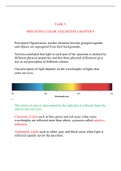
TASK 3:
PERCEVING COLOR, GOLDSTEIN CHAPTER 9
Perceptual Organization: similar elements become grouped together
and objects are segregated from their backgrounds.
Newton concluded that light in each part of the spectrum is defined by
different physical properties and that these physical differences give
rise to our perception of different colours.
Our perception of light depends on the wavelengths of lights that
enter our eyes.
The colors of objects determined by the light that is reflected from the
objects into our eyes.
Chromatic Colors such as blue green and red occur when some
wavelengths are reflected more than others, a process called selective
reflection.
Achromatic colors such as white, gray and black occur when light is
reflected equally across the spectrum.
,The difference between black white and gray is the overall amount of
light that is being reflected from an object.
Light is reflected equally but in
Light is reflected in certain different amount
wavelenghts stronger
, Selective Transmission: Only some wavelenghts are passed through
an object. (for transparent objects)
- Apple juice= transmits green and looks green.
COLOR MIXTURE:
Subtractive color mixture: When mixed, both paints only reflect
wavelengths that they have in common.
Ex: mix blue and yellow = they will reflect medium
wavelengths = green
PERCEVING COLOR, GOLDSTEIN CHAPTER 9
Perceptual Organization: similar elements become grouped together
and objects are segregated from their backgrounds.
Newton concluded that light in each part of the spectrum is defined by
different physical properties and that these physical differences give
rise to our perception of different colours.
Our perception of light depends on the wavelengths of lights that
enter our eyes.
The colors of objects determined by the light that is reflected from the
objects into our eyes.
Chromatic Colors such as blue green and red occur when some
wavelengths are reflected more than others, a process called selective
reflection.
Achromatic colors such as white, gray and black occur when light is
reflected equally across the spectrum.
,The difference between black white and gray is the overall amount of
light that is being reflected from an object.
Light is reflected equally but in
Light is reflected in certain different amount
wavelenghts stronger
, Selective Transmission: Only some wavelenghts are passed through
an object. (for transparent objects)
- Apple juice= transmits green and looks green.
COLOR MIXTURE:
Subtractive color mixture: When mixed, both paints only reflect
wavelengths that they have in common.
Ex: mix blue and yellow = they will reflect medium
wavelengths = green