Faizaan Butt 13T4
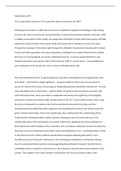
Q) The key factor in upholding and extending royal authority in the years 1485-1603 was the
development of the institutions of central government. How far do you agree with this claim?
In order to assess the significance of the institutions of central government in upholding and
extending royal authority, both the terms “royal authority” and “institutions of central government”
must be clearly defined. For the purpose of this essay, the upholding and extending of royal
authority may refer to the consolidating and enforcement of the monarch’s personal ideology and
policy – the antithesis of which may be considered the undermining and exploitation of a high-
ranking administrative role for the sake of personal gain. Institutions of central government may
then include the Privy Council, system of Lord Lieutenants, and the role of Secretary. Of these, the
significance and effectiveness of the Privy Council mean it may ultimately be considered the most
significant in both upholding and extending royal authority through its constant fluctuation in
structure and operation in concordance with the individual styles and needs of each monarch, as
well as in response to the changing needs of the country as a whole. Though alterative factors such
as the Lord Lieutenants, as well as the highly influential role of Secretary, contribute to the ability of
central government as a whole both in supporting and provoking changes to the Council, the
Council’s ultimately holds the dominant role in both upholding and extending royal authority
throughout the Tudor period.
It may be argued quite easily that the Privy Council was fundamentally designed to work as an
administrative and advisory body to represent and implement the wishes of royal authority. As it
matured, the council issued collective proclamations in the monarch’s name, appointed magistrates
in localities, enforced law and order and regulated economic affairs, as well as managed parliament
and national defence; though the Privy Council grew increasingly autonomous throughout the Tudor
period, it maintained and developed both its significance in the central government of England and
its ability to uphold and extend royal authority not only throughout the country, but within the
institutions of government themselves. It is important to note that the Privy Council arguably upheld
and enforced royal authority to a greater degree than it extended it – this is evidenced by its gradual
decrease in size over the period (dipping to 19 at the end of Henry VIII’s reign and reaching a low at
11 during 1597 under Elizabeth I – they remained so until the end of the dynasty). This potentially
, limited the extent of influence the Privy Council could exert over the entire country, even despite
the frequent political networking of various MPs, such was the awkward nature of the government’s
transition from the post-medieval to early modern period. Though the Privy Council had the capacity
to greatly excel in its upholding of royal authority, it was ultimately dependent on systems such as
Lord Lieutenant to extend it into the more remote north-western regions of the country.
Furthermore, as an institution of central government, the council’s ability to uphold royal authority
in its purest form was inevitably dependent on – and frequently limited by – the inherent fact that
its effectiveness was directly subject to the loyalty and actions of its members.
There is substantial evidence to argue that the development of the Privy Council exemplifies the
growing ability of institutions of central government to both uphold and – even if to only a certain
extent – extend royal authority throughout England. However, the nature and composition of the
council – its individual members and their agendas – present a key weakness that persists in
undermining its effectiveness throughout the period. Should the wrong people be elected into
council, it frequently risked becoming gradually more disconnected from the direct desires of the
monarch, therefore threatening to limit its ability to uphold the royal authority. Under Edward VI,
the Privy Council was significantly undermined by Edward Seymour, the Duke of Somerset, through
his accessing the king’s household and chamber, and providing his brother-in-law (Michael
Stanhope) with access to the dry stamp. Though he was overthrown and replaced by the Earl of
Warwick, it served to show that the council, similar to the role of Secretary, had moments of intense
power play and manipulation for personal gain under weaker monarchs. Ultimately however, the
structure of the council was purposefully flexible and receptive to change with the goal of securing
itself, avoiding exploitation and prioritising the upholding of royal authority – for example, it
reformed itself into a ‘chief minister’ to be addressed as a group to prevent one individual wielding
masses of power (though it maintained this to vastly varying degrees of success throughout the
dynasty). By Elizabeth’s reign, the Privy Council consisted of a core administrative body composed of
trusted advisors, under the direct control of the monarch, and so succeeded in becoming, through
its constant development and restructuring, increasingly capable in fulfilling its role as arguably the
most integral institution within central government aiming to uphold royal authority. Though its
ability to extend that authority throughout the country was limited, the nature of time and country
made than inevitable to an extent, and the council harnessed systems such as Lord Lieutenant and
Q) The key factor in upholding and extending royal authority in the years 1485-1603 was the
development of the institutions of central government. How far do you agree with this claim?
In order to assess the significance of the institutions of central government in upholding and
extending royal authority, both the terms “royal authority” and “institutions of central government”
must be clearly defined. For the purpose of this essay, the upholding and extending of royal
authority may refer to the consolidating and enforcement of the monarch’s personal ideology and
policy – the antithesis of which may be considered the undermining and exploitation of a high-
ranking administrative role for the sake of personal gain. Institutions of central government may
then include the Privy Council, system of Lord Lieutenants, and the role of Secretary. Of these, the
significance and effectiveness of the Privy Council mean it may ultimately be considered the most
significant in both upholding and extending royal authority through its constant fluctuation in
structure and operation in concordance with the individual styles and needs of each monarch, as
well as in response to the changing needs of the country as a whole. Though alterative factors such
as the Lord Lieutenants, as well as the highly influential role of Secretary, contribute to the ability of
central government as a whole both in supporting and provoking changes to the Council, the
Council’s ultimately holds the dominant role in both upholding and extending royal authority
throughout the Tudor period.
It may be argued quite easily that the Privy Council was fundamentally designed to work as an
administrative and advisory body to represent and implement the wishes of royal authority. As it
matured, the council issued collective proclamations in the monarch’s name, appointed magistrates
in localities, enforced law and order and regulated economic affairs, as well as managed parliament
and national defence; though the Privy Council grew increasingly autonomous throughout the Tudor
period, it maintained and developed both its significance in the central government of England and
its ability to uphold and extend royal authority not only throughout the country, but within the
institutions of government themselves. It is important to note that the Privy Council arguably upheld
and enforced royal authority to a greater degree than it extended it – this is evidenced by its gradual
decrease in size over the period (dipping to 19 at the end of Henry VIII’s reign and reaching a low at
11 during 1597 under Elizabeth I – they remained so until the end of the dynasty). This potentially
, limited the extent of influence the Privy Council could exert over the entire country, even despite
the frequent political networking of various MPs, such was the awkward nature of the government’s
transition from the post-medieval to early modern period. Though the Privy Council had the capacity
to greatly excel in its upholding of royal authority, it was ultimately dependent on systems such as
Lord Lieutenant to extend it into the more remote north-western regions of the country.
Furthermore, as an institution of central government, the council’s ability to uphold royal authority
in its purest form was inevitably dependent on – and frequently limited by – the inherent fact that
its effectiveness was directly subject to the loyalty and actions of its members.
There is substantial evidence to argue that the development of the Privy Council exemplifies the
growing ability of institutions of central government to both uphold and – even if to only a certain
extent – extend royal authority throughout England. However, the nature and composition of the
council – its individual members and their agendas – present a key weakness that persists in
undermining its effectiveness throughout the period. Should the wrong people be elected into
council, it frequently risked becoming gradually more disconnected from the direct desires of the
monarch, therefore threatening to limit its ability to uphold the royal authority. Under Edward VI,
the Privy Council was significantly undermined by Edward Seymour, the Duke of Somerset, through
his accessing the king’s household and chamber, and providing his brother-in-law (Michael
Stanhope) with access to the dry stamp. Though he was overthrown and replaced by the Earl of
Warwick, it served to show that the council, similar to the role of Secretary, had moments of intense
power play and manipulation for personal gain under weaker monarchs. Ultimately however, the
structure of the council was purposefully flexible and receptive to change with the goal of securing
itself, avoiding exploitation and prioritising the upholding of royal authority – for example, it
reformed itself into a ‘chief minister’ to be addressed as a group to prevent one individual wielding
masses of power (though it maintained this to vastly varying degrees of success throughout the
dynasty). By Elizabeth’s reign, the Privy Council consisted of a core administrative body composed of
trusted advisors, under the direct control of the monarch, and so succeeded in becoming, through
its constant development and restructuring, increasingly capable in fulfilling its role as arguably the
most integral institution within central government aiming to uphold royal authority. Though its
ability to extend that authority throughout the country was limited, the nature of time and country
made than inevitable to an extent, and the council harnessed systems such as Lord Lieutenant and