Biology 1.1 Chemical elements and biological compounds
Biochemistry - chemical processes within & relating to living organisms
Carbon
● Valency of 4 (4 bonds with other atoms)
● Forms strong covalent bonds
● Bonds with itself - forms straight chains, branched, ring molecules
● chains/rings of carbon atoms can form - carbohydrates, lipids, proteins, nucleic acid
Inorganic ions
Magnesium Mg Make chlorophyll & bones
Iron Fe Constituent of haemoglobin in red blood cells
Phosphate PO₄ Constituents of phospholipids in biological membranes. Used to make ATP
Calcium Ca Provides strength to plant cell walls. Important component of bones & teeth
Water
● Polar molecule (uneven distribution of charge)
● High specific heat capacity - heat needed to raise the temperature of 1kg of water
by 1C. Can absorb a lot of heat energy before temperature rises
● High latent heat of vaporisation - energy needed to evaporate water. Loss of
water by evaporation resulting in effective cooling eg. sweating/transpiration
● Ice is less dense than water - maximum density at 40C, so ice floats. Ice insulated
water below so aquatic life can continue to survive below the surface
● High surface tension - contact with air, hydrogen bonds face inwards to each water
molecule, small organisms can live on surface of water
● Universal solvent - dissolves more substances than other solvents. Chemical
reactions can only occur in dissolved state
Carbohydrates
● Carbon, hydrogen, oxygen
● (CH₂O) n = number of carbons
● 3 types of carbohydrates - monosaccharides (1 sugar molecule)
- disaccharides (2 sugar molecules)
- polysaccharides (3+ sugar molecules)
Monosaccharides
● Triose sugar - 3 carbon atoms (eg. glyceraldehyde)
● Pentose sugar - 5 carbon atoms (ribose, deoxyribose)
● Hexose sugar - 6 carbon atoms (glucose, galactose, fructose, maltose)
Glucose
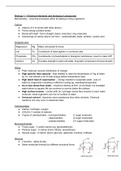
● 2 isomers - alpha & beta
● Same molecular formula but different structural forms
,Disaccharides
● Formed when 2 monosaccharides join together in
condensation reaction
● Glycosidic bond formed
● Monosaccharide + monosaccharide ⇌ disaccharide + water
Maltose Glucose + glucose ⇌ maltose + Germinating seeds
water
Sucrose Glucose + fructose ⇌ sucrose + Transports phloem of flowering
water plants
Lactose Glucose + galactose ⇌ lactose + Mammalian milk
water
Polysaccharides
● Formed from multiple monosaccharides/monomers
● Common polysaccharide: cellulose, starch, glycogen, chitin
Starch (plants)
● Storage polysaccharide
● Made from repeating α glucose
● Insoluble (doesn’t affect osmotic balance in cells)
● Amylose + amylopectin → starch
● Amylopectin - bonded between carbon 1&4 and 1&6
● Coiled into helix, forming cylinder (linear & non-branched)
● Compact structure
Glycogen (animals)
● Storage polysaccharide
● Larger & more branched chains of α glucose
● Found in muscle and liver tissue
● Readily hydrolysed back to glucose for respiration
Cellulose (plants)
● Structural polysaccharide
● Found in plant cell walls
● Made of β glucose monomers
● Adjacent glucose molecules flipped 180°
● Hydrogen bonds between adjacent chains gives structural stability
● Chains of glucose monomers form microfibrils
● Cellulase breaks cellulose down
Chitin (animals & fungi)
● Structural polysaccharide
● Found in fungal hyphae & exoskeleton of arthropods
● strong , waterproof, lightweight
● Contains acetyl amine group
, Proteins
● Structural proteins - muscle, tendons, hair
● Enzymes, hormones, antibodies, haemoglobin
● Carbon, hydrogen, oxygen, nitrogen (often sulphur)
Amino Acids
● Proteins made of long chains of amino acids
● 20 different amino acids
● All have same amino group (NH₂) & carboxyl group (COOH)
● R group is variant - simplest R group is CH₃
● Amphoteric - acts as base and acid
● Forms zwitter ions when dissolved in water
● Has no overall charge, but has separate +tive & -tive parts
● When dissolved in water - amino group picks up H+ ion
- carboxyl group loses H+ ion
● Acts as buffer (keeps pH consistent)
Peptide bonds
● Formed by condensation reactions between amino acids
● Amino group reacts with carboxyl group
● 2 amino acids - dipeptide
3 amino acids - tripeptide
4-50 amino acids - polypeptide
50+ amino acids - protein
Protein structure
● 1. Primary structure
○ Linear sequence of amino acids
○ Sequence of amino acids determined by bases on DNA
○ Peptide bonds
● 2. Secondary structure
○ Shape polypeptide chains form due to hydrogen bonds
○ Form alpha helix or beta pleated sheets
○ Peptide bonds, hydrogen bonds
● 3. Tertiary structure
○ Formed by bending & twisting polypeptide helix into compact 3D shape
○ When heated - hydrogen bonds break & structure is denatured
○ Peptide bonds, hydrogen bonds, disulphide bonds, ionic bonds, hydrophobic
interactions
● 4. Quaternary structure
○ Formed from 2+ tertiary structures
○ Associated with non-protein group (prosthetic group)
○ Forms large & complex molecules
○ Eg. Haemoglobin
Biochemistry - chemical processes within & relating to living organisms
Carbon
● Valency of 4 (4 bonds with other atoms)
● Forms strong covalent bonds
● Bonds with itself - forms straight chains, branched, ring molecules
● chains/rings of carbon atoms can form - carbohydrates, lipids, proteins, nucleic acid
Inorganic ions
Magnesium Mg Make chlorophyll & bones
Iron Fe Constituent of haemoglobin in red blood cells
Phosphate PO₄ Constituents of phospholipids in biological membranes. Used to make ATP
Calcium Ca Provides strength to plant cell walls. Important component of bones & teeth
Water
● Polar molecule (uneven distribution of charge)
● High specific heat capacity - heat needed to raise the temperature of 1kg of water
by 1C. Can absorb a lot of heat energy before temperature rises
● High latent heat of vaporisation - energy needed to evaporate water. Loss of
water by evaporation resulting in effective cooling eg. sweating/transpiration
● Ice is less dense than water - maximum density at 40C, so ice floats. Ice insulated
water below so aquatic life can continue to survive below the surface
● High surface tension - contact with air, hydrogen bonds face inwards to each water
molecule, small organisms can live on surface of water
● Universal solvent - dissolves more substances than other solvents. Chemical
reactions can only occur in dissolved state
Carbohydrates
● Carbon, hydrogen, oxygen
● (CH₂O) n = number of carbons
● 3 types of carbohydrates - monosaccharides (1 sugar molecule)
- disaccharides (2 sugar molecules)
- polysaccharides (3+ sugar molecules)
Monosaccharides
● Triose sugar - 3 carbon atoms (eg. glyceraldehyde)
● Pentose sugar - 5 carbon atoms (ribose, deoxyribose)
● Hexose sugar - 6 carbon atoms (glucose, galactose, fructose, maltose)
Glucose
● 2 isomers - alpha & beta
● Same molecular formula but different structural forms
,Disaccharides
● Formed when 2 monosaccharides join together in
condensation reaction
● Glycosidic bond formed
● Monosaccharide + monosaccharide ⇌ disaccharide + water
Maltose Glucose + glucose ⇌ maltose + Germinating seeds
water
Sucrose Glucose + fructose ⇌ sucrose + Transports phloem of flowering
water plants
Lactose Glucose + galactose ⇌ lactose + Mammalian milk
water
Polysaccharides
● Formed from multiple monosaccharides/monomers
● Common polysaccharide: cellulose, starch, glycogen, chitin
Starch (plants)
● Storage polysaccharide
● Made from repeating α glucose
● Insoluble (doesn’t affect osmotic balance in cells)
● Amylose + amylopectin → starch
● Amylopectin - bonded between carbon 1&4 and 1&6
● Coiled into helix, forming cylinder (linear & non-branched)
● Compact structure
Glycogen (animals)
● Storage polysaccharide
● Larger & more branched chains of α glucose
● Found in muscle and liver tissue
● Readily hydrolysed back to glucose for respiration
Cellulose (plants)
● Structural polysaccharide
● Found in plant cell walls
● Made of β glucose monomers
● Adjacent glucose molecules flipped 180°
● Hydrogen bonds between adjacent chains gives structural stability
● Chains of glucose monomers form microfibrils
● Cellulase breaks cellulose down
Chitin (animals & fungi)
● Structural polysaccharide
● Found in fungal hyphae & exoskeleton of arthropods
● strong , waterproof, lightweight
● Contains acetyl amine group
, Proteins
● Structural proteins - muscle, tendons, hair
● Enzymes, hormones, antibodies, haemoglobin
● Carbon, hydrogen, oxygen, nitrogen (often sulphur)
Amino Acids
● Proteins made of long chains of amino acids
● 20 different amino acids
● All have same amino group (NH₂) & carboxyl group (COOH)
● R group is variant - simplest R group is CH₃
● Amphoteric - acts as base and acid
● Forms zwitter ions when dissolved in water
● Has no overall charge, but has separate +tive & -tive parts
● When dissolved in water - amino group picks up H+ ion
- carboxyl group loses H+ ion
● Acts as buffer (keeps pH consistent)
Peptide bonds
● Formed by condensation reactions between amino acids
● Amino group reacts with carboxyl group
● 2 amino acids - dipeptide
3 amino acids - tripeptide
4-50 amino acids - polypeptide
50+ amino acids - protein
Protein structure
● 1. Primary structure
○ Linear sequence of amino acids
○ Sequence of amino acids determined by bases on DNA
○ Peptide bonds
● 2. Secondary structure
○ Shape polypeptide chains form due to hydrogen bonds
○ Form alpha helix or beta pleated sheets
○ Peptide bonds, hydrogen bonds
● 3. Tertiary structure
○ Formed by bending & twisting polypeptide helix into compact 3D shape
○ When heated - hydrogen bonds break & structure is denatured
○ Peptide bonds, hydrogen bonds, disulphide bonds, ionic bonds, hydrophobic
interactions
● 4. Quaternary structure
○ Formed from 2+ tertiary structures
○ Associated with non-protein group (prosthetic group)
○ Forms large & complex molecules
○ Eg. Haemoglobin