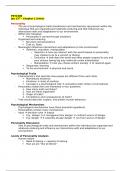
NR603 Week 1 Quiz Study Guide
Migraine: Assessment
It is important that the patient characterize the headache by describing the duration, quality, and location of the
pain.
A medication profile is essential and should include medications that have been tried in the past for headache
control. If OTC medications are taken, the number used per month should be identified
A targeted physical examination is important in ruling out harmful secondary headache pathologies and confirms
any information given in the history.
The examination findings in primary headache disorders are usually within normal limits.
Key aspects of the physical examination include a cardiopulmonary and complete neurologic assessment
with a major focus on the following:
· • Funduscopic and pupillary assessment
· • Auscultation of the carotid and vertebral arteries
· • Mental status examination
· • Palpation of the head, neck, and temporal arteries
· • Evaluation for any neck stiffness, focal weakness, sensory loss and gait
· • Vital signs
Problem findings include:
· Onset of headache after the age of 50 years
· Asymmetry of pupillary responses
· Decreased deep tendon reflexes
· Headache described as “the worst ever experienced”
· Personality change
· Onset of a new or different headache
· Onset of a headache that progressively worsens
· Papilledema
· Painful temporal arteries
Diagnosis
· If the diagnosis is not clear or the history or physical findings are cause for concern, diagnostic studies
should be used to distinguish primary headache from a secondary condition.
· Blood tests are usually not indicated, may include a complete blood count (CBC) to exclude anemia or an
infectious process, (ESR) or (CRP) to help exclude temporal arteritis, and thyroid function tests to identify
thyroid dysfunction.
· Lyme titer or rheumatoid factors may also be indicated in some situations.
Practice guidelines
· Advocate three principles for diagnostic testing:
(1) testing should be avoided if it will not change the management of the patient,
(2) testing is not indicated if the patient is not significantly more likely than the general public to
have an abnormality
(3) testing may make sense in a patient who is excessively concerned that he or she has a serious
problem that is causing the headaches.
· Neuroimaging should be considered when any serious signs or symptoms are present but it is not indicated
if the patient has had these headaches for years, if there are no focal neurologic signs, and if the headache
improves without the use of analgesics.
Treatment
· Nonpharmacological measures
behavior modification, biofeedback, acupressure, management of headache triggers, and a wellness
program.
· Preventive therapy is appropriate for patients if they are unable to deal with their attacks, they experience
more than four headaches a month, or the attacks are prolonged and refractory to medicine.
Preventive therapy is given daily and will decrease headache intensity and frequency
A connection has been shown between epilepsy and migraine; therefore anticonvulsants, such as
divalproex sodium (Depakote), gabapentin (Neurontin), and topiramate (Topamax), can be used
A patient with cold hands, Raynaud phenomenon, or hypertension may do well with calcium
channel blockers, such as diltiazem (Cardizem) and amlodipine (Norvasc), which cause vasodilation
and decrease blood pressure.
This study source was downloaded by 100000847426977 from CourseHero.com on 05-20-2022 05:19:50 GMT -05:00
https://www.coursehero.com/file/47375460/NR-603-Week-1-Study-Guidedocx/
, A beta blocker, such as propranolol (Inderal) or atenolol, may be chosen for the patient with
palpitations caused by mitral valve prolapse or panic disorders and should be avoided in those with
asthma.
If sleep is a problem or if chronic pain persists in the shoulders, a tricyclic antidepressant, such as
amitriptyline (Elavil).
The mechanism of action for both beta blockers and calcium channel blockers is not fully
understood.
Calcium channel blockers prevent calcium from entering the cells and therefore decrease
their excitability. This may in turn prevent vascular spasm and headache.
Beta blockers affect the beta1-adrenergic receptors and inhibit the usual adrenergic
responses.
it has been theorized that either may have an effect on the serotonergic system within the
brain and the vascular system.
· Abortive therapy is used to treat the intensity and duration of pain during an attack and to manage
associated symptoms, such as nausea and vomiting
A patient with a severe migraine or cluster attack that peaks to full intensity within 15 minutes will
most likely benefit from parenteral or nasal therapy rather than oral medication
Simple analgesics, such as acetaminophen and aspirin, can represent first-line treatment in the
management of mild to moderate headaches.
Caffeine combinations (Excedrin, Anacin) can potentiate their absorption and analgesia.
When simple analgesics are ineffective, combining them with a short-acting barbiturate,
such as butalbital (Fioricet, Fiorinal, Esgic), may be effective.
(NSAIDs) are helpful in treating an acute attack.
Naproxen sodium (Anaprox DS, Aleve) has a longer half-life and a better safety profile than
some of the other NSAIDs. The addition of metoclopramide will facilitate their absorption
and potentiate their effect.
Ergot derivatives are effective in the treatment of moderate to severe attacks that might not have
responded to simple or combination analgesics. Two forms are currently in use: ergotamine tartrate
(Cafergot) and dihydroergotamine.
Triptans, developed approximately 20 years ago, have given many migraine and cluster headache
patients’ relief within a short time.
Dementia: Assessment
The physical examination should focus on neurologic signs; blood pressure; carotid bruits; and the assessment of
cognition, mood, function, and behavior.
Many screening tools are available.
· The Katz Index of Independence in Activities of Daily Living or the “get up and go” test can be used to
evaluate function.
· The Folstein Mini-Mental State Examination (MMSE), the Montreal Cognitive Assessment (MoCA), and the
Mini-Cog are useful tools for evaluation of cognition.
· Other tools include the General Practitioner Assessment of Cognition (GPCOG) and the Memory Impairment
Screen (MIS).
One of the benefits of these tools is the ability to compare scores year to year to provide families with an objective
description of disease progression. It is also important to assess and to monitor for changes in behavior, specifically
anxiety, restlessness, aggression, delusions, visual or auditory hallucinations, and wandering.
Diagnosis
· Diagnostic evaluation should determine whether the patient has a reversible condition that may be
contributing to or causing cognitive decline.
The most important tests include (CBC), (TSH) concentration, vitamin B12 and folate levels, and a
metabolic screen.
Medications that have measurable levels, such as digoxin, carbamazepine (Tegretol), theophylline,
and divalproex sodium (Depakote), should be measured.
· Imaging studies are useful in identifying mass lesions, vascular lesions, or infections but do not confirm a
diagnosis of dementia.
· All guidelines recommend a baseline brain imaging study; a non–contrast-enhanced computed tomography
(CT)
However, many providers prefer magnetic resonance imaging (MRI) because of its better resolution
for patients with primary attentional or frontal temporal syndromes or if subcortical pathology or
stroke is suspected.
This study source was downloaded by 100000847426977 from CourseHero.com on 05-20-2022 05:19:50 GMT -05:00
https://www.coursehero.com/file/47375460/NR-603-Week-1-Study-Guidedocx/
Migraine: Assessment
It is important that the patient characterize the headache by describing the duration, quality, and location of the
pain.
A medication profile is essential and should include medications that have been tried in the past for headache
control. If OTC medications are taken, the number used per month should be identified
A targeted physical examination is important in ruling out harmful secondary headache pathologies and confirms
any information given in the history.
The examination findings in primary headache disorders are usually within normal limits.
Key aspects of the physical examination include a cardiopulmonary and complete neurologic assessment
with a major focus on the following:
· • Funduscopic and pupillary assessment
· • Auscultation of the carotid and vertebral arteries
· • Mental status examination
· • Palpation of the head, neck, and temporal arteries
· • Evaluation for any neck stiffness, focal weakness, sensory loss and gait
· • Vital signs
Problem findings include:
· Onset of headache after the age of 50 years
· Asymmetry of pupillary responses
· Decreased deep tendon reflexes
· Headache described as “the worst ever experienced”
· Personality change
· Onset of a new or different headache
· Onset of a headache that progressively worsens
· Papilledema
· Painful temporal arteries
Diagnosis
· If the diagnosis is not clear or the history or physical findings are cause for concern, diagnostic studies
should be used to distinguish primary headache from a secondary condition.
· Blood tests are usually not indicated, may include a complete blood count (CBC) to exclude anemia or an
infectious process, (ESR) or (CRP) to help exclude temporal arteritis, and thyroid function tests to identify
thyroid dysfunction.
· Lyme titer or rheumatoid factors may also be indicated in some situations.
Practice guidelines
· Advocate three principles for diagnostic testing:
(1) testing should be avoided if it will not change the management of the patient,
(2) testing is not indicated if the patient is not significantly more likely than the general public to
have an abnormality
(3) testing may make sense in a patient who is excessively concerned that he or she has a serious
problem that is causing the headaches.
· Neuroimaging should be considered when any serious signs or symptoms are present but it is not indicated
if the patient has had these headaches for years, if there are no focal neurologic signs, and if the headache
improves without the use of analgesics.
Treatment
· Nonpharmacological measures
behavior modification, biofeedback, acupressure, management of headache triggers, and a wellness
program.
· Preventive therapy is appropriate for patients if they are unable to deal with their attacks, they experience
more than four headaches a month, or the attacks are prolonged and refractory to medicine.
Preventive therapy is given daily and will decrease headache intensity and frequency
A connection has been shown between epilepsy and migraine; therefore anticonvulsants, such as
divalproex sodium (Depakote), gabapentin (Neurontin), and topiramate (Topamax), can be used
A patient with cold hands, Raynaud phenomenon, or hypertension may do well with calcium
channel blockers, such as diltiazem (Cardizem) and amlodipine (Norvasc), which cause vasodilation
and decrease blood pressure.
This study source was downloaded by 100000847426977 from CourseHero.com on 05-20-2022 05:19:50 GMT -05:00
https://www.coursehero.com/file/47375460/NR-603-Week-1-Study-Guidedocx/
, A beta blocker, such as propranolol (Inderal) or atenolol, may be chosen for the patient with
palpitations caused by mitral valve prolapse or panic disorders and should be avoided in those with
asthma.
If sleep is a problem or if chronic pain persists in the shoulders, a tricyclic antidepressant, such as
amitriptyline (Elavil).
The mechanism of action for both beta blockers and calcium channel blockers is not fully
understood.
Calcium channel blockers prevent calcium from entering the cells and therefore decrease
their excitability. This may in turn prevent vascular spasm and headache.
Beta blockers affect the beta1-adrenergic receptors and inhibit the usual adrenergic
responses.
it has been theorized that either may have an effect on the serotonergic system within the
brain and the vascular system.
· Abortive therapy is used to treat the intensity and duration of pain during an attack and to manage
associated symptoms, such as nausea and vomiting
A patient with a severe migraine or cluster attack that peaks to full intensity within 15 minutes will
most likely benefit from parenteral or nasal therapy rather than oral medication
Simple analgesics, such as acetaminophen and aspirin, can represent first-line treatment in the
management of mild to moderate headaches.
Caffeine combinations (Excedrin, Anacin) can potentiate their absorption and analgesia.
When simple analgesics are ineffective, combining them with a short-acting barbiturate,
such as butalbital (Fioricet, Fiorinal, Esgic), may be effective.
(NSAIDs) are helpful in treating an acute attack.
Naproxen sodium (Anaprox DS, Aleve) has a longer half-life and a better safety profile than
some of the other NSAIDs. The addition of metoclopramide will facilitate their absorption
and potentiate their effect.
Ergot derivatives are effective in the treatment of moderate to severe attacks that might not have
responded to simple or combination analgesics. Two forms are currently in use: ergotamine tartrate
(Cafergot) and dihydroergotamine.
Triptans, developed approximately 20 years ago, have given many migraine and cluster headache
patients’ relief within a short time.
Dementia: Assessment
The physical examination should focus on neurologic signs; blood pressure; carotid bruits; and the assessment of
cognition, mood, function, and behavior.
Many screening tools are available.
· The Katz Index of Independence in Activities of Daily Living or the “get up and go” test can be used to
evaluate function.
· The Folstein Mini-Mental State Examination (MMSE), the Montreal Cognitive Assessment (MoCA), and the
Mini-Cog are useful tools for evaluation of cognition.
· Other tools include the General Practitioner Assessment of Cognition (GPCOG) and the Memory Impairment
Screen (MIS).
One of the benefits of these tools is the ability to compare scores year to year to provide families with an objective
description of disease progression. It is also important to assess and to monitor for changes in behavior, specifically
anxiety, restlessness, aggression, delusions, visual or auditory hallucinations, and wandering.
Diagnosis
· Diagnostic evaluation should determine whether the patient has a reversible condition that may be
contributing to or causing cognitive decline.
The most important tests include (CBC), (TSH) concentration, vitamin B12 and folate levels, and a
metabolic screen.
Medications that have measurable levels, such as digoxin, carbamazepine (Tegretol), theophylline,
and divalproex sodium (Depakote), should be measured.
· Imaging studies are useful in identifying mass lesions, vascular lesions, or infections but do not confirm a
diagnosis of dementia.
· All guidelines recommend a baseline brain imaging study; a non–contrast-enhanced computed tomography
(CT)
However, many providers prefer magnetic resonance imaging (MRI) because of its better resolution
for patients with primary attentional or frontal temporal syndromes or if subcortical pathology or
stroke is suspected.
This study source was downloaded by 100000847426977 from CourseHero.com on 05-20-2022 05:19:50 GMT -05:00
https://www.coursehero.com/file/47375460/NR-603-Week-1-Study-Guidedocx/