Week 1 Evolution and meaning of marketing
Some marketing (management) definitions (it is ok to be critical about these)
1. Marketing is the activity, set of institutions, and processes for creating, communicating, delivering, and exchanging
offerings that have value for costumers, clients, partners, and society at large. (American marketing association)
Most accepted, product focussed.
2. Marketing is het art and science of choosing target markets and getting, keeping, and growing customers through
creating, delivering and communicating superior customer value. (Kotler et al, 2012) Sets the costumer in the middle
of the area Perceived as the best one by the teacher!
3. Marketing is the process of meeting customer needs profitability. (Gummeson & Mele, 2010) includes basic principles
in business (profitability) liked by the teacher!
4. Marketing is an exploitation of customer’s willingness to pay (Unknown) not entirely serious..
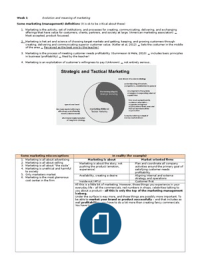
,Some marketing misconceptions In reality (for example)
1. Marketing is all about advertising Marketing is about Market oriented firms
2. Marketing is all about selling Marketing is about the story, not Plan and coordinate all company
3. Marketing is all about “the sizzle” pushing the product (emotion, activities around the primary goal of
4. Marketing is unethical and harmful experience) satisfying customer needs
to society profitability.
5. Only marketers market Availability, creating a desire Aligning internal and externa
6. Marketing is the most glamorous strategy and operations
cost center in the firm Inside-out (4P’s) Customer first
All this is a little bit of marketing. However, those things you experience in your
everyday life – all the commercials, red numbers in shops, celebrities talking to
you about a product – all this is only the top of the marketing management
iceberg.
Under the surface is way more, and those things are possibly more important. To
be able to market your brand or product successfully – and that includes as
well profitability – you have to do a lot more than creating fancy commercials.
You have to...
,Author (week 1) Main massage(s)
Achrol, R.S. & Kotler, P. 1970’s – 1990’s >2000
(2011) 1. Product uniqueness 1. Experience
Frontiers of the marketing 2. Cognitive psychology (does not work 2. Behavioral psychology
paradigm in the third anymore, only for products like “Dreft”. Neuroscience
millennium Utility (het nut) Emotions
3. Vertical integration of the supply chain. 3. Ecosystem/Arena of suppliers
Marketing evolution 4. Social issue as an business opportunity
Three-tiered framework Marketing theories evolved from a firm oriented view to encompass the exchanging dyad.
More recently the paradigm expanded to a network level of explanation, and relational
theories have come to the fore.
,1. Functional (sales/production) and institutional (experience) perspective: (physical)
distribution and onwards.
2. Exchange perspective (1970’s): dyadic relations
3. Network perspective
In the paper they developed a three-tiered explanation of the emerging field of marketing;
1. Its subphenomena (focusses on the consumer experiences as the fundamental
domain of relevant theory and the human sensory systems as the fundamental bases
of explanation). Shift the theoretical tools of consumer behavior analysis from cognitive
concepts (attitudes, information storage ), to the mechanisms of sensory (reality,
experience).
The fundamental process in marketing is consumption, and the elemental
concepts in consumption are satisfaction, value and utility.
What does it say that we experience something, and that this experience was
satisfying or not? primary subject of consumer behavior theory and research.
An important shift in the behavioral sciences from cognitive psychology to
neurological psychology. change in the micro science of marketing.
To cope marketing will need to develop a vastly expanded base of theoretical
and methodological tools.
2. Its phenomena (marketing networks)
Powerful changes in the way a business organization is structured and functions.
The post-industrial, vertically integrated, multidivisional firm is evolving into
complex global business networks from the production end to the consumption
end. (No more vertical integration, marketing is being distributed between
consumption networks, marketing networks, innovation networks and production
networks).
Shift in control and coordination mechanisms from power-based systems to norm-
based relational systems
3. Its superphenomena (sustainability and development)
Marketing is responsible for the function and malfunction of consumption.
For managers:
o Need to understand the nature and theory of network organizations.
o There is a new consumption philosophy of customer care (acting on behalf
, of the customer and his/her long-term interests).
o Growth in not a panacea (wondermiddel) in the new marketing.
o The new marketing will demand a new cost accounting featuring nature
costing.
o Firms will need to be proactively engaged with industry groups and
regulations.
One can expect a new kind of regulatory environment that struggles to preserve market
bahavior and incentives amidst more closely monitored social preference and obligations. One
can expect a regulatory regime more closely engaged with industry groups to develop self-
regulation norms and mechanisms, but also demand a clear responsibility for ameliorating
damage to consumers and the environment.
Swaan, de A., Driest, vd F. In the past decade, what marketers do to engage customers has changed almost beyond
& Weed, K. (2014) recognition. Tools and strategies that were cutting-edge a few years ago are fast becoming
The ultimate marketing obsolete, and new approaches are appearing every day. Yet in most companies the
machine organizational structure of the marketing function hasn.t changes since the practice of brand
management emerged, more than 40 years ago. Marketers understand that their organization
Marketing evolution need an overhaul.
The orchestrator model
A simple blueprint of the ideal structure does not exist: marketing leaders must ask; “what
values an goals guide our brand strategy, what capabilities drive marketing challenge, and
what structures and ways of working will support them? (structure must follow strategy, not
the other way around).
It is clear that marketing is nog linger a discrete entity but now extends throughout the firm,
tapping virtually every function.
Winning characteristics: describes the broad traits of high-performing organizations, as
well as specific drives of organizational effectiveness.
Big data, deep insight/know everything (excellence in market analysis is the key –
and integrates data about what customers do with knowledge and why they’re doing it.
o You want this information!
o Answers the question: are you correct in delivering the experience?
Purposeful positioning (effective delivery of functional, emotional (satisfied needs)
, and societal(sustainability) benefits at the same time, fine-tuned for the target
customer.
o Is just a criteria you have to meet.
Total experience (not products are important – the customer’s total experience with
the firm and its products and services is. Personalize offerings, adding touchpoints,
both improve breadth and depth of experience).
To deliver a seamless experience, one informed by data and imbued with brand purpose, all
employees of the company must share a common vision. results in organizational growth.
The five drives of organizational effectiveness: (internal aspects)
1. Connecting: linking marketing with all functions of the organization.
2. Inspiring: making every member of the organization a marketing team member.
Strengthens commitment and when rooted in a respected brand purpose, all employees
will be motivated by the same mission.
3. Focussing: aligning local and global marketing objectives.
4. Organizing for agility: creating nimble marketing organizations by orchestrating
networks. Organizational structure, roles, and processes are among the toughest
leadership challenges – and that the need for clarity about them is constantly
underestimated or ignored.
5. Building capabilities: ensuring continuous training to meet tomorrows’ challenges.
New marketing roles: the orchestrator model build cross-functional teams to create task
forces for a range of marketing programs/challenges.
Think focussed on data and analytics
Feel focussed on consumer engagement
Do focussed on content and production
Challagalla, G., Murtha, Decision-making approach in current literature:
B.R. & Jaworski, B. (2014) Mechanistic approach: standard operating procedures, well-structured tasks, limited
Marketing doctrine: a flexibility, limited applicability to strategic marketing tasks.
principles-based approach to Organic approach: inculcate employees with shared values and norms as guidance,
guiding marketing decision more flexibility, limited guidance
making in firms This article Marketing doctrine, principles-based approach, simple rules,
Marketing doctrine heuristics.
Some marketing (management) definitions (it is ok to be critical about these)
1. Marketing is the activity, set of institutions, and processes for creating, communicating, delivering, and exchanging
offerings that have value for costumers, clients, partners, and society at large. (American marketing association)
Most accepted, product focussed.
2. Marketing is het art and science of choosing target markets and getting, keeping, and growing customers through
creating, delivering and communicating superior customer value. (Kotler et al, 2012) Sets the costumer in the middle
of the area Perceived as the best one by the teacher!
3. Marketing is the process of meeting customer needs profitability. (Gummeson & Mele, 2010) includes basic principles
in business (profitability) liked by the teacher!
4. Marketing is an exploitation of customer’s willingness to pay (Unknown) not entirely serious..
,Some marketing misconceptions In reality (for example)
1. Marketing is all about advertising Marketing is about Market oriented firms
2. Marketing is all about selling Marketing is about the story, not Plan and coordinate all company
3. Marketing is all about “the sizzle” pushing the product (emotion, activities around the primary goal of
4. Marketing is unethical and harmful experience) satisfying customer needs
to society profitability.
5. Only marketers market Availability, creating a desire Aligning internal and externa
6. Marketing is the most glamorous strategy and operations
cost center in the firm Inside-out (4P’s) Customer first
All this is a little bit of marketing. However, those things you experience in your
everyday life – all the commercials, red numbers in shops, celebrities talking to
you about a product – all this is only the top of the marketing management
iceberg.
Under the surface is way more, and those things are possibly more important. To
be able to market your brand or product successfully – and that includes as
well profitability – you have to do a lot more than creating fancy commercials.
You have to...
,Author (week 1) Main massage(s)
Achrol, R.S. & Kotler, P. 1970’s – 1990’s >2000
(2011) 1. Product uniqueness 1. Experience
Frontiers of the marketing 2. Cognitive psychology (does not work 2. Behavioral psychology
paradigm in the third anymore, only for products like “Dreft”. Neuroscience
millennium Utility (het nut) Emotions
3. Vertical integration of the supply chain. 3. Ecosystem/Arena of suppliers
Marketing evolution 4. Social issue as an business opportunity
Three-tiered framework Marketing theories evolved from a firm oriented view to encompass the exchanging dyad.
More recently the paradigm expanded to a network level of explanation, and relational
theories have come to the fore.
,1. Functional (sales/production) and institutional (experience) perspective: (physical)
distribution and onwards.
2. Exchange perspective (1970’s): dyadic relations
3. Network perspective
In the paper they developed a three-tiered explanation of the emerging field of marketing;
1. Its subphenomena (focusses on the consumer experiences as the fundamental
domain of relevant theory and the human sensory systems as the fundamental bases
of explanation). Shift the theoretical tools of consumer behavior analysis from cognitive
concepts (attitudes, information storage ), to the mechanisms of sensory (reality,
experience).
The fundamental process in marketing is consumption, and the elemental
concepts in consumption are satisfaction, value and utility.
What does it say that we experience something, and that this experience was
satisfying or not? primary subject of consumer behavior theory and research.
An important shift in the behavioral sciences from cognitive psychology to
neurological psychology. change in the micro science of marketing.
To cope marketing will need to develop a vastly expanded base of theoretical
and methodological tools.
2. Its phenomena (marketing networks)
Powerful changes in the way a business organization is structured and functions.
The post-industrial, vertically integrated, multidivisional firm is evolving into
complex global business networks from the production end to the consumption
end. (No more vertical integration, marketing is being distributed between
consumption networks, marketing networks, innovation networks and production
networks).
Shift in control and coordination mechanisms from power-based systems to norm-
based relational systems
3. Its superphenomena (sustainability and development)
Marketing is responsible for the function and malfunction of consumption.
For managers:
o Need to understand the nature and theory of network organizations.
o There is a new consumption philosophy of customer care (acting on behalf
, of the customer and his/her long-term interests).
o Growth in not a panacea (wondermiddel) in the new marketing.
o The new marketing will demand a new cost accounting featuring nature
costing.
o Firms will need to be proactively engaged with industry groups and
regulations.
One can expect a new kind of regulatory environment that struggles to preserve market
bahavior and incentives amidst more closely monitored social preference and obligations. One
can expect a regulatory regime more closely engaged with industry groups to develop self-
regulation norms and mechanisms, but also demand a clear responsibility for ameliorating
damage to consumers and the environment.
Swaan, de A., Driest, vd F. In the past decade, what marketers do to engage customers has changed almost beyond
& Weed, K. (2014) recognition. Tools and strategies that were cutting-edge a few years ago are fast becoming
The ultimate marketing obsolete, and new approaches are appearing every day. Yet in most companies the
machine organizational structure of the marketing function hasn.t changes since the practice of brand
management emerged, more than 40 years ago. Marketers understand that their organization
Marketing evolution need an overhaul.
The orchestrator model
A simple blueprint of the ideal structure does not exist: marketing leaders must ask; “what
values an goals guide our brand strategy, what capabilities drive marketing challenge, and
what structures and ways of working will support them? (structure must follow strategy, not
the other way around).
It is clear that marketing is nog linger a discrete entity but now extends throughout the firm,
tapping virtually every function.
Winning characteristics: describes the broad traits of high-performing organizations, as
well as specific drives of organizational effectiveness.
Big data, deep insight/know everything (excellence in market analysis is the key –
and integrates data about what customers do with knowledge and why they’re doing it.
o You want this information!
o Answers the question: are you correct in delivering the experience?
Purposeful positioning (effective delivery of functional, emotional (satisfied needs)
, and societal(sustainability) benefits at the same time, fine-tuned for the target
customer.
o Is just a criteria you have to meet.
Total experience (not products are important – the customer’s total experience with
the firm and its products and services is. Personalize offerings, adding touchpoints,
both improve breadth and depth of experience).
To deliver a seamless experience, one informed by data and imbued with brand purpose, all
employees of the company must share a common vision. results in organizational growth.
The five drives of organizational effectiveness: (internal aspects)
1. Connecting: linking marketing with all functions of the organization.
2. Inspiring: making every member of the organization a marketing team member.
Strengthens commitment and when rooted in a respected brand purpose, all employees
will be motivated by the same mission.
3. Focussing: aligning local and global marketing objectives.
4. Organizing for agility: creating nimble marketing organizations by orchestrating
networks. Organizational structure, roles, and processes are among the toughest
leadership challenges – and that the need for clarity about them is constantly
underestimated or ignored.
5. Building capabilities: ensuring continuous training to meet tomorrows’ challenges.
New marketing roles: the orchestrator model build cross-functional teams to create task
forces for a range of marketing programs/challenges.
Think focussed on data and analytics
Feel focussed on consumer engagement
Do focussed on content and production
Challagalla, G., Murtha, Decision-making approach in current literature:
B.R. & Jaworski, B. (2014) Mechanistic approach: standard operating procedures, well-structured tasks, limited
Marketing doctrine: a flexibility, limited applicability to strategic marketing tasks.
principles-based approach to Organic approach: inculcate employees with shared values and norms as guidance,
guiding marketing decision more flexibility, limited guidance
making in firms This article Marketing doctrine, principles-based approach, simple rules,
Marketing doctrine heuristics.