

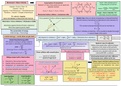
Momentum = Mass x Velocity Conservation of momentum 𝑢1 𝑢2 Power = Rate of doing work or
Newton’s 3rd law: Every action has an equal and energy input per unit of time.
Impulse = Force x Time = Ft opposite reaction. 𝑚1 𝑚2 𝑒𝑛𝑒𝑟𝑔𝑦 𝐹𝑜𝑟𝑐𝑒 𝑥 𝑑𝑖𝑠𝑡𝑎𝑛𝑐𝑒
Impulse = m(v-u) Power =
𝑡𝑖𝑚𝑒
= 𝑡𝑖𝑚𝑒
Impulse = Final Momentum – Initial Momentum 𝑚1 𝑢1 + 𝑚2 𝑢2 = 𝑚1 𝑣1 + 𝑚2 𝑣2
Therefore… Impulse = Change in Momentum 𝑣1 𝑣2 Power = Force x Velocity = FV
Momentum before collision = momentum after Directions must be constant.
Ft = m(v-u) = Impulse
MUST DETERMINE A DIRECTION FOR POSITIVE Force upwards: Friction x distance (against friction) Hooke’s law: when an elastic string/spring is released/stretched
then the tension (T) produced is proportional to the extension (x)
Work done = Force x Distance = FD (Joules or N/M) 𝑇 ∝𝑥
T = kx
Work done against friction (Friction x Distance) The constant of proportionality (K) can be rewritten to:
Work done against gravity (mgh) 𝝀
𝑻= 𝒙
ϴ mg 𝒍
The conservation of energy Where λ = Modulus of elasticity = force needed to double the length
Initial energy = Final energy l = natural length of the sprint
∆ 𝒕𝒐𝒕𝒂𝒍 𝒆𝒏𝒆𝒓𝒈𝒚 = 𝒘𝒐𝒓𝒌 𝒅𝒐𝒏𝒆 𝒐𝒏 𝒑𝒂𝒓𝒕𝒊𝒄𝒍𝒆 𝟏 𝟏 𝒗𝟐 − 𝒗𝟏
(𝑫𝒓𝒊𝒗𝒊𝒏𝒈 𝒇𝒐𝒓𝒄𝒆 𝒙 𝒅𝒊𝒔𝒕𝒂𝒏𝒄𝒆) + 𝒎𝒖𝟐 + 𝒎𝒈𝒉𝟏 = 𝒎𝒗𝟐 + 𝒎𝒈𝒉𝟐 + (𝑹𝒆𝒔𝒊𝒔𝒕𝒂𝒏𝒕 𝒇𝒐𝒓𝒄𝒆 𝒙 𝒅𝒊𝒔𝒕𝒂𝒏𝒄𝒆) 𝒆=
𝟐 𝟐 0≤𝑒 ≤1
Weight component is not part of the resistant force as it is already included through work done against gravity.
𝒖𝟏 − 𝒖𝟐
Elastic Potential Energy (EPE)
EPE stored in a string or spring is equal to
𝟏 𝝀𝒙𝟐 𝟏 𝝀𝒙𝟐 Newton’s law of restitution
work done in stretching or compressing it. (𝑭𝑫) + 𝒎𝒖𝟐 + 𝒎𝒈𝒉𝟏 + = 𝒎𝒗𝟐 + 𝒎𝒈𝒉𝟐 + + (𝑹𝒆𝒔𝒊𝒔𝒕𝒂𝒏𝒕 𝑭𝒙𝑫)
𝟐 𝟐𝒍 𝟐 𝟐𝒍 Defines how speeds after collisions/impact
𝝀𝒙𝟐 When strings and springs are being stretched, mainly to find velocities and
𝑬𝑷𝑬 = distances we use COE depends on the nature of the particles.
𝟐𝒍
(𝐴𝑣𝑒𝑟𝑎𝑔𝑒 𝐹𝑜𝑟𝑐𝑒 𝑥 𝐷𝑖𝑠𝑡𝑎𝑛𝑐𝑒) = 𝐸𝑃𝐸 Coefficient of restitution (e) determines the
𝜆𝑥 2 𝑇ℎ𝑒 𝑎𝑛𝑔𝑙𝑒 𝑜𝑓 𝑑𝑒𝑓𝑙𝑒𝑐𝑡𝑖𝑜𝑛 = 𝛼 + 𝛽 outcome out a situation with only the
𝑅𝑒𝑠𝑢𝑙𝑡𝑎𝑛𝑡 𝐹 𝑥 𝐷 = Direct collision with smooth plane velocity BEFORE a collision.
2𝑙 𝑢𝑐𝑜𝑠(𝛼 ) = 𝑣𝑐𝑜𝑠(𝛽)
𝑠𝑝𝑒𝑒𝑑 𝑜𝑓 𝑟𝑒𝑏𝑜𝑢𝑛𝑑 𝑒𝑢𝑠𝑖𝑛(𝛼 ) = 𝑣𝑠𝑖𝑛(𝛽) Velocity going towards each other: difference
Oblique impact with a fixed surface 𝑒=
𝑠𝑝𝑒𝑒𝑑 𝑜𝑓 𝑎𝑝𝑝𝑟𝑜𝑎𝑐ℎ 𝑒𝑡𝑎𝑛(𝛼 ) = 𝑡𝑎𝑛(𝛽) Velocity going away: addition of the two
• Only force is the normal reaction Oblique impact with fixed surfaces (vectors)
Parallel components unchanged
• Impulse will be normal to the surface The principles remain the same, however, the
Vertical components impacted by e 𝑣1
• Component of momentum and velocity
components are transferred into vector
parallel to the surface is unchanged. 𝑢1 𝑣1 α format.
𝑣𝑠𝑖𝑛(𝛽) α
• Horizontal velocities don’t change 𝑢𝑠𝑖𝑛(𝛼)
𝑢1 The vertical components are impacted by e. The
• Vertical velocities change and impacted by α β When you move the vertical is parallel to the impulse which is 90⸰.
restitution. 𝑢𝑐𝑜𝑠(𝛼) 𝑢1 to make both direction vectors go 𝒖. 𝑰̂ = |𝒖||𝑰̂| 𝐜𝐨𝐬(𝟗𝟎+∝) = −𝒖𝒔𝒊𝒏(∝)
𝑣𝑐𝑜𝑠(𝛽) from the same point.
𝒗. 𝑰̂ = |𝒗||𝑰̂| 𝐜𝐨𝐬(𝟗𝟎 − 𝜷) = 𝒗𝒔𝒊𝒏(𝜷)
Suvat Equations Suvat Equations 𝑢𝑐𝑜𝑠(𝛼 ) = 𝑣𝑐𝑜𝑠(𝛽)
𝒗+𝒖 𝒗 = 𝒖 + 𝒂𝒕 𝒖. 𝒘̂ = 𝒗. 𝒘
̂ Where 𝑣𝑠𝑖𝑛(𝛽) = 𝑒𝑢𝑠𝑖𝑛(𝛼)
𝒔= 𝒕 Where 𝒖 . 𝒘
̂ = 𝒖𝒄𝒐𝒔(∝)
𝟐 𝟏 𝒗. 𝑰 = −𝒆𝒖. 𝑰̂
̂ And 𝐯. 𝐈̂ = −𝐞𝐮. 𝐈̂
𝒔 = 𝒖𝒕 + 𝒂𝒕𝟐 And 𝒗. 𝒘
̂ = 𝒗𝒄𝒐𝒔(𝜷)
𝟏 𝟐
𝒔 = 𝒗𝒕 − 𝒂𝒕𝟐
𝟐 𝒗𝟐 = 𝒖𝟐 + 𝟐𝒂𝒔
Newton’s 3rd law: Every action has an equal and energy input per unit of time.
Impulse = Force x Time = Ft opposite reaction. 𝑚1 𝑚2 𝑒𝑛𝑒𝑟𝑔𝑦 𝐹𝑜𝑟𝑐𝑒 𝑥 𝑑𝑖𝑠𝑡𝑎𝑛𝑐𝑒
Impulse = m(v-u) Power =
𝑡𝑖𝑚𝑒
= 𝑡𝑖𝑚𝑒
Impulse = Final Momentum – Initial Momentum 𝑚1 𝑢1 + 𝑚2 𝑢2 = 𝑚1 𝑣1 + 𝑚2 𝑣2
Therefore… Impulse = Change in Momentum 𝑣1 𝑣2 Power = Force x Velocity = FV
Momentum before collision = momentum after Directions must be constant.
Ft = m(v-u) = Impulse
MUST DETERMINE A DIRECTION FOR POSITIVE Force upwards: Friction x distance (against friction) Hooke’s law: when an elastic string/spring is released/stretched
then the tension (T) produced is proportional to the extension (x)
Work done = Force x Distance = FD (Joules or N/M) 𝑇 ∝𝑥
T = kx
Work done against friction (Friction x Distance) The constant of proportionality (K) can be rewritten to:
Work done against gravity (mgh) 𝝀
𝑻= 𝒙
ϴ mg 𝒍
The conservation of energy Where λ = Modulus of elasticity = force needed to double the length
Initial energy = Final energy l = natural length of the sprint
∆ 𝒕𝒐𝒕𝒂𝒍 𝒆𝒏𝒆𝒓𝒈𝒚 = 𝒘𝒐𝒓𝒌 𝒅𝒐𝒏𝒆 𝒐𝒏 𝒑𝒂𝒓𝒕𝒊𝒄𝒍𝒆 𝟏 𝟏 𝒗𝟐 − 𝒗𝟏
(𝑫𝒓𝒊𝒗𝒊𝒏𝒈 𝒇𝒐𝒓𝒄𝒆 𝒙 𝒅𝒊𝒔𝒕𝒂𝒏𝒄𝒆) + 𝒎𝒖𝟐 + 𝒎𝒈𝒉𝟏 = 𝒎𝒗𝟐 + 𝒎𝒈𝒉𝟐 + (𝑹𝒆𝒔𝒊𝒔𝒕𝒂𝒏𝒕 𝒇𝒐𝒓𝒄𝒆 𝒙 𝒅𝒊𝒔𝒕𝒂𝒏𝒄𝒆) 𝒆=
𝟐 𝟐 0≤𝑒 ≤1
Weight component is not part of the resistant force as it is already included through work done against gravity.
𝒖𝟏 − 𝒖𝟐
Elastic Potential Energy (EPE)
EPE stored in a string or spring is equal to
𝟏 𝝀𝒙𝟐 𝟏 𝝀𝒙𝟐 Newton’s law of restitution
work done in stretching or compressing it. (𝑭𝑫) + 𝒎𝒖𝟐 + 𝒎𝒈𝒉𝟏 + = 𝒎𝒗𝟐 + 𝒎𝒈𝒉𝟐 + + (𝑹𝒆𝒔𝒊𝒔𝒕𝒂𝒏𝒕 𝑭𝒙𝑫)
𝟐 𝟐𝒍 𝟐 𝟐𝒍 Defines how speeds after collisions/impact
𝝀𝒙𝟐 When strings and springs are being stretched, mainly to find velocities and
𝑬𝑷𝑬 = distances we use COE depends on the nature of the particles.
𝟐𝒍
(𝐴𝑣𝑒𝑟𝑎𝑔𝑒 𝐹𝑜𝑟𝑐𝑒 𝑥 𝐷𝑖𝑠𝑡𝑎𝑛𝑐𝑒) = 𝐸𝑃𝐸 Coefficient of restitution (e) determines the
𝜆𝑥 2 𝑇ℎ𝑒 𝑎𝑛𝑔𝑙𝑒 𝑜𝑓 𝑑𝑒𝑓𝑙𝑒𝑐𝑡𝑖𝑜𝑛 = 𝛼 + 𝛽 outcome out a situation with only the
𝑅𝑒𝑠𝑢𝑙𝑡𝑎𝑛𝑡 𝐹 𝑥 𝐷 = Direct collision with smooth plane velocity BEFORE a collision.
2𝑙 𝑢𝑐𝑜𝑠(𝛼 ) = 𝑣𝑐𝑜𝑠(𝛽)
𝑠𝑝𝑒𝑒𝑑 𝑜𝑓 𝑟𝑒𝑏𝑜𝑢𝑛𝑑 𝑒𝑢𝑠𝑖𝑛(𝛼 ) = 𝑣𝑠𝑖𝑛(𝛽) Velocity going towards each other: difference
Oblique impact with a fixed surface 𝑒=
𝑠𝑝𝑒𝑒𝑑 𝑜𝑓 𝑎𝑝𝑝𝑟𝑜𝑎𝑐ℎ 𝑒𝑡𝑎𝑛(𝛼 ) = 𝑡𝑎𝑛(𝛽) Velocity going away: addition of the two
• Only force is the normal reaction Oblique impact with fixed surfaces (vectors)
Parallel components unchanged
• Impulse will be normal to the surface The principles remain the same, however, the
Vertical components impacted by e 𝑣1
• Component of momentum and velocity
components are transferred into vector
parallel to the surface is unchanged. 𝑢1 𝑣1 α format.
𝑣𝑠𝑖𝑛(𝛽) α
• Horizontal velocities don’t change 𝑢𝑠𝑖𝑛(𝛼)
𝑢1 The vertical components are impacted by e. The
• Vertical velocities change and impacted by α β When you move the vertical is parallel to the impulse which is 90⸰.
restitution. 𝑢𝑐𝑜𝑠(𝛼) 𝑢1 to make both direction vectors go 𝒖. 𝑰̂ = |𝒖||𝑰̂| 𝐜𝐨𝐬(𝟗𝟎+∝) = −𝒖𝒔𝒊𝒏(∝)
𝑣𝑐𝑜𝑠(𝛽) from the same point.
𝒗. 𝑰̂ = |𝒗||𝑰̂| 𝐜𝐨𝐬(𝟗𝟎 − 𝜷) = 𝒗𝒔𝒊𝒏(𝜷)
Suvat Equations Suvat Equations 𝑢𝑐𝑜𝑠(𝛼 ) = 𝑣𝑐𝑜𝑠(𝛽)
𝒗+𝒖 𝒗 = 𝒖 + 𝒂𝒕 𝒖. 𝒘̂ = 𝒗. 𝒘
̂ Where 𝑣𝑠𝑖𝑛(𝛽) = 𝑒𝑢𝑠𝑖𝑛(𝛼)
𝒔= 𝒕 Where 𝒖 . 𝒘
̂ = 𝒖𝒄𝒐𝒔(∝)
𝟐 𝟏 𝒗. 𝑰 = −𝒆𝒖. 𝑰̂
̂ And 𝐯. 𝐈̂ = −𝐞𝐮. 𝐈̂
𝒔 = 𝒖𝒕 + 𝒂𝒕𝟐 And 𝒗. 𝒘
̂ = 𝒗𝒄𝒐𝒔(𝜷)
𝟏 𝟐
𝒔 = 𝒗𝒕 − 𝒂𝒕𝟐
𝟐 𝒗𝟐 = 𝒖𝟐 + 𝟐𝒂𝒔


