MODULE 01
FROM THE GROUND UP:
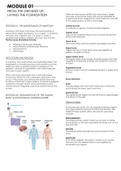
LAYING THE FOUNDATION There are microscopic (small) and macroscopic (large)
structures of the human body that can be organized by
fundamental levels, ranging from small molecules and cells
to the organ system, as seen in the image.
SECTION 01: THE IMPORTANCE OF ANATOMY Chemical Level
A molecule is a group of atoms bonded together.
Anatomy is the study of structure. The word anatomy is
derived from Greek and means “to cut apart”. In anatomy, Cellular Level
the parts of an organism are “cut apart” in order to Cells are the smallest living structure and are formed from
ascertain their position, relations, structure, and function. atoms and molecules.
The four areas of anatomy include:
Tissue Level
• Histology (microscopic features) Tissues are similar cells that perform specialized functions.
• Gross anatomy (macroscopic features)
Organ Level
• Neuroanatomy
Organs are two or more tissues that work together to
• Embryology
perform complex functions.
Organ System Level
UNITY OF FORM AND FUNCTION
The organ system level consists of related organs that work
together to coordinate activities and achieve a common
In anatomy, form and function are inextricably linked. The
function.
organization of a bodily structure is instrumental as it is the
means by which a specific function is carried out. This
applies to all levels of organization, from small molecules Organismal Level
and cells to organ systems. All body systems function interdependently in a single living
human.
When a structure has proper form, it will have proper
functioning. When the form is disrupted, dysfunction may
occur. In this course, you will study the proper form and BODY DIVISIONS
functions of the body’s organ systems, as well as investigate
dysfunction through various clinical examples in each Axial
module and an integrated case study near the end of the The axial region forms the main vertical axis of the body,
course. and includes the head, neck, and trunk.
Appendicular
SECTION 02: ORGANIZATION OF THE HUMAN The appendicular regions include the limbs or appendages
BODY & ANATOMICAL NOMENCLATURE that attach to the axis.
ORGAN SYSTEMS
At macroscopic levels, we can organize individual organs
into organ systems based on structure and function. The
details of these systems will be discussed in upcoming
modules.
INTEGUMENTARY
The integumentary system makes up our body covering
and includes our skin and associated structures such as our
hair and nails.
SKELETAL
The skeletal system includes the bones and joints of the
body.
MUSCULAR
As its name suggests, this system contains your muscles.
The muscular and skeletal systems work together for
movement and support.
, NERVOUS ANTERIOR – front-on view
The nervous system includes the brain, spinal cord, and LATERAL – side-on view
nerves that run throughout the body.
DORSAL – back = brain, spinal cord (CNS)
ENDOCRINE • CRANIAL – brain
The endocrine system includes glands that produce and • VERTEBRAL – spinal cord
secrete hormones. Along with the nervous system, these
two organ systems function in the integration and VENTRAL – front
coordination of the body to act as a unit. • THORACIC – above diaphragm
o SUPERIOR MEDIASTINUM – esophagus,
trachea (sternum protects these + aorta)
DIGESTIVE
o PERICARDIAL – heart
The digestive system starts at the mouth with a long tube
o PLEURAL (RIGHT & LEFT) – lungs
and ends at the anus.
• ABDOMINO-PELVIC – below diaphragm
RESPIRATORY
o ABDOMINAL – digestive viscera
The respiratory system allows you to breathe and includes o PELVIC – urinary bladder & urinary organs
the nose, air passageways, and lungs.
CARDIOVASCULAR
It is fundamental for all anatomists to adopt a consistent
The cardiovascular system includes blood, blood vessels,
language in order to describe and locate structures
and the heart.
accurately.
In anatomy, all directional terms use anatomical position as
LYMPHATIC
a point of reference. The characteristics of anatomical
The lymphatic system includes the lymphatic vessels, cells,
position include:
and structures that can initiate an immune response.
Standing upright
Lymphatic vessels: Thin-walled vessels structured like blood
Feet parallel and on the floor
vessels that carry lymph (interstitial fluid of the body).
Head level and looking forward
Arms at side of body
URINARY Palms facing forward and thumbs pointing away from
The urinary system includes the kidneys, ureters, bladder, body
and urethra. The respiratory, cardiovascular, lymphatic,
and urinary systems function together in the processing and
transportation of nutrients, oxygen, and waste products.
DIRECTIONAL TERMS
REPRODUCTIVE
The reproductive system provides the means for the sexual Directional terms provide precise descriptions of the
maturation and procreation of each individual. location of structures relative to other structures in
anatomical position. Often, directional terms are paired
Hormones: Molecules released from one cell into the blood with an associated term that means the opposite.
that travel throughout the body to affect other cells.
Superior (Cranial) /Inferior (Caudal)
BODY CAVITIES
Anterior / Posterior
Medial/ Lateral
LANGUAGE OF ANATOMY
FROM THE GROUND UP:
LAYING THE FOUNDATION There are microscopic (small) and macroscopic (large)
structures of the human body that can be organized by
fundamental levels, ranging from small molecules and cells
to the organ system, as seen in the image.
SECTION 01: THE IMPORTANCE OF ANATOMY Chemical Level
A molecule is a group of atoms bonded together.
Anatomy is the study of structure. The word anatomy is
derived from Greek and means “to cut apart”. In anatomy, Cellular Level
the parts of an organism are “cut apart” in order to Cells are the smallest living structure and are formed from
ascertain their position, relations, structure, and function. atoms and molecules.
The four areas of anatomy include:
Tissue Level
• Histology (microscopic features) Tissues are similar cells that perform specialized functions.
• Gross anatomy (macroscopic features)
Organ Level
• Neuroanatomy
Organs are two or more tissues that work together to
• Embryology
perform complex functions.
Organ System Level
UNITY OF FORM AND FUNCTION
The organ system level consists of related organs that work
together to coordinate activities and achieve a common
In anatomy, form and function are inextricably linked. The
function.
organization of a bodily structure is instrumental as it is the
means by which a specific function is carried out. This
applies to all levels of organization, from small molecules Organismal Level
and cells to organ systems. All body systems function interdependently in a single living
human.
When a structure has proper form, it will have proper
functioning. When the form is disrupted, dysfunction may
occur. In this course, you will study the proper form and BODY DIVISIONS
functions of the body’s organ systems, as well as investigate
dysfunction through various clinical examples in each Axial
module and an integrated case study near the end of the The axial region forms the main vertical axis of the body,
course. and includes the head, neck, and trunk.
Appendicular
SECTION 02: ORGANIZATION OF THE HUMAN The appendicular regions include the limbs or appendages
BODY & ANATOMICAL NOMENCLATURE that attach to the axis.
ORGAN SYSTEMS
At macroscopic levels, we can organize individual organs
into organ systems based on structure and function. The
details of these systems will be discussed in upcoming
modules.
INTEGUMENTARY
The integumentary system makes up our body covering
and includes our skin and associated structures such as our
hair and nails.
SKELETAL
The skeletal system includes the bones and joints of the
body.
MUSCULAR
As its name suggests, this system contains your muscles.
The muscular and skeletal systems work together for
movement and support.
, NERVOUS ANTERIOR – front-on view
The nervous system includes the brain, spinal cord, and LATERAL – side-on view
nerves that run throughout the body.
DORSAL – back = brain, spinal cord (CNS)
ENDOCRINE • CRANIAL – brain
The endocrine system includes glands that produce and • VERTEBRAL – spinal cord
secrete hormones. Along with the nervous system, these
two organ systems function in the integration and VENTRAL – front
coordination of the body to act as a unit. • THORACIC – above diaphragm
o SUPERIOR MEDIASTINUM – esophagus,
trachea (sternum protects these + aorta)
DIGESTIVE
o PERICARDIAL – heart
The digestive system starts at the mouth with a long tube
o PLEURAL (RIGHT & LEFT) – lungs
and ends at the anus.
• ABDOMINO-PELVIC – below diaphragm
RESPIRATORY
o ABDOMINAL – digestive viscera
The respiratory system allows you to breathe and includes o PELVIC – urinary bladder & urinary organs
the nose, air passageways, and lungs.
CARDIOVASCULAR
It is fundamental for all anatomists to adopt a consistent
The cardiovascular system includes blood, blood vessels,
language in order to describe and locate structures
and the heart.
accurately.
In anatomy, all directional terms use anatomical position as
LYMPHATIC
a point of reference. The characteristics of anatomical
The lymphatic system includes the lymphatic vessels, cells,
position include:
and structures that can initiate an immune response.
Standing upright
Lymphatic vessels: Thin-walled vessels structured like blood
Feet parallel and on the floor
vessels that carry lymph (interstitial fluid of the body).
Head level and looking forward
Arms at side of body
URINARY Palms facing forward and thumbs pointing away from
The urinary system includes the kidneys, ureters, bladder, body
and urethra. The respiratory, cardiovascular, lymphatic,
and urinary systems function together in the processing and
transportation of nutrients, oxygen, and waste products.
DIRECTIONAL TERMS
REPRODUCTIVE
The reproductive system provides the means for the sexual Directional terms provide precise descriptions of the
maturation and procreation of each individual. location of structures relative to other structures in
anatomical position. Often, directional terms are paired
Hormones: Molecules released from one cell into the blood with an associated term that means the opposite.
that travel throughout the body to affect other cells.
Superior (Cranial) /Inferior (Caudal)
BODY CAVITIES
Anterior / Posterior
Medial/ Lateral
LANGUAGE OF ANATOMY