7 Radioactivity and particles
The following sub-topics are covered in this section.
(a) Units
(b) Radioactivity
(c) Fission and fusion
(a) Units
7.1 use the following units:
● becquerel (Bq)
● centimetre (cm)
● hour (h)
● minute (min)
● second (s)
The unit of radioactivity in a becquerel (Bq) which is = 1 nucleus disintegration per
second.
(b) Radioactivity
7.2 describe the structure of an atom in terms of protons, neutrons and electrons and use
symbols such as 14 c 6 to describe particular nuclei
electron - 1/1840
proton + 1
neutron 0 1
7.3 know the terms atomic (proton) number, mass (nucleon) number and isotope
Mass number = nucleon number = atomic mass
Atomic number = proton number
Isotope = an atom of an element which has the same number of
protons and electrons but a different neutron number
Radioisotope = an isotope that is radioactive e.g. carbon 14
which is used in carbon decay
, 7.4 know that alpha (α) particles, beta (β−) particles, and gamma (γ) rays are
ionising radiations emitted from unstable nuclei in a random process
Some atomic nuclei are unstable and they undergo a process of radioactive decay. In the
process the nucleus loses energy and emits some ionising particles or radiation, going into a
lower and more stable state.
Ionising radiation or particles have enough energy to detach electrons from the matter they
interact with, so ionising them. This can damage cells or mutate their DNA producing cancer.
7.5 describe the nature of alpha (α) particles, beta (β−) particles, and gamma
(γ) rays, and recall that they may be distinguished in terms of penetrating power
and ability to ionise
7.6 practical: investigate the penetration powers of different types of radiation using
either radioactive sources or simulations
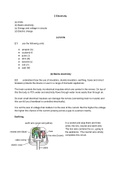
With different sources of radiation and a geiger-Muller detector see what you need to put in
front of the source of radiation for the geiger-muller counter to stop detecting radiation.
See table above
7.7 describe the effects on the atomic and mass numbers of a nucleus of the emission of
each of the four main types of radiation (alpha, beta, gamma and neutron radiation)
The following sub-topics are covered in this section.
(a) Units
(b) Radioactivity
(c) Fission and fusion
(a) Units
7.1 use the following units:
● becquerel (Bq)
● centimetre (cm)
● hour (h)
● minute (min)
● second (s)
The unit of radioactivity in a becquerel (Bq) which is = 1 nucleus disintegration per
second.
(b) Radioactivity
7.2 describe the structure of an atom in terms of protons, neutrons and electrons and use
symbols such as 14 c 6 to describe particular nuclei
electron - 1/1840
proton + 1
neutron 0 1
7.3 know the terms atomic (proton) number, mass (nucleon) number and isotope
Mass number = nucleon number = atomic mass
Atomic number = proton number
Isotope = an atom of an element which has the same number of
protons and electrons but a different neutron number
Radioisotope = an isotope that is radioactive e.g. carbon 14
which is used in carbon decay
, 7.4 know that alpha (α) particles, beta (β−) particles, and gamma (γ) rays are
ionising radiations emitted from unstable nuclei in a random process
Some atomic nuclei are unstable and they undergo a process of radioactive decay. In the
process the nucleus loses energy and emits some ionising particles or radiation, going into a
lower and more stable state.
Ionising radiation or particles have enough energy to detach electrons from the matter they
interact with, so ionising them. This can damage cells or mutate their DNA producing cancer.
7.5 describe the nature of alpha (α) particles, beta (β−) particles, and gamma
(γ) rays, and recall that they may be distinguished in terms of penetrating power
and ability to ionise
7.6 practical: investigate the penetration powers of different types of radiation using
either radioactive sources or simulations
With different sources of radiation and a geiger-Muller detector see what you need to put in
front of the source of radiation for the geiger-muller counter to stop detecting radiation.
See table above
7.7 describe the effects on the atomic and mass numbers of a nucleus of the emission of
each of the four main types of radiation (alpha, beta, gamma and neutron radiation)