LEARNING AIM C1 C2 AND C3
Study online at https://quizlet.com/_abuond
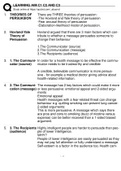
1. THEORIES OF There are THREE theories of persuasion:
PERSUASION -The Hovland and Yale theory of persuasion
-Fear arousal theory of persuasion
-Elaboration-likelihood model of persuasion.
2. Hovland-Yale Hovland argued that there are 3 main factors which con-
Theory of tribute to whether a message persuades someone to
Persuasion change their behaviour
1.The Communicator (source)
2.The Communication (message)
3.The Recipients (audience)
3. 1. The Communi- In order for a health message to be effective the commu-
cator (source) nicator needs to be trustworthy and credible
A credible, believable communicator is more persua-
sive - for example a medical doctor giving advice about
health-related information.
4. 2. The Communi- The message has 2 key factors which could make it more
cation (message) or less persuasive: emotional appeal and 2-sided argu-
ments
Emotional appeal:
Health messages with a fear-related threat can change
behaviour e.g. quitting smoking can prevent lung cancer.
2-sided arguments:
This is more persuasive. A message which says there
are pros and cons to smoking (buzz of nicotine versus
expense) can be better received than a 1-sided biased
argument.
5. 3. The Recipients Highly intelligent people are harder to persuade than peo-
(audience) ple of lower intelligence.
WHY?
People of lower intelligence are easily persuaded as they
may not pay full attention or fully understand a message.
Self-esteem is a factor in the audience too. Health cam-
, LEARNING AIM C1 C2 AND C3
Study online at https://quizlet.com/_abuond
paigns targeting people with lower self-esteem are effec-
tive.
6. Hovland & Weiss Aims - to investigate how credibility of a message affected
(1951) opinion change over time
Method - 2 groups of Yale Uni students were given 4 arti-
cles (positive and negative) about topics, including the use
of anti-histamine drugs. Group 1 had articles from credible
sources, group 2 had articles from tabloid newspapers.
Students opinions were measured before the presenta-
tion, immediately afterwards and several weeks later
Findings - pps changed their minds with credible sources,
and low-credibility articles were seen as presenting unfair
arguments. However, over time, agreement with low cred-
ibility arguments increased by 7.4%
Conclusion - persuasive messages are likely to change
opinion if they are from credible sources. The study iden-
tified the 'sleeper effect' (opinion matching low credibility
sources over time).
7. Evaluation - - Hovland and Weiss' (1951) research can show us how to
Strength of Hov- make health campaigns more effective.
land et al study The study showed us that credibility of the source is im-
portant in the short-term to have a behaviour change - so
interventions should prioritise credibility.
Long-term behaviour changes should focus on emotional
appeal and the content of the message.
+Research supports the role of the message quality in
the effectiveness of behaviour change, supporting the
theory. Sturges and Rogers (1996) found that the most
persuasive messages combine emotional threat and a
suggestion on how to quit smoking.
8. Evaluation - The study by Hovland and Weiss (1951) is incredibly dif-
Weakness of ficult to generalise. The pps were Yale University students
Hovland et al - people with high intelligence and younger than the av-
erage person in the USA in 1951 (THINK: McCartyism!).
The pps were also a 'captive audience' - the researchers
, LEARNING AIM C1 C2 AND C3
Study online at https://quizlet.com/_abuond
selected what resources they would be exposed to, and
this may not be the case in the real world. For these
reasons, the research is hard to generalise.
Research does not support the idea of low self-esteem
making someone more persuadable. There is conflicting
results from different studies, meaning the inclusion of
self-esteem in the theory feels random. This undermines
the validity of the theory.
9. Fear-arousal the- Janis and Feshbach proposed the Fear Arousal Theory
ory of persua- in 1953, arguing that persuasive messages can change
sion attitudes and behaviours if they arouse fear.
10. Early Theories Fear creates unpleasant physical and psychological
and the Effects of arousal - by changing behaviour, we can avoid the feared
Fear outcome.
This suggests change in behaviour can be negatively
reinforced (we want to move away from feeling fearful, and
the relief is rewarding).
Health campaigns use this technique a lot - anti-smoking
adverts may show the effects of lung cancer in graphic
detail to arouse fear. The advert then presents the solution
(quitting) which will reduce the fear.
11. Fear-Behaviour The theory suggests that the relationship between fear
Relationship and behaviour is not linear - but curvilinear instead. This
means little fear has no effect on behaviour change, mod-
erate fear is very effective but too much fear is counter
productive. Too much fear leads to a different state - denial.
12. •Janis & Fesh- Aims - to see if fear-arousing messages produce denial in
bach (1953) place of behaviour change
Method - 200 students were randomly divided into 3
groups matched by age, intelligence and gender and
watched 15-minute lectures. Group 1 = strong fear arousal
lecture emphasising 'tooth decay can happen to you'.
Study online at https://quizlet.com/_abuond
1. THEORIES OF There are THREE theories of persuasion:
PERSUASION -The Hovland and Yale theory of persuasion
-Fear arousal theory of persuasion
-Elaboration-likelihood model of persuasion.
2. Hovland-Yale Hovland argued that there are 3 main factors which con-
Theory of tribute to whether a message persuades someone to
Persuasion change their behaviour
1.The Communicator (source)
2.The Communication (message)
3.The Recipients (audience)
3. 1. The Communi- In order for a health message to be effective the commu-
cator (source) nicator needs to be trustworthy and credible
A credible, believable communicator is more persua-
sive - for example a medical doctor giving advice about
health-related information.
4. 2. The Communi- The message has 2 key factors which could make it more
cation (message) or less persuasive: emotional appeal and 2-sided argu-
ments
Emotional appeal:
Health messages with a fear-related threat can change
behaviour e.g. quitting smoking can prevent lung cancer.
2-sided arguments:
This is more persuasive. A message which says there
are pros and cons to smoking (buzz of nicotine versus
expense) can be better received than a 1-sided biased
argument.
5. 3. The Recipients Highly intelligent people are harder to persuade than peo-
(audience) ple of lower intelligence.
WHY?
People of lower intelligence are easily persuaded as they
may not pay full attention or fully understand a message.
Self-esteem is a factor in the audience too. Health cam-
, LEARNING AIM C1 C2 AND C3
Study online at https://quizlet.com/_abuond
paigns targeting people with lower self-esteem are effec-
tive.
6. Hovland & Weiss Aims - to investigate how credibility of a message affected
(1951) opinion change over time
Method - 2 groups of Yale Uni students were given 4 arti-
cles (positive and negative) about topics, including the use
of anti-histamine drugs. Group 1 had articles from credible
sources, group 2 had articles from tabloid newspapers.
Students opinions were measured before the presenta-
tion, immediately afterwards and several weeks later
Findings - pps changed their minds with credible sources,
and low-credibility articles were seen as presenting unfair
arguments. However, over time, agreement with low cred-
ibility arguments increased by 7.4%
Conclusion - persuasive messages are likely to change
opinion if they are from credible sources. The study iden-
tified the 'sleeper effect' (opinion matching low credibility
sources over time).
7. Evaluation - - Hovland and Weiss' (1951) research can show us how to
Strength of Hov- make health campaigns more effective.
land et al study The study showed us that credibility of the source is im-
portant in the short-term to have a behaviour change - so
interventions should prioritise credibility.
Long-term behaviour changes should focus on emotional
appeal and the content of the message.
+Research supports the role of the message quality in
the effectiveness of behaviour change, supporting the
theory. Sturges and Rogers (1996) found that the most
persuasive messages combine emotional threat and a
suggestion on how to quit smoking.
8. Evaluation - The study by Hovland and Weiss (1951) is incredibly dif-
Weakness of ficult to generalise. The pps were Yale University students
Hovland et al - people with high intelligence and younger than the av-
erage person in the USA in 1951 (THINK: McCartyism!).
The pps were also a 'captive audience' - the researchers
, LEARNING AIM C1 C2 AND C3
Study online at https://quizlet.com/_abuond
selected what resources they would be exposed to, and
this may not be the case in the real world. For these
reasons, the research is hard to generalise.
Research does not support the idea of low self-esteem
making someone more persuadable. There is conflicting
results from different studies, meaning the inclusion of
self-esteem in the theory feels random. This undermines
the validity of the theory.
9. Fear-arousal the- Janis and Feshbach proposed the Fear Arousal Theory
ory of persua- in 1953, arguing that persuasive messages can change
sion attitudes and behaviours if they arouse fear.
10. Early Theories Fear creates unpleasant physical and psychological
and the Effects of arousal - by changing behaviour, we can avoid the feared
Fear outcome.
This suggests change in behaviour can be negatively
reinforced (we want to move away from feeling fearful, and
the relief is rewarding).
Health campaigns use this technique a lot - anti-smoking
adverts may show the effects of lung cancer in graphic
detail to arouse fear. The advert then presents the solution
(quitting) which will reduce the fear.
11. Fear-Behaviour The theory suggests that the relationship between fear
Relationship and behaviour is not linear - but curvilinear instead. This
means little fear has no effect on behaviour change, mod-
erate fear is very effective but too much fear is counter
productive. Too much fear leads to a different state - denial.
12. •Janis & Fesh- Aims - to see if fear-arousing messages produce denial in
bach (1953) place of behaviour change
Method - 200 students were randomly divided into 3
groups matched by age, intelligence and gender and
watched 15-minute lectures. Group 1 = strong fear arousal
lecture emphasising 'tooth decay can happen to you'.