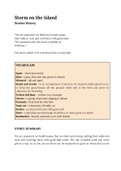
Storm on the Island
Seamus Heaney
“We are prepared: we build our houses squat,
Sink walls in rock and roof them with good slate.
The wizened earth had never troubled us
With hay...”
Full poem unable to be reproduced due to copyright
VOCABULARY
Squat - short and stocky
Slate - a grey, flat rock that grows in sheets
Wizened - old and aged
Stacks and stooks - is an arrangement of sheaves of cut grain-stalks placed so as
to keep the grain-heads off the ground while still in the field and prior to
collection for threshing
To blow full blast - to blow very strongly
Chorus - a group of persons singing in unison
Pummels - beat heavily with fists
Tame cat - a domestic, friendly cat
Strafes - an attack from low-flying aircraft
Salvo - a simultaneous discharge of artillery or other guns in a battle
Bombarded - heavily attacked, as in with bombs
STORY/SUMMARY
We are prepared: we build houses that are short and strong, sinking their walls into
rock and covering them with good slate roofs. The old, wrinkled earth has never
given us hay, so as you can see there are no haystacks or grain or wheat that can be
, lost. Nor are there trees which might be helpful to us when the storm blows full
blast: you know what I mean - leaves and branches make a lot of noise in a storm,
so that you can listen to the thing you fear, forgetting that it is attacking your house
too. But there are no trees, no natural shelter. You might think that the sea is
company, as it explodes comfortably down there on the cliffs below us, but no:
when the storm begins, the spray from the sea hits the windows of our houses and
spits like a tame cat gone wild. We just sit there while the invisible wind dives and
hovers around our house. Space is filled up with bangs and bursts, like a warzone.
We are attacked by the empty air - it’s so strange that we are afraid of a huge
nothing.
SPEAKER/VOICE
The speaker uses first person plural pronouns ‘we’ and ‘our’ to demonstrate that
he is speaking about the collective experience of the inhabitants of the island as a
single group. He uses a conversational style indicated by phrases such as ‘you
might think’ and ‘as you can see’ to create a familiar, personal relationship with
the reader - yet Heaney is aware of the irony in these phrases because in reality
the reader of the poem is not on the island and not able to directly see, they can
only imagine the situation through the poem’s imagery. The tone in the poem
shifts from confident at the beginning: ‘We are prepared’, to philosophical and
reflective at the end: ‘Strange, it is a huge nothing that we fear’. The practical
opening of the poem gives way to the chaos of the storm.
LANGUAGE
Adjective - ‘squat’ - the description of the houses suggests stockiness and strength,
as they are built short in order to be more stable in the difficult weather. However,
it also suggests that there is no room for beauty or elegance on this island, the
inhabitants are forced to adapt to the harsh environmental conditions rather than
living comfortably.
Verb - ‘Troubled’ - this verb occurs in the phrase ‘The wizened earth has never
troubled us /With hay’, making it appear polite and cordial, as in the phrase ‘sorry
Seamus Heaney
“We are prepared: we build our houses squat,
Sink walls in rock and roof them with good slate.
The wizened earth had never troubled us
With hay...”
Full poem unable to be reproduced due to copyright
VOCABULARY
Squat - short and stocky
Slate - a grey, flat rock that grows in sheets
Wizened - old and aged
Stacks and stooks - is an arrangement of sheaves of cut grain-stalks placed so as
to keep the grain-heads off the ground while still in the field and prior to
collection for threshing
To blow full blast - to blow very strongly
Chorus - a group of persons singing in unison
Pummels - beat heavily with fists
Tame cat - a domestic, friendly cat
Strafes - an attack from low-flying aircraft
Salvo - a simultaneous discharge of artillery or other guns in a battle
Bombarded - heavily attacked, as in with bombs
STORY/SUMMARY
We are prepared: we build houses that are short and strong, sinking their walls into
rock and covering them with good slate roofs. The old, wrinkled earth has never
given us hay, so as you can see there are no haystacks or grain or wheat that can be
, lost. Nor are there trees which might be helpful to us when the storm blows full
blast: you know what I mean - leaves and branches make a lot of noise in a storm,
so that you can listen to the thing you fear, forgetting that it is attacking your house
too. But there are no trees, no natural shelter. You might think that the sea is
company, as it explodes comfortably down there on the cliffs below us, but no:
when the storm begins, the spray from the sea hits the windows of our houses and
spits like a tame cat gone wild. We just sit there while the invisible wind dives and
hovers around our house. Space is filled up with bangs and bursts, like a warzone.
We are attacked by the empty air - it’s so strange that we are afraid of a huge
nothing.
SPEAKER/VOICE
The speaker uses first person plural pronouns ‘we’ and ‘our’ to demonstrate that
he is speaking about the collective experience of the inhabitants of the island as a
single group. He uses a conversational style indicated by phrases such as ‘you
might think’ and ‘as you can see’ to create a familiar, personal relationship with
the reader - yet Heaney is aware of the irony in these phrases because in reality
the reader of the poem is not on the island and not able to directly see, they can
only imagine the situation through the poem’s imagery. The tone in the poem
shifts from confident at the beginning: ‘We are prepared’, to philosophical and
reflective at the end: ‘Strange, it is a huge nothing that we fear’. The practical
opening of the poem gives way to the chaos of the storm.
LANGUAGE
Adjective - ‘squat’ - the description of the houses suggests stockiness and strength,
as they are built short in order to be more stable in the difficult weather. However,
it also suggests that there is no room for beauty or elegance on this island, the
inhabitants are forced to adapt to the harsh environmental conditions rather than
living comfortably.
Verb - ‘Troubled’ - this verb occurs in the phrase ‘The wizened earth has never
troubled us /With hay’, making it appear polite and cordial, as in the phrase ‘sorry