Describe and explain what a nucleotide is:
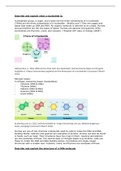
A phosphate group, a sugar, and a base are the three components of a nucleotide.
(“What are the three components of a nucleotide - Brainly.com”) They are sugars and
bases that make up DNA and RNA. An organic molecule is referred to as a base. Purines
and pyrimidines are the two types of bases. Purines are adenine and guanine, while
pyrimidines are thymine, uracil, and cytosine. (“Expand ATP class 12 biology CBSE”)
Helmenstine, A., 2022. What Are the Three Parts of a Nucleotide?. [online] Science Notes and Projects.
Available at: <https://sciencenotes.org/what-are-the-three-parts-of-a-nucleotide/> [Accessed 3 March
2022].
Nitrogen bases:
5 nitrogen containing bases (nucleotides):
- Cytosine (DNA & RNA)
- Thymine (DNA)
- Adenine (DNA & RNA)
- Guanine (DNA & RNA)
- Uracil (RNA)
Ib.bioninja.com.au. 2022. [online] Available at: <https://ib.bioninja.com.au/_Media/nitrogenous-
bases_med.jpeg> [Accessed 3 March 2022].
Purines are one of two chemical compounds used by cells to make the DNA and RNA
building blocks. Adenine and guanine are examples of purines. Purines can also be found
in foods, such as meat. Their structures have two rings in them. Guanine and adenine
are two examples of these. The second class of nitrogen bases is pyrimidine. Cells use
these to create the DNA and RNA building blocks. Pyrimidines are single-ringed
structures with a smaller size. Cytosine, uracil, and thymine are examples of these.
Describe and explain the structure of a DNA molecule
, Nucleotides, which make up DNA, are repeating units. A polynucleotide is a structure
that has more than two nucleotides joining them together. DNA is made up of strands of
polynucleotides. They are antiparallel – they are structured in such a way that they run
in opposite directions. Allowing nucleotides to be connected, covalent bonds form
between the phosphate group of one nucleotide and the third carbon atom of the
pentose sugar in the next nucleotide. (“If A DNA Double Helix Contains 28% T
Nucleotides, then ...”) This results in an alternating backbone of sugar - phosphate -
sugar - phosphate all along the polynucleotide chain. (“What Are The 3 Parts of a
Nucleotide and How Are They”)
2022. [online] Available at: <https://www.researchgate.net/figure/Structure-of-a-DNA-molecule-
13_fig1_331741386> [Accessed 3 March 2022].
Phosphodiester bonds
A phosphodiester bond is formed when two hydroxyl groups in phosphoric acid react with
hydroxyl groups on other molecules to form two ester bonds. Each ester bond is formed
through a condensation reaction in which water is lost. (“Phosphodiester bond - The
School of Biomedical Sciences Wiki”) This bond is a critical structural component of DNA
and RNA's backbone, connecting the 3' carbon of one nucleotide to the 5' carbon of
another to form DNA and RNA strands.
Base pairing with Hydrogen bonds
Hydrogen bonds between base pairs hold DNA strands together. Adenine forming a base
pair with thymine and cytosine forming a base pair with guanine are two examples.
(“Base Pair - Genome.gov”) Because nucleotides have a shape that allows them to bond
together with hydrogen bonds, hydrogen bonds between base pairs are possible. (“How
do you determine the number of hydrogen bonds in a DNA ...”) They work well together.
The DNA strands are held together by hydrogen bonds between base pairs. (“What does
the hydrogen bond between so that the strands of ...”)
DNA replication
1. The DNA helicase slowly but completely unwinds the double helix. This is
accomplished by dissolving the hydrogen bonds that exist between the complementary
bases. This diagram depicts the formation of two new DNA strands.
2. Free nucleotide bases are exposed because of this.
3. The two single strands of DNA are separated and used as templates to create new
strands of DNA. The DNA polymerase binds to the exposed strand and adds new
complementary nucleotide bases (A, C, G, and T) to the DNA strand.
A phosphate group, a sugar, and a base are the three components of a nucleotide.
(“What are the three components of a nucleotide - Brainly.com”) They are sugars and
bases that make up DNA and RNA. An organic molecule is referred to as a base. Purines
and pyrimidines are the two types of bases. Purines are adenine and guanine, while
pyrimidines are thymine, uracil, and cytosine. (“Expand ATP class 12 biology CBSE”)
Helmenstine, A., 2022. What Are the Three Parts of a Nucleotide?. [online] Science Notes and Projects.
Available at: <https://sciencenotes.org/what-are-the-three-parts-of-a-nucleotide/> [Accessed 3 March
2022].
Nitrogen bases:
5 nitrogen containing bases (nucleotides):
- Cytosine (DNA & RNA)
- Thymine (DNA)
- Adenine (DNA & RNA)
- Guanine (DNA & RNA)
- Uracil (RNA)
Ib.bioninja.com.au. 2022. [online] Available at: <https://ib.bioninja.com.au/_Media/nitrogenous-
bases_med.jpeg> [Accessed 3 March 2022].
Purines are one of two chemical compounds used by cells to make the DNA and RNA
building blocks. Adenine and guanine are examples of purines. Purines can also be found
in foods, such as meat. Their structures have two rings in them. Guanine and adenine
are two examples of these. The second class of nitrogen bases is pyrimidine. Cells use
these to create the DNA and RNA building blocks. Pyrimidines are single-ringed
structures with a smaller size. Cytosine, uracil, and thymine are examples of these.
Describe and explain the structure of a DNA molecule
, Nucleotides, which make up DNA, are repeating units. A polynucleotide is a structure
that has more than two nucleotides joining them together. DNA is made up of strands of
polynucleotides. They are antiparallel – they are structured in such a way that they run
in opposite directions. Allowing nucleotides to be connected, covalent bonds form
between the phosphate group of one nucleotide and the third carbon atom of the
pentose sugar in the next nucleotide. (“If A DNA Double Helix Contains 28% T
Nucleotides, then ...”) This results in an alternating backbone of sugar - phosphate -
sugar - phosphate all along the polynucleotide chain. (“What Are The 3 Parts of a
Nucleotide and How Are They”)
2022. [online] Available at: <https://www.researchgate.net/figure/Structure-of-a-DNA-molecule-
13_fig1_331741386> [Accessed 3 March 2022].
Phosphodiester bonds
A phosphodiester bond is formed when two hydroxyl groups in phosphoric acid react with
hydroxyl groups on other molecules to form two ester bonds. Each ester bond is formed
through a condensation reaction in which water is lost. (“Phosphodiester bond - The
School of Biomedical Sciences Wiki”) This bond is a critical structural component of DNA
and RNA's backbone, connecting the 3' carbon of one nucleotide to the 5' carbon of
another to form DNA and RNA strands.
Base pairing with Hydrogen bonds
Hydrogen bonds between base pairs hold DNA strands together. Adenine forming a base
pair with thymine and cytosine forming a base pair with guanine are two examples.
(“Base Pair - Genome.gov”) Because nucleotides have a shape that allows them to bond
together with hydrogen bonds, hydrogen bonds between base pairs are possible. (“How
do you determine the number of hydrogen bonds in a DNA ...”) They work well together.
The DNA strands are held together by hydrogen bonds between base pairs. (“What does
the hydrogen bond between so that the strands of ...”)
DNA replication
1. The DNA helicase slowly but completely unwinds the double helix. This is
accomplished by dissolving the hydrogen bonds that exist between the complementary
bases. This diagram depicts the formation of two new DNA strands.
2. Free nucleotide bases are exposed because of this.
3. The two single strands of DNA are separated and used as templates to create new
strands of DNA. The DNA polymerase binds to the exposed strand and adds new
complementary nucleotide bases (A, C, G, and T) to the DNA strand.