

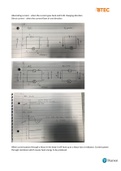
Alternating current – when the current goes back and forth changing direction
Direct current – when the current flows in one direction
When current passes through a tissue in the body it will heat up as a tissue has a resistance. Current passes
through resistance which causes heat energy to be produced.
, I=V/R
V – voltage source of electric shock
R – resistance of tissue
The amount of current passing through a human body depends on 2 things
Voltage supplied by the source and the electrical resistance of your body
Ear to ear -
110V
100 OHMS
= 1.1 mA
Hand to hand -
110 V
500 OHMS
+220mA
Dry skin -
(100,000 – 600,000 OHMS)
100V
100,000 OHMS
= 1.1mA
Wet skin -
110V
1000 OHMS
= 100mA
Dry skin -
I=V/R = 230/100,000 = 2.3mA
Causes a slight shock – not painful
Wet skin -
I=V/R - 230/1000 = 230mA
230mA leads to respiratory arrest which means you could possibly stop breathing
High voltage (500V or greater) breaks down the skin and reduces its resistance
2.3mA causes a slight shock – not painful
Current Effect
(contact for 1
s)
Below 1 mA Not perceptible
1 mA Threshold of feeling and tingling
5 mA Slight shock, not painful, average individual can let go. Involuntary
reaction can lead to indirect injuries
6-25 Painful shocks. Loss of muscle of control
mA(women)
9 to 30 mA Freezing current “can't let go” the person may be thrown away from the
2
BTEC Assignment Brief v1.0
BTEC Internal Assessment QDAM January 2015
Direct current – when the current flows in one direction
When current passes through a tissue in the body it will heat up as a tissue has a resistance. Current passes
through resistance which causes heat energy to be produced.
, I=V/R
V – voltage source of electric shock
R – resistance of tissue
The amount of current passing through a human body depends on 2 things
Voltage supplied by the source and the electrical resistance of your body
Ear to ear -
110V
100 OHMS
= 1.1 mA
Hand to hand -
110 V
500 OHMS
+220mA
Dry skin -
(100,000 – 600,000 OHMS)
100V
100,000 OHMS
= 1.1mA
Wet skin -
110V
1000 OHMS
= 100mA
Dry skin -
I=V/R = 230/100,000 = 2.3mA
Causes a slight shock – not painful
Wet skin -
I=V/R - 230/1000 = 230mA
230mA leads to respiratory arrest which means you could possibly stop breathing
High voltage (500V or greater) breaks down the skin and reduces its resistance
2.3mA causes a slight shock – not painful
Current Effect
(contact for 1
s)
Below 1 mA Not perceptible
1 mA Threshold of feeling and tingling
5 mA Slight shock, not painful, average individual can let go. Involuntary
reaction can lead to indirect injuries
6-25 Painful shocks. Loss of muscle of control
mA(women)
9 to 30 mA Freezing current “can't let go” the person may be thrown away from the
2
BTEC Assignment Brief v1.0
BTEC Internal Assessment QDAM January 2015


