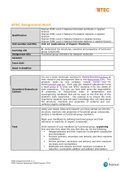
BTEC Assignment Brief
Pearson BTEC Level 3 National Extended Certificate in Applied
Science
Pearson BTEC Level 3 National Foundation Diploma in Applied
Qualification
Science
Pearson BTEC Level 3 National Diploma in Applied Science
Pearson BTEC Level 3 National Extended Diploma in Applied Science
Unit number and title Unit 14: Applications of Organic Chemistry
A: Understand the structures, reactions and properties of functional
Learning aim
group compounds.
Assignment title Functional group chemistry for designer molecules
Assessor
Issue date
Hand in deadline
You are a junior technician working for Reckitt BenckiserUnilever at
their research and development base in Hull Manchester (UK). The
products made by this company include Vanish and Mr
Sheen.comfort and lux. Each year the research laboratories invite
a small group of ‘A’ level and ‘BTEC’ students in for two weeks of
Vocational Scenario or work experience. This year you have been given the responsibility
Context of preparing an instructional video or presentation and
accompanying handbook that will be used on the first day of the
student’s work experience. The purpose is to ensure the work
experience students have the basic knowledge they will need about
the structure, reactions and properties of carbonyl and non-
carbonyl organic compounds.
Using your lesson notes and research you have carried out into the
structure, reactions and properties of functional group compounds,
produce a handbook on functional group chemistry.
Begin your handbook by defining functional groups and their
relevance to reactivity of organic compounds.
Task Write sections of your handbook by functional group, explaining
how and why they react the way that they do, for the following:
• Halogenoalkanes and their reactions (nucleophilic substitution
and elimination)
• Alcohols (primary, secondary and tertiary) and their reactions
(oxidation)
• Amines (primary, secondary and tertiary) and their reactions
(as bases and nucleophiles)
• Aldehydes and ketones and their reactions (oxidation &
reduction; nucleophilic addition and addition-elimination)
1
BTEC Assignment Brief v1.0
BTEC Internal Assessment QDAM January 2015
, • Carboxylic acids and their reactions (as acids; addition-
elimination to form esters)
• Acyl chlorides, acid anhydrides and amides, and their
reactions
Each section will be illustrated with balanced equations and reaction
conditions, and include nomenclature and structural formulae of all
starting materials and products, including commercially important
products, formed.
The handbook must next have a section on mechanisms, in which
you which will construct and analyse an example of each of the
following reaction mechanism types:
• Addition e.g. aldehyde or ketone with HCN
• Substitution e.g. halogenoalkane with aqueous NaOH
• Elimination e.g. halogenoalkane with ethanolic NaOH
• Addition-elimination e.g. aldehyde or ketone with 2,4-
dinitrophenylhydrazine
This section must explore and interpret the similarities and
differences between each of the four mechanisms.
For the final section, use relevant information from the other
sections of your handbook, to give a plan of a multi-step
synthesis of
• ethyl ethanoate (CH3CO2CH2CH3), starting from ethanol and
ethanal
• N-ethylacetamide (CH3CONHCH2CH3), starting from
chloroethane and ethanoyl chloride
You will need to include reagents, reaction conditions and
intermediate products involved in each step.
Your handbook will be much more interesting to your audience if
pictures of 3D models of your molecules are included where it is
appropriate.
Finally, prepare an instructional video or presentation, using your
pictures and diagrams to accompany your verbal presentation and
explanation of your handbook content.
Checklist of evidence An instructional video recording or presentation which:
required
Uses pictures and diagrams to illustrate your verbal
explanation of the content of your handbook.
A hand book to accompany the video or presentation which:
Explains the typical non-carbonyl and carbonyl reactions
included in the task, to include correct names and formulae of
starting materials and products, balanced equations, reaction
conditions and any commercially important products;
Shows plans of the multi-step synthesis routes for a) ethyl
ethanoate (CH3CO2CH2CH3), starting from ethanol and ethanal
and b) N-ethylacetamide (CH3CONHCH2CH3), starting from
chloroethane and ethanoyl chloride;
Gives an analysis of the typical reaction mechanisms
(substitution, addition, elimination and addition-
2
BTEC Assignment Brief v1.0
BTEC Internal Assessment QDAM January 2015
, elimination) that you have constructed, interpreting the
similarities and differences between each of the
mechanisms.
Sources of information must be appropriately referenced.
Correct scientific terminology must be used.
Criteria covered by this task:
Unit/Criteria
To achieve the criteria, you must show that you are able to:
reference
Analyse the types of reaction mechanisms undergone by non-carbonyl and
A. D1
carbonyl compounds.
A.M1 Construct mechanisms for non-carbonyl and carbonyl compounds.
Plan a multi-step synthesis of carbonyl and non-carbonyl organic molecules in
A. M2
order to produce many organic substances, taking more than one reaction step.
Explain the reactions of a range of carbonyl and non-carbonyl functional group
A. P1
compounds.
Sources of information
to support you with www.chemguide.co.uk
this Assignment
http://scienceaid.co.uk/chemistry/organic/index.html
http://rod.beavon.org.uk
http://www.chemhelper.com/mechanisms.html
Edexcel A Level Science – A2 Chemistry Students Book
ISBN 9781408206058
Edexcel A Level Science – AS Chemistry Students Book
ISBN 9781405896351
Centres are encouraged to include local employers in delivery by
asking them to give guest lectures and provide opportunities for
industrial visits and work experience.
Other assessment
materials attached to
this Assignment Brief
Construct mechanisms for non-carbonyl and carbonyl compounds.
3
BTEC Assignment Brief v1.0
BTEC Internal Assessment QDAM January 2015
, 4
BTEC Assignment Brief v1.0
BTEC Internal Assessment QDAM January 2015
Pearson BTEC Level 3 National Extended Certificate in Applied
Science
Pearson BTEC Level 3 National Foundation Diploma in Applied
Qualification
Science
Pearson BTEC Level 3 National Diploma in Applied Science
Pearson BTEC Level 3 National Extended Diploma in Applied Science
Unit number and title Unit 14: Applications of Organic Chemistry
A: Understand the structures, reactions and properties of functional
Learning aim
group compounds.
Assignment title Functional group chemistry for designer molecules
Assessor
Issue date
Hand in deadline
You are a junior technician working for Reckitt BenckiserUnilever at
their research and development base in Hull Manchester (UK). The
products made by this company include Vanish and Mr
Sheen.comfort and lux. Each year the research laboratories invite
a small group of ‘A’ level and ‘BTEC’ students in for two weeks of
Vocational Scenario or work experience. This year you have been given the responsibility
Context of preparing an instructional video or presentation and
accompanying handbook that will be used on the first day of the
student’s work experience. The purpose is to ensure the work
experience students have the basic knowledge they will need about
the structure, reactions and properties of carbonyl and non-
carbonyl organic compounds.
Using your lesson notes and research you have carried out into the
structure, reactions and properties of functional group compounds,
produce a handbook on functional group chemistry.
Begin your handbook by defining functional groups and their
relevance to reactivity of organic compounds.
Task Write sections of your handbook by functional group, explaining
how and why they react the way that they do, for the following:
• Halogenoalkanes and their reactions (nucleophilic substitution
and elimination)
• Alcohols (primary, secondary and tertiary) and their reactions
(oxidation)
• Amines (primary, secondary and tertiary) and their reactions
(as bases and nucleophiles)
• Aldehydes and ketones and their reactions (oxidation &
reduction; nucleophilic addition and addition-elimination)
1
BTEC Assignment Brief v1.0
BTEC Internal Assessment QDAM January 2015
, • Carboxylic acids and their reactions (as acids; addition-
elimination to form esters)
• Acyl chlorides, acid anhydrides and amides, and their
reactions
Each section will be illustrated with balanced equations and reaction
conditions, and include nomenclature and structural formulae of all
starting materials and products, including commercially important
products, formed.
The handbook must next have a section on mechanisms, in which
you which will construct and analyse an example of each of the
following reaction mechanism types:
• Addition e.g. aldehyde or ketone with HCN
• Substitution e.g. halogenoalkane with aqueous NaOH
• Elimination e.g. halogenoalkane with ethanolic NaOH
• Addition-elimination e.g. aldehyde or ketone with 2,4-
dinitrophenylhydrazine
This section must explore and interpret the similarities and
differences between each of the four mechanisms.
For the final section, use relevant information from the other
sections of your handbook, to give a plan of a multi-step
synthesis of
• ethyl ethanoate (CH3CO2CH2CH3), starting from ethanol and
ethanal
• N-ethylacetamide (CH3CONHCH2CH3), starting from
chloroethane and ethanoyl chloride
You will need to include reagents, reaction conditions and
intermediate products involved in each step.
Your handbook will be much more interesting to your audience if
pictures of 3D models of your molecules are included where it is
appropriate.
Finally, prepare an instructional video or presentation, using your
pictures and diagrams to accompany your verbal presentation and
explanation of your handbook content.
Checklist of evidence An instructional video recording or presentation which:
required
Uses pictures and diagrams to illustrate your verbal
explanation of the content of your handbook.
A hand book to accompany the video or presentation which:
Explains the typical non-carbonyl and carbonyl reactions
included in the task, to include correct names and formulae of
starting materials and products, balanced equations, reaction
conditions and any commercially important products;
Shows plans of the multi-step synthesis routes for a) ethyl
ethanoate (CH3CO2CH2CH3), starting from ethanol and ethanal
and b) N-ethylacetamide (CH3CONHCH2CH3), starting from
chloroethane and ethanoyl chloride;
Gives an analysis of the typical reaction mechanisms
(substitution, addition, elimination and addition-
2
BTEC Assignment Brief v1.0
BTEC Internal Assessment QDAM January 2015
, elimination) that you have constructed, interpreting the
similarities and differences between each of the
mechanisms.
Sources of information must be appropriately referenced.
Correct scientific terminology must be used.
Criteria covered by this task:
Unit/Criteria
To achieve the criteria, you must show that you are able to:
reference
Analyse the types of reaction mechanisms undergone by non-carbonyl and
A. D1
carbonyl compounds.
A.M1 Construct mechanisms for non-carbonyl and carbonyl compounds.
Plan a multi-step synthesis of carbonyl and non-carbonyl organic molecules in
A. M2
order to produce many organic substances, taking more than one reaction step.
Explain the reactions of a range of carbonyl and non-carbonyl functional group
A. P1
compounds.
Sources of information
to support you with www.chemguide.co.uk
this Assignment
http://scienceaid.co.uk/chemistry/organic/index.html
http://rod.beavon.org.uk
http://www.chemhelper.com/mechanisms.html
Edexcel A Level Science – A2 Chemistry Students Book
ISBN 9781408206058
Edexcel A Level Science – AS Chemistry Students Book
ISBN 9781405896351
Centres are encouraged to include local employers in delivery by
asking them to give guest lectures and provide opportunities for
industrial visits and work experience.
Other assessment
materials attached to
this Assignment Brief
Construct mechanisms for non-carbonyl and carbonyl compounds.
3
BTEC Assignment Brief v1.0
BTEC Internal Assessment QDAM January 2015
, 4
BTEC Assignment Brief v1.0
BTEC Internal Assessment QDAM January 2015