
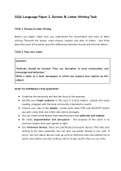
AQA Language Paper 2, Section B: Letter Writing Task
TASK 1: Research Letter Writing
Before you begin, make sure you understand the conventions and rules of letter
writing. Research the layout, word choices, register and style of letters - also think
about the level of formality: learn the differences between formal and informal letters.
TASK 2: Plan your Letter
Question:
“Festivals should be banned. They are disruptive to local communities and
encourage bad behaviour.”
Write a letter to a local newspaper in which you express your opinion on this
subject.
HOW TO APPROACH THE QUESTION
● Underline the keywords and find the focus of the question
● Identify your target audience: in this case, it is local readers - people who enjoy
reading, engaged with the local community, interested in events
● Choose your side of the debate - bullet point ideas FOR and AGAINST before
you pick a side, then see which side seems strongest
● You can invent small details that make the piece feel authentic and realistic
● Be really argumentative and persuasive - the purpose of the piece is to
convince readers that your opinion is right
● Use rhetorical devices, these are specifically persuasive devices that help your
writing to be more powerful. You can also use poetic devices if you wish. If
you’re not sure about devices, look up a list of rhetorical ones and another list of
poetic ones before you start writing, and try to get used to them as you write.
, ● Use a formal register with correct letter style (use realistic letter writing
phrases)
● Include at least one counter paragraph where you explore the opposite side of
the debate fairly
Your plan should look something like this:
Dear…
P1: Purpose of writing
P2: One topic (possibly a counter paragraph)
P3: Another topic
P4: Another topic
P5: Another topic (possibly a counter paragraph)
P6: Summarise hopes and wishes
Yours Sincerely,
Your Name
TASK 3: Write the letter!
● If this is one of your first practise pieces, don’t try to do it in timed conditions.
You can use timings if you’re quite used to these types of questions already.
● Make sure to keep to the accurate structure of a letter
● Think about word choices, structuring, spellings and punctuation - use a huge
range of sentence lengths, sentence types and punctuation.
● Give yourself time at the end to check, edit and improve your work.
● If you’re very stuck and unsure how to start, have a look at the example plan
and example answer below.
TASK 1: Research Letter Writing
Before you begin, make sure you understand the conventions and rules of letter
writing. Research the layout, word choices, register and style of letters - also think
about the level of formality: learn the differences between formal and informal letters.
TASK 2: Plan your Letter
Question:
“Festivals should be banned. They are disruptive to local communities and
encourage bad behaviour.”
Write a letter to a local newspaper in which you express your opinion on this
subject.
HOW TO APPROACH THE QUESTION
● Underline the keywords and find the focus of the question
● Identify your target audience: in this case, it is local readers - people who enjoy
reading, engaged with the local community, interested in events
● Choose your side of the debate - bullet point ideas FOR and AGAINST before
you pick a side, then see which side seems strongest
● You can invent small details that make the piece feel authentic and realistic
● Be really argumentative and persuasive - the purpose of the piece is to
convince readers that your opinion is right
● Use rhetorical devices, these are specifically persuasive devices that help your
writing to be more powerful. You can also use poetic devices if you wish. If
you’re not sure about devices, look up a list of rhetorical ones and another list of
poetic ones before you start writing, and try to get used to them as you write.
, ● Use a formal register with correct letter style (use realistic letter writing
phrases)
● Include at least one counter paragraph where you explore the opposite side of
the debate fairly
Your plan should look something like this:
Dear…
P1: Purpose of writing
P2: One topic (possibly a counter paragraph)
P3: Another topic
P4: Another topic
P5: Another topic (possibly a counter paragraph)
P6: Summarise hopes and wishes
Yours Sincerely,
Your Name
TASK 3: Write the letter!
● If this is one of your first practise pieces, don’t try to do it in timed conditions.
You can use timings if you’re quite used to these types of questions already.
● Make sure to keep to the accurate structure of a letter
● Think about word choices, structuring, spellings and punctuation - use a huge
range of sentence lengths, sentence types and punctuation.
● Give yourself time at the end to check, edit and improve your work.
● If you’re very stuck and unsure how to start, have a look at the example plan
and example answer below.


