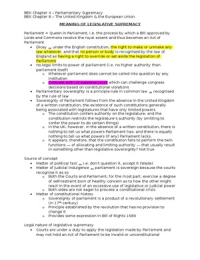
BEK Chapter 4 – Parliamentary Supremacy
BEK Chapter 8 – The United Kingdom & the European Union
MEANING OF LEGISLATIVE SUPREMACY
Parliament = Queen in Parliament, i.e. the process by which a Bill approved by
Lords and Commons receive the royal assent and thus becomes an Act of
Parliament
Dicey under the English constitution, the right to make or unmake any
law whatever, and that no person or body is recognised by the law of
England as having a right to override or set aside the legislation of
Parliament
no legal limits to power of parliament (i.e. no higher authority than
parliament itself)
o Whatever parliament does cannot be called into question by any
institution
o Contrast with US supreme court which can challenge congress
decisions based on constitutional violations
Parliamentary sovereignty is a principle rule in common law recognised
by the rule of law
Sovereignty of Parliament follows from the absence in the United Kingdom
of a written constitution, the existence of such constitutions generally
being associated with legislatures that have only limited powers
o The constitution confers authority on the legislature; and the
constitution restricts the legislature’s authority (by omitting to
confer the power to do certain things)
o In the UK, however, in the absence of a written constitution, there is
nothing to tell us what powers Parliament has: and there is equally
nothing to tell us what powers (if any) Parliament lacks.
o It appears, therefore, that the constitution fails to perform the twin
functions — of allocating and limiting authority — that usually result
in something other than legislative sovereignty? Not true
Source of concept
Matter of political fact i.e. don’t question it, accept it (Wade)
Matter of judicial indulgence parliament is sovereign because the courts
recognise it as so
o Both the Courts and Parliament, for the most part, exercise a degree
of self-restraint born of healthy concern as to how the other might
react in the event of an excessive use of legislative or judicial power
o Both sides are not eager to provoke a constitutional crisis
Matter of constitutional history
o Sovereignty of parliament is a product of a revolutionary settlement
(in 17th century)
o Principle established by the revolution that has no provision to
change it
o Provides some expression in Bill of Rights 1689
Legal nature of legislative supremacy
Courts are under a duty to apply the legislation made by Parliament and
may not hold an Act of Parliament to be invalid or unconstitutional
BEK Chapter 8 – The United Kingdom & the European Union
MEANING OF LEGISLATIVE SUPREMACY
Parliament = Queen in Parliament, i.e. the process by which a Bill approved by
Lords and Commons receive the royal assent and thus becomes an Act of
Parliament
Dicey under the English constitution, the right to make or unmake any
law whatever, and that no person or body is recognised by the law of
England as having a right to override or set aside the legislation of
Parliament
no legal limits to power of parliament (i.e. no higher authority than
parliament itself)
o Whatever parliament does cannot be called into question by any
institution
o Contrast with US supreme court which can challenge congress
decisions based on constitutional violations
Parliamentary sovereignty is a principle rule in common law recognised
by the rule of law
Sovereignty of Parliament follows from the absence in the United Kingdom
of a written constitution, the existence of such constitutions generally
being associated with legislatures that have only limited powers
o The constitution confers authority on the legislature; and the
constitution restricts the legislature’s authority (by omitting to
confer the power to do certain things)
o In the UK, however, in the absence of a written constitution, there is
nothing to tell us what powers Parliament has: and there is equally
nothing to tell us what powers (if any) Parliament lacks.
o It appears, therefore, that the constitution fails to perform the twin
functions — of allocating and limiting authority — that usually result
in something other than legislative sovereignty? Not true
Source of concept
Matter of political fact i.e. don’t question it, accept it (Wade)
Matter of judicial indulgence parliament is sovereign because the courts
recognise it as so
o Both the Courts and Parliament, for the most part, exercise a degree
of self-restraint born of healthy concern as to how the other might
react in the event of an excessive use of legislative or judicial power
o Both sides are not eager to provoke a constitutional crisis
Matter of constitutional history
o Sovereignty of parliament is a product of a revolutionary settlement
(in 17th century)
o Principle established by the revolution that has no provision to
change it
o Provides some expression in Bill of Rights 1689
Legal nature of legislative supremacy
Courts are under a duty to apply the legislation made by Parliament and
may not hold an Act of Parliament to be invalid or unconstitutional