Tuesday 26 th March 2019
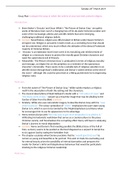
Essay Plan: Compare the ways in which the writers of your two texts present religion.
Introduction:
Bram Stoker’s ‘Dracula’ and Oscar Wilde’s ‘The Picture of Dorian Gray,’ are gothic
works of literature born out of a changing face of Fin-de-siecle Victorian London and
some of the increasingly atheist and scientific beliefs that were emerging,
challenging traditional religious beliefs.
Context: Nevertheless, religion was still prevalent in Britain under Queen Victoria’s
stringent rule. Religion is prevalent in both novels as a controlling force that should
not be undermined, which very much reflects the attitudes of the devout Protestant
majority of Victorian Britain.
‘Dracula’ is an epistolary novel more overt in its moralising and reinforcement of
religion as a necessary means to protect the morally good Christian characters and
repel the supernatural evil of Dracula.
Meanwhile, ‘The Picture of Dorian Gray’ is ambivalent in terms of religious morality
and message, as religion lies on the periphery as a reminder of the eponymous
character’s immorality. There seems to be a notable lack of religious salvation in an
afterlife shown through Basil’s obliteration and Dorian’s violent demise at the end of
the novel – although this could be perceived as a fitting punishment for transgressing
religious rules.
Point one:
From the outset of ‘The Picture of Dorian Gray,’ Wilde subtly employs a religious
motif in the description of both the setting and the characters.
The visceral descriptions of Basil Hallward’s studio with a “rich odour of roses” and
“the heavy scent of lilac,” conjure up a heavenly image that may be alluding to the
Garden of Eden from the Bible (context).
Similarly, Wilde also uses naturalistic imagery to describe Dorian Gray with his “rose
white boyhood.” The colour symbolism of “white” emphasises the pure state young
Dorian is in, which is soon to be tainted by the Mephistophelean Lord Henry when
he encourages him to use his appearance to his advantage.
Henry entices Dorian with “the only way to get rid of temptation is to yield to it,”
infiltrating his hedonistic worldview that serves as a counterculture to the pious
Victorian society, and foreshadows the corrupting effect Henry will have in catalysing
Dorian’s journey to moral degradation.
Context: Henry and Dorian’s first meeting parallels the Biblical story of the Fall of
Man, as Henry seems to be posited as the Devil disguised as a serpent to tempt Eve
to sin against God by eating the forbidden fruit.
The chapter escalates when Dorian proclaims that he “would give [his] soul” to
remain as young and beautiful as his portrait. This wish to trade his everlasting soul
for eternal beauty arises the possibility of eternal damnation and prepares the
reader for Dorian’s sinful and blasphemous behaviour that would be particularly
shocking to the religious Victorian readership.
Point two:
Essay Plan: Compare the ways in which the writers of your two texts present religion.
Introduction:
Bram Stoker’s ‘Dracula’ and Oscar Wilde’s ‘The Picture of Dorian Gray,’ are gothic
works of literature born out of a changing face of Fin-de-siecle Victorian London and
some of the increasingly atheist and scientific beliefs that were emerging,
challenging traditional religious beliefs.
Context: Nevertheless, religion was still prevalent in Britain under Queen Victoria’s
stringent rule. Religion is prevalent in both novels as a controlling force that should
not be undermined, which very much reflects the attitudes of the devout Protestant
majority of Victorian Britain.
‘Dracula’ is an epistolary novel more overt in its moralising and reinforcement of
religion as a necessary means to protect the morally good Christian characters and
repel the supernatural evil of Dracula.
Meanwhile, ‘The Picture of Dorian Gray’ is ambivalent in terms of religious morality
and message, as religion lies on the periphery as a reminder of the eponymous
character’s immorality. There seems to be a notable lack of religious salvation in an
afterlife shown through Basil’s obliteration and Dorian’s violent demise at the end of
the novel – although this could be perceived as a fitting punishment for transgressing
religious rules.
Point one:
From the outset of ‘The Picture of Dorian Gray,’ Wilde subtly employs a religious
motif in the description of both the setting and the characters.
The visceral descriptions of Basil Hallward’s studio with a “rich odour of roses” and
“the heavy scent of lilac,” conjure up a heavenly image that may be alluding to the
Garden of Eden from the Bible (context).
Similarly, Wilde also uses naturalistic imagery to describe Dorian Gray with his “rose
white boyhood.” The colour symbolism of “white” emphasises the pure state young
Dorian is in, which is soon to be tainted by the Mephistophelean Lord Henry when
he encourages him to use his appearance to his advantage.
Henry entices Dorian with “the only way to get rid of temptation is to yield to it,”
infiltrating his hedonistic worldview that serves as a counterculture to the pious
Victorian society, and foreshadows the corrupting effect Henry will have in catalysing
Dorian’s journey to moral degradation.
Context: Henry and Dorian’s first meeting parallels the Biblical story of the Fall of
Man, as Henry seems to be posited as the Devil disguised as a serpent to tempt Eve
to sin against God by eating the forbidden fruit.
The chapter escalates when Dorian proclaims that he “would give [his] soul” to
remain as young and beautiful as his portrait. This wish to trade his everlasting soul
for eternal beauty arises the possibility of eternal damnation and prepares the
reader for Dorian’s sinful and blasphemous behaviour that would be particularly
shocking to the religious Victorian readership.
Point two: