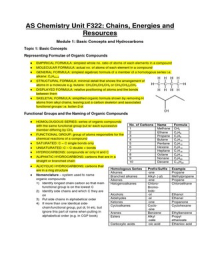
AS Chemistry Unit F322: Chains, Energies and
Resources
Module 1: Basic Concepts and Hydrocarbons
Topic 1: Basic Concepts
Representing Formulae of Organic Compounds
● EMPIRICAL FORMULA: simplest whole no. ratio of atoms of each elements in a compound
● MOLECULAR FORMULA: actual no. of atoms of each element in a compound
● GENERAL FORMULA: simplest algebraic formula of a member of a homologous series i.e.
alkane: CnH2n+2
● STRUCTURAL FORMULA: minimal detail that shows the arrangement of
atoms in a molecule e.g. butane: CH3CH2CH2CH3 or CH3(CH2)2CH3
● DISPLAYED FORMULA: relative positioning of atoms and the bonds
between them
● SKELETAL FORMULA: simplified organic formula shown by removing H
atoms from alkyl chains, leaving just a carbon skeleton and associated
functional groups i.e. butan-2-ol
Functional Groups and the Naming of Organic Compounds
● HOMOLOUGOUS SERIES: series of organic compounds
with the same functional group but w/ each successive No. of Carbons Name Formula
member differing by CH2 1 Methane CH2
2 Ethane C2H6
● FUNCTIONAL GROUP: group of atoms responsible for the 3 Propane C3H8
chemical reactions of a compound 4 Butane C4H10
● SATURATED: C – C single bonds only 5 Pentane C5H12
● UNSATURATED: C – C double + bonds 6 Hexane C6H14
● HYDROCARBONS: compounds w/ only H and C 7 Heptane C7H16
8 Octane C8H18
● ALIPHATIC HYDROCARBONS: carbons that are in a 9 Nonane C9H20
straight or branched chain 10 Decane C10H22
● ALICYCLIC HYDROCARBONS: carbons that
are in a ring structure Homologous Series Prefix/Suffix Example
Alkanes -ane Propane
● Nomenclature – system used to name Branched alkanes Alkyl- (-yl) Methylpropane
organic compounds Alkenes -ene Propene
1) Identify longest chain carbon so that main Halogenoalkanes Chloro- Chloroethane
functional group is on the lowest C Bromo-
2) Identify side chains and which C they are Iodo-
on Alcohols -ol Ethanol
3) Put side chains in alphabetical order Aldehydes -al Ethanal
4) If more than one identical side- Ketones -one Propanone
Cycloalkanes Cyclo- Cyclohexane
chain/functional group, put di, tri etc. but
-ane
ignore this part of name when putting in Arenes Benzene Ethylbenzene
alphabetical order (e.g. in CGP book) Esters Alkyl Propyl
-oate ethanoate
Carboxylic acids -oic acid Ethanioc acid
, Isomerism
● STRUCTURAL ISOMERS: compounds w/ the same molecular formula but dif structural
formula
● Three dif types of structural isomers:
Chain Isomers:
-the C skeleton can be arranged differently, as a straight or branched chain in different ways
-similar chem properties
-physical properties, e.g. boiling point, will be dif as shape of molecule is dif
Positional Isomers:
-skeletal and functional group may be same only w/ group attached to a dif. Carbon
-dif physical properties, maybe dif chemical properties too
Functional Group Isomers:
-same atoms can be arranged into dif functional groups
-have v. dif chemical and physical properties
● Atoms can rotate as much as they like around C – C single bonds so what looks like an
isomer may not be
● STEREOISOMERS: compounds w/ same structural formula but w/ a dif arrangement of
atoms in space
● Can’t rotate much around C = C double bonds so some alkenes have stereoisomers
● E/Z Isomerism/Cis-trans Isomerism:
-must have C = C double bond present
-must have two dif groups attached to each C
-E = trans, Z = cis
- E/trans is when both groups are on opposite sides
-Z/cis is when both groups are on the same side (so both below/above)
-special case of this is cis-trans isomerism where two of the groups on each carbon is the
same
Reaction Mechanisms
● During chem reaction bonds broken in process called bond fission
● Covalent bond can be broken two ways:
Heterolytic Fission:
-two dif substances are formed
-one of the bonded atoms takes both of the shared
pair of electrons
-positively charged cation and negatively charge
anion (one that takes both electrons) made
Homolytic Fission:
-two electrically uncharged ‘radicals’ (particles that
have an unpaired electron) made
-each bonded atom takes one electron from the
shared pair
-because they are now radicals they are extremely reactive
(double headed arrow means both electrons move, one headed arrow means one moves)
Resources
Module 1: Basic Concepts and Hydrocarbons
Topic 1: Basic Concepts
Representing Formulae of Organic Compounds
● EMPIRICAL FORMULA: simplest whole no. ratio of atoms of each elements in a compound
● MOLECULAR FORMULA: actual no. of atoms of each element in a compound
● GENERAL FORMULA: simplest algebraic formula of a member of a homologous series i.e.
alkane: CnH2n+2
● STRUCTURAL FORMULA: minimal detail that shows the arrangement of
atoms in a molecule e.g. butane: CH3CH2CH2CH3 or CH3(CH2)2CH3
● DISPLAYED FORMULA: relative positioning of atoms and the bonds
between them
● SKELETAL FORMULA: simplified organic formula shown by removing H
atoms from alkyl chains, leaving just a carbon skeleton and associated
functional groups i.e. butan-2-ol
Functional Groups and the Naming of Organic Compounds
● HOMOLOUGOUS SERIES: series of organic compounds
with the same functional group but w/ each successive No. of Carbons Name Formula
member differing by CH2 1 Methane CH2
2 Ethane C2H6
● FUNCTIONAL GROUP: group of atoms responsible for the 3 Propane C3H8
chemical reactions of a compound 4 Butane C4H10
● SATURATED: C – C single bonds only 5 Pentane C5H12
● UNSATURATED: C – C double + bonds 6 Hexane C6H14
● HYDROCARBONS: compounds w/ only H and C 7 Heptane C7H16
8 Octane C8H18
● ALIPHATIC HYDROCARBONS: carbons that are in a 9 Nonane C9H20
straight or branched chain 10 Decane C10H22
● ALICYCLIC HYDROCARBONS: carbons that
are in a ring structure Homologous Series Prefix/Suffix Example
Alkanes -ane Propane
● Nomenclature – system used to name Branched alkanes Alkyl- (-yl) Methylpropane
organic compounds Alkenes -ene Propene
1) Identify longest chain carbon so that main Halogenoalkanes Chloro- Chloroethane
functional group is on the lowest C Bromo-
2) Identify side chains and which C they are Iodo-
on Alcohols -ol Ethanol
3) Put side chains in alphabetical order Aldehydes -al Ethanal
4) If more than one identical side- Ketones -one Propanone
Cycloalkanes Cyclo- Cyclohexane
chain/functional group, put di, tri etc. but
-ane
ignore this part of name when putting in Arenes Benzene Ethylbenzene
alphabetical order (e.g. in CGP book) Esters Alkyl Propyl
-oate ethanoate
Carboxylic acids -oic acid Ethanioc acid
, Isomerism
● STRUCTURAL ISOMERS: compounds w/ the same molecular formula but dif structural
formula
● Three dif types of structural isomers:
Chain Isomers:
-the C skeleton can be arranged differently, as a straight or branched chain in different ways
-similar chem properties
-physical properties, e.g. boiling point, will be dif as shape of molecule is dif
Positional Isomers:
-skeletal and functional group may be same only w/ group attached to a dif. Carbon
-dif physical properties, maybe dif chemical properties too
Functional Group Isomers:
-same atoms can be arranged into dif functional groups
-have v. dif chemical and physical properties
● Atoms can rotate as much as they like around C – C single bonds so what looks like an
isomer may not be
● STEREOISOMERS: compounds w/ same structural formula but w/ a dif arrangement of
atoms in space
● Can’t rotate much around C = C double bonds so some alkenes have stereoisomers
● E/Z Isomerism/Cis-trans Isomerism:
-must have C = C double bond present
-must have two dif groups attached to each C
-E = trans, Z = cis
- E/trans is when both groups are on opposite sides
-Z/cis is when both groups are on the same side (so both below/above)
-special case of this is cis-trans isomerism where two of the groups on each carbon is the
same
Reaction Mechanisms
● During chem reaction bonds broken in process called bond fission
● Covalent bond can be broken two ways:
Heterolytic Fission:
-two dif substances are formed
-one of the bonded atoms takes both of the shared
pair of electrons
-positively charged cation and negatively charge
anion (one that takes both electrons) made
Homolytic Fission:
-two electrically uncharged ‘radicals’ (particles that
have an unpaired electron) made
-each bonded atom takes one electron from the
shared pair
-because they are now radicals they are extremely reactive
(double headed arrow means both electrons move, one headed arrow means one moves)