Isomerism
An isomer is a compound with the same molecular formular but different arrangement of atoms in
space. The two major families of isomerism include structural isomerism and stereoisomerism.
Different isomers can result in compounds having various different properties and reactions, despite
the molecular formulas remaining the same throughout each isomer.
What is structural isomerism?
Structural isomerism is where isomers have atoms which are arranged in completely different orders
but still have the same molecular formula.
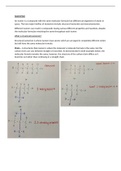
Chain – A structural chain isomer is where the molecule’s molecular formula is the same, but the
carbon chain can vary between straight or branched. As demonstrated in both examples below, the
molecular formula remains the same, however, the structure of the carbon chain differs as it
branches out rather than continuing in a straight chain.
, Positional – A positional isomer has a functional group (or other important group) which is attached
to different positions on the carbon. In both examples below, the atoms highlighted in blue have just
changed their position along the carbon chain. The molecular formula of the compound has not
changed, however, the change in position of these atoms can result in differences in properties and
reactions.
Functional – A functional isomer is where the functional group is completely different. Examples
include alcohols and ethers and aldehydes and ketones. As demonstrated in the examples, the
molecular formula of the compounds has not changed, however, the functional group is different.
What is stereoisomerism?
Stereoisomerism is where compounds have the same molecular formula and order of atoms,
however, their 3D orientation in space is different.
Geometric isomerism – When a carbon-carbon double bond results in restricted rotation within the
molecule.
An isomer is a compound with the same molecular formular but different arrangement of atoms in
space. The two major families of isomerism include structural isomerism and stereoisomerism.
Different isomers can result in compounds having various different properties and reactions, despite
the molecular formulas remaining the same throughout each isomer.
What is structural isomerism?
Structural isomerism is where isomers have atoms which are arranged in completely different orders
but still have the same molecular formula.
Chain – A structural chain isomer is where the molecule’s molecular formula is the same, but the
carbon chain can vary between straight or branched. As demonstrated in both examples below, the
molecular formula remains the same, however, the structure of the carbon chain differs as it
branches out rather than continuing in a straight chain.
, Positional – A positional isomer has a functional group (or other important group) which is attached
to different positions on the carbon. In both examples below, the atoms highlighted in blue have just
changed their position along the carbon chain. The molecular formula of the compound has not
changed, however, the change in position of these atoms can result in differences in properties and
reactions.
Functional – A functional isomer is where the functional group is completely different. Examples
include alcohols and ethers and aldehydes and ketones. As demonstrated in the examples, the
molecular formula of the compounds has not changed, however, the functional group is different.
What is stereoisomerism?
Stereoisomerism is where compounds have the same molecular formula and order of atoms,
however, their 3D orientation in space is different.
Geometric isomerism – When a carbon-carbon double bond results in restricted rotation within the
molecule.