Wild Nights - Wild Nights!
Emily Dickinson
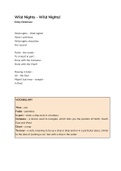
Wild nights - Wild nights!
Were I with thee
Wild nights should be
Our luxury!
Futile - the winds -
To a Heart in port -
Done with the Compass -
Done with the Chart!
Rowing in Eden -
Ah - the Sea!
Might I but moor - tonight -
In thee!
VOCABULARY
Thee - you
Futile - pointless
In port - when a ship rests in a harbour
Compass - a device used to navigate, which tells you the position of North, South,
East and West
Chart - a map
To moor - a verb, meaning to tie up a ship or drop anchor in a particular place, similar
to the idea of ‘parking a car’, but with a ship in the water
, STORY/SUMMARY
Stanza 1: Wild, crazy, exciting nights - wild nights! If I were with you, these kinds of
evenings would be a luxurious pleasure in which we could both indulge.
Stanza 2: The winds are pointless when a heart is securely resting in a port, there is no
need for a compass or map.
Stanza 3: It feels like rowing in paradise - Ah - the Sea is so pleasant and calm! I hope
that tonight I can rest myself next to you.
SPEAKER/VOICE
The speaker has an excited, energetic tone and seems full of positive, giddy energy as
she talks directly to her addressee about how much she enjoys their time together. The
overall sentiment is that she feels as though her journey has come to an end when
they are with one another.
LANGUAGE DEVICES
Repetition - the poem begins with a repetition of the phrase ‘Wild nights’, which
emphasises their excitement - the plural of ‘nights’ suggests that the speaker enjoys
spending multiple evenings with the addressee, although the content of those
evenings is kept private and not discussed in the poem. The adjective ‘Wild’ suggests
that there is something fun and liberating, but also perhaps uncultured and primitive
about the type of experience that the speaker describes.
The extended metaphor of sailing - The references to ‘winds’, ‘port’, ‘Compass’, ‘Chart’
and ‘moor’ing convey an extended metaphor of sailing, which demonstrates the wider
conceit that the speaker is a kind of sailor or navigator who has been travelling the
world in search of a place to rest. The idea that the addressee is a safe person to stay
with, who provides comfort and a sense of ease, is complicated a little by the adverb
‘tonight’, which suggests that the state is only temporary and is not expected to be
permanent.
Emily Dickinson
Wild nights - Wild nights!
Were I with thee
Wild nights should be
Our luxury!
Futile - the winds -
To a Heart in port -
Done with the Compass -
Done with the Chart!
Rowing in Eden -
Ah - the Sea!
Might I but moor - tonight -
In thee!
VOCABULARY
Thee - you
Futile - pointless
In port - when a ship rests in a harbour
Compass - a device used to navigate, which tells you the position of North, South,
East and West
Chart - a map
To moor - a verb, meaning to tie up a ship or drop anchor in a particular place, similar
to the idea of ‘parking a car’, but with a ship in the water
, STORY/SUMMARY
Stanza 1: Wild, crazy, exciting nights - wild nights! If I were with you, these kinds of
evenings would be a luxurious pleasure in which we could both indulge.
Stanza 2: The winds are pointless when a heart is securely resting in a port, there is no
need for a compass or map.
Stanza 3: It feels like rowing in paradise - Ah - the Sea is so pleasant and calm! I hope
that tonight I can rest myself next to you.
SPEAKER/VOICE
The speaker has an excited, energetic tone and seems full of positive, giddy energy as
she talks directly to her addressee about how much she enjoys their time together. The
overall sentiment is that she feels as though her journey has come to an end when
they are with one another.
LANGUAGE DEVICES
Repetition - the poem begins with a repetition of the phrase ‘Wild nights’, which
emphasises their excitement - the plural of ‘nights’ suggests that the speaker enjoys
spending multiple evenings with the addressee, although the content of those
evenings is kept private and not discussed in the poem. The adjective ‘Wild’ suggests
that there is something fun and liberating, but also perhaps uncultured and primitive
about the type of experience that the speaker describes.
The extended metaphor of sailing - The references to ‘winds’, ‘port’, ‘Compass’, ‘Chart’
and ‘moor’ing convey an extended metaphor of sailing, which demonstrates the wider
conceit that the speaker is a kind of sailor or navigator who has been travelling the
world in search of a place to rest. The idea that the addressee is a safe person to stay
with, who provides comfort and a sense of ease, is complicated a little by the adverb
‘tonight’, which suggests that the state is only temporary and is not expected to be
permanent.