

UNIT 11 – DNA TECHIQUES AND GENETIC ENGINEERING
DNA extraction of Kiwi
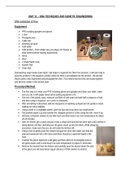
Equipment
PPE including googles and gloves
1 Kiwi
Pineapple juice
Table salt
Washing up liquid
Cold water
Cold alcohol – Rum (make sure you place it in freezer at
least 30mins before starting experiment)
Sieve
Bowl
2 small Plastic cups
Kitchen Roll
Chop stick
Dishwashing soap breaks down lipids. Salt helps to separate the DNA from proteins. It will also help to
keep the proteins in the aqueous solution while the DNA is precipitated into the alcohol. The alcohol
(Rum) used in this experiment will precipitate the DNA. This means that the DNA will clump together
and become visible in the alcohol layer.
Procedure/Method
The first step is to wear your PPE including gloves and googles and clean your table, make
sure you dry it with paper towel before putting equipment of it.
Get one of the plastic cups, measure out 80ml of cold water and add half a teaspoon of salt
and then using a chopstick, stir it until it is dissolved.
After everything is dissolved, add two teaspoons of washing up liquid and stir gently to avoid
making too many bubbles
Using a knife or a vegetable peeler, peel the kiwi and chop them into small pieces
Get another plastic cup and transfer the chopped-up kiwi in it then using the fork, mush it up
Add your extraction solution to the kiwi mush and then leave it at room temperature for about
20-25 minutes
After 20-25mins get a sieve and put it over a clean bowl and line the sieve with a few sheets of
damp kitchen roll then carefully pour the green mush up into the sieve. While doing this
procedure, make sure that you do not break the kitchen roll.
Using a fork to gently push the mixture through the sieve and make sure that the
pulp and seeds are left in the sieve and there should be a greenish liquid in the
bowl.
Transfer the green liquid into a tall glass and then add 1ml of pineapple juice to
the green liquid, swirl it and leave it at room temperature for about 5-10minutes
Remove the alcohol from the freezer and carefully pour the alcohol down the side
of the glass you will need about equal volumes of DNA solution to alcohol
, After about 10 minutes you should be able to see a mass of white stringy
stuff at the top of the tube You can fish this out using the chopstick and place
it onto a piece of card.
Polymerase Chain Reaction
Polymerase chain reaction (PCR) is a technique used to exponentially
expand a particular target DNA sequence, taking into consideration the
isolation, sequencing, or cloning of a single sequence among many. PCR,
which is a biochemical process capable of amplifying a single DNA molecule into millions of copies in a
short time and for this to take place in does not have to take process in a cell instead, it is taken in a
test tube. This is the commonly used method of taking a very small sample of DNA and turning it up to
a sufficient volume to be analysed in depth. For this reason, this is now a common and crucial
technique used in biomedical research and criminal forensics industry. To perform PCR, you must need
four things; a primer, the short strands of DNA; Taq polymerase, the enzyme that oversees replicating
DNA; and lastly, you need nucleotides, and these are the target sample that you want to amplify.
PCR uses two key reagents - primers (which are short single-strand DNA fragments known as
oligonucleotides – they are a complementary sequence to the target DNA region) and a DNA
polymerase. For this to be accomplished, there are three stages that occurs during the procedure of
PCR test and they are: denaturation, the annealing, and the primer extension.
Denaturation- During this process, double-stranded DNA templates are heated to separate the
strands. It is a process in which proteins or nucleic acids lose the quaternary structure, tertiary
structure, and secondary structure. The specific structure of a protein determines the function it has in
the body. The process that causes a protein to lose its shape is known as denaturation. If proteins in a
living cell are denatured, this results in the disruption of cell activity and possibly cell death.
Annealing- Short DNA molecules called primers bind to flanking regions of the target DNA. The
annealing temperature (typically between 48-72°C) is related to the melting temperature (Tm) of the
primers and must be determined for each primer pair used in PCR. This is when the temperature is
lowered to enable the DNA primers to attach to the template DNA. At the annealing step of the PCR
reaction, the primers interact with the template.
Extension- Lastly, the DNA polymerase extends the 3′ end of each primer along the template strands.
This is when the temperature is raised, and the new strand of DNA is made by the Taq polymerase
enzyme. The temperature is increased to 72 °C, which is optimum for DNA polymerase activity to allow
the hybridized primers to be extended. The extension is achieved by using the loosened nucleotides of
each base to grow the complementary DNA strand. The temperature that is used during the extension
phase is dependent on the DNA polymerase that is used.
Polymerase to amplify DNA of cheek cell
Equipment
PPE including googles ang gloves
50ml cold water
Disposable clear plastic cup
Salt and water (solution- sodium chloride)
Dropping Pipette
Alcohol (anything above 35%)
DNA extraction of Kiwi
Equipment
PPE including googles and gloves
1 Kiwi
Pineapple juice
Table salt
Washing up liquid
Cold water
Cold alcohol – Rum (make sure you place it in freezer at
least 30mins before starting experiment)
Sieve
Bowl
2 small Plastic cups
Kitchen Roll
Chop stick
Dishwashing soap breaks down lipids. Salt helps to separate the DNA from proteins. It will also help to
keep the proteins in the aqueous solution while the DNA is precipitated into the alcohol. The alcohol
(Rum) used in this experiment will precipitate the DNA. This means that the DNA will clump together
and become visible in the alcohol layer.
Procedure/Method
The first step is to wear your PPE including gloves and googles and clean your table, make
sure you dry it with paper towel before putting equipment of it.
Get one of the plastic cups, measure out 80ml of cold water and add half a teaspoon of salt
and then using a chopstick, stir it until it is dissolved.
After everything is dissolved, add two teaspoons of washing up liquid and stir gently to avoid
making too many bubbles
Using a knife or a vegetable peeler, peel the kiwi and chop them into small pieces
Get another plastic cup and transfer the chopped-up kiwi in it then using the fork, mush it up
Add your extraction solution to the kiwi mush and then leave it at room temperature for about
20-25 minutes
After 20-25mins get a sieve and put it over a clean bowl and line the sieve with a few sheets of
damp kitchen roll then carefully pour the green mush up into the sieve. While doing this
procedure, make sure that you do not break the kitchen roll.
Using a fork to gently push the mixture through the sieve and make sure that the
pulp and seeds are left in the sieve and there should be a greenish liquid in the
bowl.
Transfer the green liquid into a tall glass and then add 1ml of pineapple juice to
the green liquid, swirl it and leave it at room temperature for about 5-10minutes
Remove the alcohol from the freezer and carefully pour the alcohol down the side
of the glass you will need about equal volumes of DNA solution to alcohol
, After about 10 minutes you should be able to see a mass of white stringy
stuff at the top of the tube You can fish this out using the chopstick and place
it onto a piece of card.
Polymerase Chain Reaction
Polymerase chain reaction (PCR) is a technique used to exponentially
expand a particular target DNA sequence, taking into consideration the
isolation, sequencing, or cloning of a single sequence among many. PCR,
which is a biochemical process capable of amplifying a single DNA molecule into millions of copies in a
short time and for this to take place in does not have to take process in a cell instead, it is taken in a
test tube. This is the commonly used method of taking a very small sample of DNA and turning it up to
a sufficient volume to be analysed in depth. For this reason, this is now a common and crucial
technique used in biomedical research and criminal forensics industry. To perform PCR, you must need
four things; a primer, the short strands of DNA; Taq polymerase, the enzyme that oversees replicating
DNA; and lastly, you need nucleotides, and these are the target sample that you want to amplify.
PCR uses two key reagents - primers (which are short single-strand DNA fragments known as
oligonucleotides – they are a complementary sequence to the target DNA region) and a DNA
polymerase. For this to be accomplished, there are three stages that occurs during the procedure of
PCR test and they are: denaturation, the annealing, and the primer extension.
Denaturation- During this process, double-stranded DNA templates are heated to separate the
strands. It is a process in which proteins or nucleic acids lose the quaternary structure, tertiary
structure, and secondary structure. The specific structure of a protein determines the function it has in
the body. The process that causes a protein to lose its shape is known as denaturation. If proteins in a
living cell are denatured, this results in the disruption of cell activity and possibly cell death.
Annealing- Short DNA molecules called primers bind to flanking regions of the target DNA. The
annealing temperature (typically between 48-72°C) is related to the melting temperature (Tm) of the
primers and must be determined for each primer pair used in PCR. This is when the temperature is
lowered to enable the DNA primers to attach to the template DNA. At the annealing step of the PCR
reaction, the primers interact with the template.
Extension- Lastly, the DNA polymerase extends the 3′ end of each primer along the template strands.
This is when the temperature is raised, and the new strand of DNA is made by the Taq polymerase
enzyme. The temperature is increased to 72 °C, which is optimum for DNA polymerase activity to allow
the hybridized primers to be extended. The extension is achieved by using the loosened nucleotides of
each base to grow the complementary DNA strand. The temperature that is used during the extension
phase is dependent on the DNA polymerase that is used.
Polymerase to amplify DNA of cheek cell
Equipment
PPE including googles ang gloves
50ml cold water
Disposable clear plastic cup
Salt and water (solution- sodium chloride)
Dropping Pipette
Alcohol (anything above 35%)


